




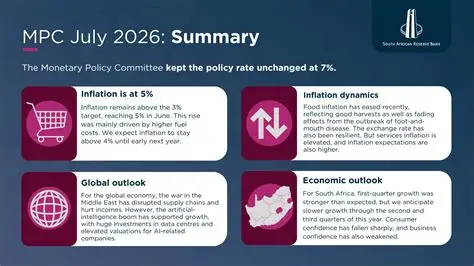
“The South African Reserve Bank (SARB) kept the repo rate unchanged at 7% in its July 2026 MPC meeting, citing persistent inflationary pressures from rising fuel costs and global volatility. While first-quarter growth was stronger than expected, consumer and business confidence remain weak, with municipal dysfunction and external shocks weighing on the outlook.”
South Africa’s July 2026 Monetary Policy Committee (MPC) meeting has drawn significant attention from economists, businesses, and households alike. The SARB’s decision to hold the repo rate at 7% reflects a delicate balancing act between curbing inflation and supporting fragile economic growth. With inflation currently at 5%, driven largely by fuel costs and global supply chain disruptions, the central bank faces mounting pressure to stabilize prices without stifling recovery.
Global Context
The MPC statement highlighted the impact of the ongoing crisis in the Middle East, particularly disruptions in the Strait of Hormuz, which have caused oil prices to rebound from $70 to $90 per barrel. This volatility has rippled across global markets, raising transport and production costs. At the same time, the global AI investment boom has provided some offset, boosting valuations and investment flows. Major central banks, including the ECB and Bank of Japan, raised rates in June, while the US Federal Reserve held steady but emphasized price stability.
Domestic Economic Conditions
South Africa’s economy grew close to 2% year-on-year in Q1 2026, largely due to higher net exports rather than domestic demand. However, consumer confidence has fallen sharply, and business confidence has weakened. Municipal dysfunction has emerged as a binding constraint on growth, with infrastructure and service delivery challenges undermining productivity. Export commodity prices have declined, though terms of trade improved due to lower import costs.
Inflation Pressures
Fuel costs remain the primary driver of inflation. Petrol and diesel prices eased earlier in July but rebounded as global oil markets tightened again. Headline inflation is expected to remain above 4% until early 2027, with transport inflation rising sharply. Producer-price inflation has also accelerated, with petroleum-related products contributing significantly to higher input costs.
Monetary Policy Decision
The SARB’s decision to hold the repo rate at 7% reflects caution. Raising rates further could suppress already weak domestic demand, while cutting rates risks fueling inflation. The MPC acknowledged downside risks to growth but emphasized the need to anchor inflation expectations. The rand has remained resilient, trading close to its starting level against the dollar and stronger against the euro.
Economic Reforms and Investment
Despite challenges, South Africa’s reform agenda is gaining traction. Freight rail cargo volumes increased by 4.4% year-on-year, and major investments in the automotive sector, including Toyota’s R10.4 billion expansion and Chery Group’s acquisition of the Rosslyn plant, are strengthening manufacturing capacity. These developments are expected to support thousands of jobs and bolster South Africa’s role as a regional export hub.
Risks and Outlook
The outlook remains uncertain. Global oil volatility, weak domestic demand, and structural constraints pose risks to growth. However, reforms in logistics, manufacturing, and visa processing under the Trusted Employer Scheme could improve competitiveness. The SARB projects recovery in the second half of 2026, contingent on stabilization of global conditions and domestic reforms.
Conclusion
The July 2026 MPC decision underscores the SARB’s cautious approach in navigating a complex economic environment. By holding the repo rate at 7%, the central bank aims to balance inflation control with growth support. For households, higher fuel costs remain a burden, while businesses face uncertainty in investment planning. Yet, with reforms gaining traction and resilience in key sectors, South Africa’s economy may be positioned for gradual recovery in the coming months.



