




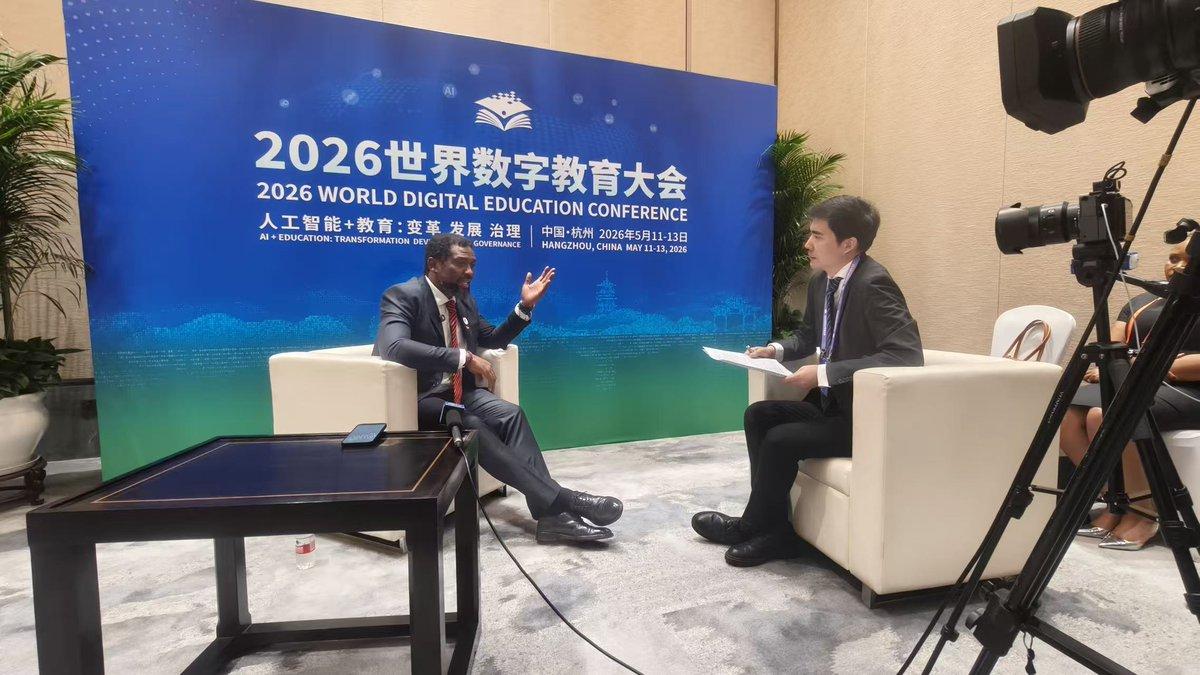
“South Africa’s Higher Education and Training Minister, Buti Manamela, has urged universities to rethink teaching and student assessment as artificial intelligence transforms how learners access information, write assignments and solve problems. He also called for stronger African AI research capacity, trustworthy data, open resources and technology that supports African languages, warning against permanent dependence on systems developed elsewhere.”
South Africa faces a turning point as universities rethink education in the age of artificial intelligence
South Africa’s higher education sector is facing growing pressure to reconsider how it teaches, assesses and prepares students for employment as artificial intelligence (AI) becomes increasingly capable of producing written assignments, summarising research and answering complex questions.
The debate has moved beyond whether students should be allowed to use AI tools. A more important question is emerging: how can universities ensure that graduates possess the knowledge, independent judgement and practical abilities needed to succeed when machines can generate convincing answers within seconds?
This challenge was highlighted by Higher Education and Training Minister Buti Manamela during a national webinar titled The Intellectual Directions of Higher Education in South Africa. According to the South African Government News Agency, the minister called on universities to modernise assessment methods while strengthening the country’s ability to develop and govern its own AI technologies.
The discussion has implications for students, lecturers, employers, policymakers and technology companies. It also raises broader questions about whether South Africa can use AI to strengthen its education system without increasing inequality or becoming overly dependent on foreign technology providers.
Moving beyond traditional examinations
For decades, universities have relied on essays, written assignments, examinations and research projects to determine whether students understand their subjects. These methods remain important, but generative AI has made some traditional assessments more difficult to interpret.
AI systems can generate structured essays, explain theories, summarise lengthy documents and produce answers that resemble academic work. Although these capabilities can support learning, they also make it harder for lecturers to establish whether a submitted assignment reflects a student’s own understanding.
Manamela argued that universities should not limit their response to finding better ways to detect AI-generated assignments. Instead, institutions need assessment methods that examine how students develop arguments, test evidence, make ethical decisions and apply knowledge to unfamiliar situations.
This approach could lead to greater use of oral examinations, supervised writing, practical demonstrations, research presentations and projects in which students explain the reasoning behind their conclusions.
For example, a business student might use AI to help analyse market information. However, the student should still be able to explain the assumptions behind the analysis, identify weaknesses in the available data and justify a recommended business strategy.
Similarly, a medical student might use AI to organise information about a clinical case, but must still demonstrate professional judgement, understand the limitations of the information and recognise when expert supervision is necessary.
These examples illustrate a central principle: using AI effectively is not the same as understanding the subject in which it is being used.
AI offers opportunities for teaching and research
Despite the concerns, AI could provide meaningful benefits to South African universities when introduced carefully.
According to the SAnews report, Manamela identified research, translation, teaching and administrative support as areas in which generative AI could be useful.
Researchers, for example, may use AI-assisted tools to organise large collections of documents, identify themes for further investigation or improve the clarity of their writing. Lecturers could use these systems to prepare preliminary teaching materials, generate practice questions and develop explanations of difficult concepts.
AI-assisted translation also offers possibilities for students who learn more effectively when complex concepts are explained in familiar languages. Properly developed tools could help universities expand access to educational resources beyond English.
However, these benefits depend on the quality of the systems being used. AI can generate inaccurate statements, reproduce biases in training data and present uncertain information with unjustified confidence.
Consequently, universities need policies that explain when AI use is acceptable, how students should acknowledge assistance and which tasks must demonstrate independent work.
Lecturers also need appropriate training. Without sufficient knowledge of the technology, educators may struggle to distinguish useful applications from practices that undermine academic standards.
Protecting critical thinking and academic integrity
One of the most significant risks associated with AI-assisted learning is the possibility that students may become dependent on automated answers before developing the ability to investigate problems themselves.
Learning requires more than obtaining the correct answer. Students must develop the capacity to question assumptions, compare competing explanations, recognise uncertainty and revise their conclusions when new evidence becomes available.
When an AI system performs too much of this intellectual work, students may complete assignments more quickly without developing the skills those assignments were intended to teach.
This does not mean that all AI use weakens learning. The outcome depends on how the technology is incorporated into teaching.
A student who asks AI to explain a difficult concept, checks the explanation against credible academic sources and then applies the concept independently may benefit from the process. By contrast, a student who submits an automatically generated answer without understanding it may miss the opportunity to learn.
Universities should therefore establish clear expectations and design assessments that reward genuine understanding.
Rather than treating AI use as automatically dishonest, institutions can distinguish between permitted assistance, inappropriate dependence and deliberate misrepresentation. Clear rules would help students understand their responsibilities while allowing lecturers to use technology constructively.
Building South Africa’s own AI capabilities
The debate extends beyond classroom practices. Manamela also emphasised the need for South Africa and the wider African continent to strengthen their capacity to develop and govern AI technologies.
This ambition matters because the countries and companies that develop AI systems can influence how those systems process information, which languages they support and what assumptions are embedded in their outputs.
If South African institutions depend exclusively on technologies developed elsewhere, they may have limited influence over the tools on which their students, researchers and businesses rely.
Developing local capacity could include funding university research, supporting computer science programmes, encouraging collaboration between universities and industry, and making suitable research resources available to local developers.
It could also involve improving access to reliable datasets that represent South African society, while protecting personal information and respecting legal and ethical obligations.
Local development does not necessarily mean building every technology independently. International partnerships and access to established AI platforms can remain valuable. The objective is to ensure that South African researchers and institutions possess enough expertise to evaluate, adapt and contribute to these systems rather than merely consume them.
African languages must be part of AI development
Language is another important dimension of the debate.
South Africa has 11 official languages, yet the quality of digital tools and online resources can differ substantially across languages. Systems trained predominantly on English-language material may perform less reliably when asked to interpret local expressions, translate specialised concepts or respond to questions in less-represented languages.
This creates a risk that AI adoption could reproduce existing educational inequalities.
Students with access to high-quality English-language tools may benefit from automated tutoring and research assistance, while students who depend on languages poorly supported by those systems may receive less reliable information.
Manamela highlighted the importance of African-language technologies, multilingual resources and scholarly vocabularies.
Progress in this area requires more than translating English material word for word. Developers need language resources that reflect local usage, cultural context and the specialised terminology used in subjects such as law, science, agriculture and public health.
Universities could contribute by supporting language research, developing carefully curated datasets and working with communities, linguists and technology developers.
These efforts could make AI more useful to students and researchers while strengthening the position of African languages in digital knowledge production.
The challenge of unequal access
The potential benefits of AI will not automatically reach every South African student.
Access depends on factors including reliable internet connectivity, suitable devices, electricity, institutional resources and the affordability of digital services. Students who lack these essentials may struggle to benefit from AI-assisted learning even when universities encourage its use.
There is also a risk that institutions with greater financial resources will adopt advanced systems more quickly than universities facing significant budget constraints.
If AI becomes an essential part of academic work without adequate support, the result could be a wider gap between students who can access reliable technology and those who cannot.
Universities and policymakers therefore need to consider infrastructure and affordability alongside innovation.
Practical responses could include providing computer laboratories, expanding campus connectivity, negotiating affordable access to educational software and developing learning materials that remain usable when internet access is limited.
Institutions should also ensure that students are not unfairly penalised because they cannot afford premium AI services.
Equitable access does not require every student to use the same technology. It requires assessment standards and learning opportunities that remain fair regardless of a student’s financial circumstances.
Universities must connect AI research to public needs
Manamela’s remarks also placed universities within a wider national development agenda. The SAnews report highlighted his call for research and teaching to engage with challenges such as water insecurity, unemployment, failing infrastructure and preventable disease.
AI could support research into some of these problems, although its value depends on the availability of suitable data and the involvement of people who understand the underlying issues.
In agriculture, for instance, AI-assisted analysis could help researchers investigate crop diseases or interpret environmental information. In public health, carefully evaluated systems could assist with analysing patterns in health data. In municipalities, data-analysis tools could help identify service-delivery problems.
These are potential applications rather than guarantees of improved outcomes. Each requires testing, oversight and evidence that the technology performs reliably in the setting where it will be used.
Universities should also work with employers, technical and vocational education and training colleges, community colleges and civil society. Such partnerships could help connect research to practical needs and give students opportunities to apply their skills outside lecture halls.
Responsible governance is essential
The growing role of AI also creates governance questions for universities.
Institutions need to consider data privacy, cybersecurity, intellectual property, discrimination and the reliability of AI-generated information. They must decide which systems are appropriate for handling confidential research, student records and other sensitive material.
AI-generated citations and references require particular care. A system may produce a convincing-looking reference that does not correspond to a real publication. Students and researchers must therefore verify sources rather than assume that an automated answer is accurate.
This issue is especially important in academic research, where credibility depends on evidence that other scholars can inspect and reproduce.
Universities can respond by teaching students how to verify claims, document their use of AI and distinguish between generated suggestions and established evidence.
Institutional policies should also provide clear procedures for addressing errors and complaints. Students need to understand the rules, while lecturers need practical guidance on applying them consistently.
The future of South African higher education
South Africa’s AI debate is unfolding alongside broader questions about university funding, access, institutional sustainability and the purpose of higher education. Manamela raised these concerns during the same webinar, arguing for a connected university system with institutions that have distinct strengths and responsibilities.
These issues matter because technological reform cannot succeed in isolation from the conditions in which students and educators work.
Universities need capable lecturers, sustainable funding, reliable infrastructure and meaningful relationships with the communities they serve. AI may support these goals, but it cannot replace the institutional foundations of a quality education.
The most productive response is likely to combine technological experimentation with careful evaluation. Universities can test new assessment methods, measure learning outcomes, consult students and lecturers, and revise policies when evidence shows that an approach is ineffective.
They should also recognise that AI literacy involves more than knowing how to write prompts. Graduates need to understand when AI is useful, when it is unreliable, how to protect information and when human expertise must take precedence.
For students, this means developing the ability to work with AI without surrendering independent judgement. For lecturers, it means designing learning experiences that encourage curiosity and demonstrate genuine understanding. For policymakers, it means supporting the infrastructure, research and governance required for responsible adoption.
Conclusion: South Africa must learn with AI and help shape it
The message emerging from South Africa’s higher education debate is that artificial intelligence should prompt universities to reconsider how knowledge is taught, assessed and produced.
Automated writing and research tools can improve productivity, support translation and make some educational activities more accessible. Nevertheless, their benefits depend on reliable information, responsible use and students who understand the work they submit.
South Africa also faces a strategic choice about its place in the global AI economy. Strengthening research capacity, supporting African-language technologies and investing in trustworthy data could help the country contribute to the development of AI rather than depend exclusively on systems created elsewhere.
The way forward is neither to reject AI entirely nor to accept every new tool without scrutiny. It is to develop teaching practices, institutional policies and research partnerships that preserve academic integrity while encouraging innovation.
Ultimately, the success of AI in South African universities should not be measured by how many students use chatbots or how quickly assignments are completed. It should be measured by whether students learn more effectively, researchers produce credible knowledge and institutions become better equipped to serve society.
That is the central challenge for South African higher education: to prepare graduates for a world shaped by AI while ensuring that human judgement, critical thinking and locally relevant knowledge remain at the heart of education.



