




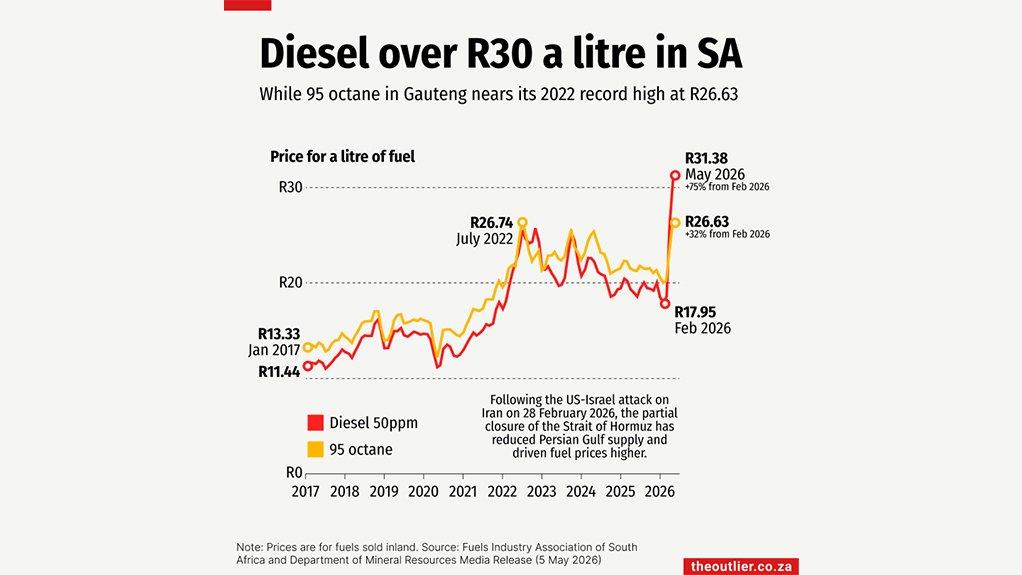
“South Africa is facing a renewed macroeconomic squeeze as international oil prices, a weaker rand and higher domestic fuel costs combine to push petrol above R30 a litre and increase pressure on inflation, households and businesses. The shock comes at a difficult time for the economy, with the South African Reserve Bank forecasting only 1.2% growth for 2026 after GDP contracted in the second quarter, while the central bank has already raised its policy rate to 7.25%.”
South Africa’s economic outlook is coming under renewed pressure as an international oil shock works its way through the domestic economy, raising fuel prices, increasing business costs and complicating the South African Reserve Bank’s efforts to balance inflation control with economic growth.
The issue has emerged as one of the most important macroeconomic developments facing South Africa this week because fuel is not simply a household expense. It is a major input into transportation, agriculture, manufacturing, logistics, retail and virtually every other part of the economy. Consequently, a sustained increase in fuel prices can affect inflation, consumer spending, company profitability, investment decisions, the trade balance and monetary policy simultaneously.
A Moneyweb analysis published on 8 October highlights the unusually severe effect of the latest oil shock on South African consumers. The article points to the combination of higher international oil prices, a weaker rand, domestic levies and a smaller fuel-price buffer as factors contributing to the unusually large increase in the amount motorists are paying.
The latest adjustment has already pushed the Gauteng price of 95-octane petrol to about R30.25 per litre, following an increase of R3.33 a litre from 7 October. Diesel prices have also moved sharply higher, with the wholesale increase reaching more than R3 per litre.
That development matters beyond the petrol station.
Oil shock reaches the wider economy
South Africa imports a large proportion of the energy products required to keep its economy moving. When global crude and refined petroleum prices rise, the country must spend more on imports. At the same time, when the rand weakens against the US dollar, those imported commodities become even more expensive in local currency.
This creates a double pressure.
The country pays more in dollar terms because oil prices are higher, while each dollar of imported oil costs more rand when the domestic currency is weaker. Reuters reported that the rand has recently been pressured by a stronger US dollar and elevated oil prices, with investors becoming more cautious toward risk-sensitive emerging-market currencies.
The consequences are particularly important for South Africa because transportation is heavily dependent on road networks. Trucks move goods between ports, factories, warehouses, farms and shops, while millions of workers depend on road transport to reach their workplaces.
Therefore, a sharp fuel-price increase can become an economy-wide cost increase.
A logistics company facing higher diesel prices may raise its transportation charges. A food distributor may then face higher delivery costs. Retailers can pass some of those expenses to consumers, while manufacturers may also increase prices to protect margins.
Farmers face similar pressures because fuel is needed for tractors, irrigation equipment, harvesting machinery and transportation. Higher diesel prices can therefore eventually feed into food prices.
Inflation becomes the central concern
The biggest macroeconomic risk is that a temporary energy shock becomes embedded in broader inflation.
The South African Reserve Bank’s October 2026 Monetary Policy Review shows how seriously policymakers are treating the issue. The central bank says headline inflation increased from 3.2% in the first quarter of 2026 to 4.5% in the second quarter and expects inflation to remain above 5% until the second quarter of 2027 before moving back toward the target range.
This is a significant change from the environment in which South Africa had been hoping for a gradual improvement in inflation and lower borrowing costs.
The Reserve Bank has already increased its policy rate by a cumulative 50 basis points over the April-to-October review period, bringing the repo rate to 7.25%.
Higher interest rates are intended to prevent inflation expectations from becoming entrenched. However, they also make borrowing more expensive for households and companies.
That creates a difficult policy trade-off.
If the Reserve Bank responds aggressively to fuel-driven inflation, it can weaken consumer spending and investment at a time when economic growth is already fragile. If it does not respond sufficiently and inflation becomes entrenched, purchasing power could deteriorate and inflation expectations could become harder to control.
Growth is already weak
The fuel shock is arriving against a weak domestic growth backdrop.
According to the Reserve Bank’s September Quarterly Bulletin, South Africa’s real GDP contracted by 0.2% in the second quarter of 2026, following six consecutive quarters of expansion. The decline was linked partly to weakness in the primary and secondary sectors, including mining, while the tertiary sector recorded only marginal growth.
The October Monetary Policy Review forecasts average economic growth of only 1.2% in 2026, down from the previous forecast of 1.4%. The Reserve Bank expects growth to improve gradually toward approximately 2% by 2029 as structural reforms progress.
Higher fuel prices could make that recovery more difficult.
When households spend more on petrol and transportation, they have less money available for restaurants, clothing, entertainment, household goods and other discretionary purchases. Businesses experience a similar squeeze because more revenue must be directed toward operating costs.
This can create a negative feedback loop.
Higher fuel prices raise operating costs. Higher operating costs push up prices. Higher prices reduce household purchasing power. Weaker purchasing power reduces demand. Weaker demand makes it harder for businesses to expand, hire workers or invest.
The import bill is another warning sign
The pressure is also visible in South Africa’s external accounts.
Moneyweb reported on 7 October that crude oil, diesel and petrol accounted for 24.5% of total imports during the three months to June 2026, compared with 15.9% in the preceding quarter. The publication described this as the highest share since 1994.
That statistic illustrates how an international energy crisis can affect a country’s balance of payments.
When petroleum products take up a larger share of import spending, South Africa has less room for other imports and becomes more exposed to international energy prices. If elevated oil prices persist, the country could face a larger import bill and additional pressure on the rand.
The currency therefore becomes an important part of the inflation story.
A weaker rand makes imported fuel even more expensive, which can place additional pressure on inflation. Higher inflation, in turn, can influence expectations about future interest rates and investor sentiment toward South African assets.
Businesses are already feeling the pressure
The latest economic data also suggest that companies are facing challenging operating conditions.
The S&P Global South Africa PMI fell to 49.0 in September, from 50.5 in August. A reading below 50 indicates contraction. According to the survey, new orders fell sharply, while companies reported rising fuel-related input costs and supply-chain pressures.
The survey is particularly important because it provides a relatively timely indication of private-sector conditions.
Companies reported weaker demand as consumers and businesses became more cautious. At the same time, higher fuel costs contributed to increased input-price inflation.
This combination is particularly uncomfortable for businesses because companies cannot always pass the full increase in costs to customers.
A manufacturer that raises prices too aggressively may lose sales. A retailer may absorb part of the increase and see profit margins shrink. A transport company may have little choice but to increase charges.
The result can be slower investment and weaker employment growth.
Government faces a difficult choice
The fuel crisis has also revived debate about whether government should temporarily reduce fuel taxes to protect households.
South Africa previously used fuel-tax relief measures during an earlier period of severe fuel-price pressure. However, economists have warned that repeating such intervention would place additional pressure on government finances.
IOL reported that a renewed fuel levy reduction could cost the fiscus more than R6 billion per month, depending on the scale of intervention and the duration of the oil shock. Economists also warned that extensive borrowing to finance relief could undermine fiscal consolidation and potentially affect investor confidence.
This leaves policymakers with a difficult choice.
Doing nothing leaves households and businesses exposed to the full shock. Providing broad relief, however, reduces government revenue and could weaken the fiscal position.
A more targeted approach could therefore become increasingly important, particularly if high fuel prices persist long enough to cause significant damage to vulnerable households and businesses.
What happens next?
The immediate economic outlook will depend heavily on international oil prices, developments around Middle Eastern supply routes, movements in the rand and the duration of the disruption.
If oil prices fall relatively quickly and global supply normalises, some of the current pressure could prove temporary. South Africa could then see fuel-price pressures ease and inflation gradually return toward the Reserve Bank’s target.
However, a prolonged period of expensive oil would create a much more difficult scenario.
The Reserve Bank has already warned that persistent fuel, administered-price and food shocks could become embedded in inflation expectations and wages.
That is the key macroeconomic risk.
South Africa’s challenge is therefore not simply that petrol has crossed R30 a litre. The deeper concern is whether the energy shock becomes a sustained increase in the cost of doing business and living in the country.
For households, that means higher transportation and food costs. For companies, it means higher operating expenses and weaker demand. For government, it means pressure to provide support while protecting fiscal sustainability. For the Reserve Bank, it means maintaining inflation credibility without unnecessarily damaging economic growth.
The coming months will therefore be critical.
South Africa entered 2026 hoping that structural reforms, improved electricity availability and better infrastructure performance could gradually lift potential growth. Yet the latest oil shock demonstrates how vulnerable that recovery remains to external events.
The immediate priority for policymakers will be to prevent a temporary commodity-price shock from turning into a permanent inflation problem.
At the same time, South Africa will need to continue addressing the structural weaknesses that limit growth, including energy costs, logistics constraints, infrastructure problems, weak productivity and unemployment.
The fuel-price crisis is therefore more than a story about motorists paying more at the pump. It is a test of South Africa’s broader macroeconomic resilience.
If oil markets stabilise, the economy could still regain momentum as reforms improve productive capacity. But if high energy prices persist, the combination of inflation, weak household demand, higher interest rates and slower business activity could delay the country’s recovery.
For now, the central economic question is whether South Africa can absorb the external oil shock without allowing it to become deeply embedded in domestic inflation and economic expectations.



