




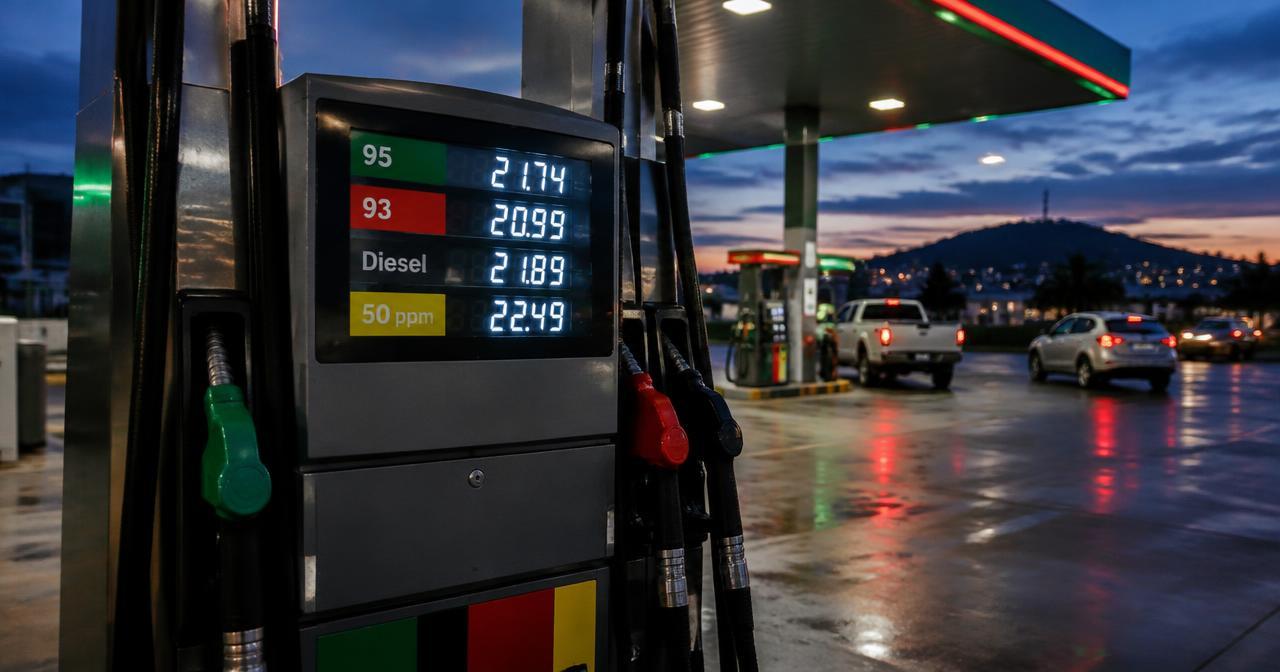
“South Africa’s latest fuel-price shock is becoming a major microeconomic issue, with inland 95 petrol reaching R30.25 per litre from 7 October after a R3.33 increase, while diesel prices also climbed sharply. The higher cost of mobility is putting pressure on household budgets, taxi operators, retailers, delivery businesses and other firms, while SANTACO is consulting government and industry stakeholders before deciding whether taxi fares should increase.”
South Africa’s latest fuel-price increase is rapidly becoming more than a problem for motorists. The sharp rise in petrol and diesel prices is working its way through household budgets, public transport, retail prices and business operating costs, making the development one of the most important microeconomic stories affecting South Africans on 8 October 2026.
From Wednesday, 7 October, inland motorists began paying significantly more for fuel. The regulated price of 95-octane petrol increased by R3.33 per litre, reaching R30.25 per litre, while 93-octane petrol increased by R3.12 to about R29.88 per litre. Diesel prices also increased substantially, with the official wholesale reference prices rising by roughly R2.84 to R3.24 per litre depending on the grade.
The significance of the increase lies in its effect on individual economic decisions. Microeconomics examines how households, consumers and businesses respond when prices change. Fuel is particularly important because it is an input into transportation and production. Therefore, when fuel becomes substantially more expensive, consumers and businesses must decide whether to absorb the additional cost, reduce consumption, substitute toward alternatives or pass the cost on to other people through higher prices.
That adjustment process is already visible in South Africa’s taxi industry.
Taxi fares under pressure
The South African National Taxi Council, or SANTACO, has not announced an immediate taxi-fare increase. Instead, the organisation is consulting taxi operators, fuel suppliers and government about ways of reducing the financial impact of the fuel increase. The council has stressed that commuters should not panic because no fare increase has been announced at this stage.
This situation illustrates a basic microeconomic dilemma. Taxi operators face higher input costs, but commuters are also facing pressure on their household incomes. If operators increase fares significantly, passenger demand could fall as some consumers reduce trips, combine journeys or search for alternative transportation.
However, taxi operators cannot simply absorb unlimited increases in fuel costs. Their vehicles require fuel to provide the service, meaning fuel represents a direct operating expense. If revenue remains unchanged while fuel expenditure rises, profit margins become smaller.
Consequently, the industry faces a difficult choice between higher prices for passengers and lower margins for operators.
The consequences extend beyond taxi passengers. Workers who depend on taxis to reach employment may face higher commuting costs if fares eventually rise. For lower-income households, transportation is often a necessary rather than discretionary expense. This means that families may have to reduce spending elsewhere to maintain access to work, education, healthcare and essential services.
The pressure on household budgets
The fuel increase also demonstrates how a change in the price of one product can influence household consumption patterns.
Consider a motorist filling a 50-litre tank with inland 95 petrol. The R3.33 increase translates into approximately R166.50 more for a 50-litre fill-up compared with the previous price.
For households that fill their vehicles several times each month, the additional expenditure can become substantial.
Consumers therefore face a trade-off. They may drive less, combine errands, use public transport more frequently, postpone discretionary purchases or reduce spending on other goods and services. These responses matter because household consumption is a major component of economic activity.
The impact is particularly important when incomes are already under pressure. Lower-income households generally have less flexibility to absorb sudden increases in essential costs. A wealthy household may be able to reduce entertainment spending, postpone a purchase or switch vehicles. A household living close to its monthly budget may have fewer alternatives.
The result can be a squeeze on effective purchasing power even if nominal wages do not change.
Fuel costs can spread through the supply chain
The economic impact does not stop at the petrol station.
Most goods sold in South Africa have to be transported at some stage. Food, clothing, building materials, agricultural products and manufactured goods all depend on logistics. When diesel and petrol become more expensive, transport operators face higher costs.
Businesses then have several choices. They can absorb the additional expense, reduce their profit margins, improve efficiency, negotiate with suppliers or increase prices.
The final choice depends on the competitiveness of the market.
In a highly competitive market, a business may struggle to raise prices because customers can switch to competitors. A company that increases prices too aggressively risks losing market share. However, if most businesses in an industry face similar fuel-cost increases, consumers may have fewer opportunities to avoid the higher prices.
This creates the possibility of broader price pressure.
The South African private-sector PMI released earlier in the week already showed the sensitivity of businesses to rising costs. The September PMI fell to 49.0 from 50.5, indicating contraction, while companies reported weaker demand and intensified supply-chain pressures. Fuel-driven input-cost inflation was also identified as a significant problem.
Small businesses face a difficult calculation
Small businesses may be particularly vulnerable because they often operate with thinner financial buffers.
A small delivery company, for example, cannot simply stop using vehicles when fuel prices rise. A plumbing business needs transport to reach customers. A retailer needs stock delivered. A farmer may require diesel for machinery and transport. A mobile service provider may depend on vehicles to serve customers across several locations.
Higher fuel costs therefore raise the minimum amount of revenue required for many businesses to remain profitable.
This can influence hiring decisions as well. If operating costs increase rapidly while customer demand weakens, businesses may postpone expansion, reduce overtime, limit recruitment or reconsider investment.
The microeconomic consequences can therefore move from prices to employment and investment decisions.
Why the international oil market matters
South Africa’s domestic fuel prices are strongly influenced by international conditions because the country imports crude oil and finished petroleum products. The government says the monthly fuel-price adjustment takes account of international petroleum prices, exchange-rate movements and other local factors.
The latest increase was driven partly by a sharp rise in global oil prices. The government reported that average Brent crude prices increased from about $87.89 to $101 per barrel during the relevant review period, while international petroleum-product prices also increased amid supply shortages and geopolitical uncertainty.
This creates a difficult situation for South African consumers. The price of fuel at the pump can rise even though an individual household has no influence over international oil production or global geopolitical developments.
The exchange rate can add another layer of pressure. A weaker rand makes imported products more expensive in rand terms, potentially amplifying the effect of higher international oil prices.
Inflation and interest-rate risks
The fuel shock also matters for the broader cost of living because fuel can contribute indirectly to inflation.
The South African Reserve Bank’s October 2026 Monetary Policy Review warned that persistent fuel, administered-price and food shocks could become embedded in inflation expectations and wages. The Reserve Bank reported that headline inflation had increased during 2026 and projected inflation to remain elevated before eventually returning toward target.
This creates a potential feedback mechanism.
Higher fuel prices can increase transportation costs. Higher transportation costs can increase the cost of delivering goods. Businesses may respond by increasing selling prices. Workers facing higher living costs may seek higher wages. If wage and price adjustments reinforce one another, inflationary pressure can become more persistent.
That is precisely why fuel prices are important from both a microeconomic and macroeconomic perspective.
The impact on essential goods
One of the most concerning aspects is that fuel is not simply another household purchase. It is an input used to obtain many other goods and services.
A family does not necessarily consume petrol directly as an end product. Instead, petrol enables the household to travel to work, school, shops and healthcare facilities.
Likewise, a supermarket does not sell fuel as its primary product, but fuel is required to move food from producers and distribution centres to stores.
This means the economic burden can appear in unexpected places.
Food prices, delivery fees, school transport costs, logistics charges and service prices can all be affected if higher fuel expenses are passed through supply chains.
What happens next?
The immediate question is whether SANTACO eventually increases taxi fares. The council’s current position is that consultations must take place before any decision is made.
The longer-term question is how households and businesses adapt.
Consumers may become more sensitive to fuel-efficient vehicles, public transport and trip consolidation. Businesses may look for more efficient logistics, renegotiate supply contracts or explore alternative energy and transportation options.
Government intervention is another possibility. Trade unions and other groups have already called for measures to cushion households from the impact of rising fuel prices.
However, government support also involves trade-offs because subsidies or reductions in fuel-related taxes can affect public finances.
For South African households, the immediate reality is straightforward: the cost of moving people and goods has increased sharply.
The crossing of the R30-per-litre threshold for inland 95 petrol is therefore more than a symbolic price milestone. It represents a significant change in the economic environment faced by consumers, transport operators and businesses.
From a microeconomic perspective, the central issue is how those groups respond to the shock. Some will consume less fuel, some will search for substitutes, some businesses will absorb higher costs, and others will pass them on through higher prices.
The coming weeks will reveal how far the fuel-price increase travels through South Africa’s economy—and how much of the burden ultimately falls on households.



