




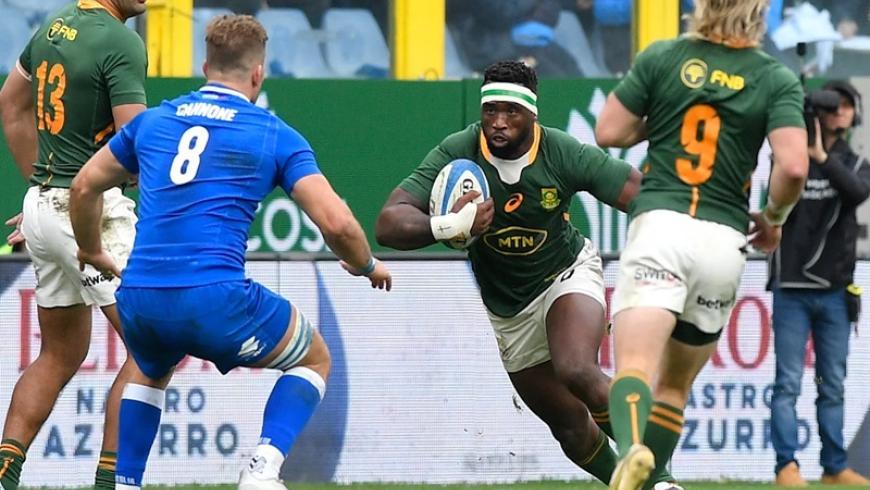
“The Springboks face Italy in Turin on Saturday, 7 November, as South Africa begins its November Nations Championship campaign with ambitions of maintaining its international dominance. Coach Rassie Erasmus has selected an experienced squad for the encounter, while the match provides an important opportunity to strengthen South Africa’s position ahead of subsequent Tests against France and Ireland.”
Springboks face Italy in Turin as Rassie Erasmus targets another major Nations Championship victory
South Africa’s Springboks return to international rugby action on Saturday, 7 November 2026, with a significant Nations Championship encounter against Italy at Allianz Stadium in Turin. The match marks the beginning of an important November campaign for the world champions, who are determined to maintain their international dominance while strengthening their position ahead of the competition’s decisive stages.
Head coach Rassie Erasmus has selected a highly experienced matchday squad for the encounter, reflecting the importance attached to the opening fixture of the European tour. South Africa enters the match among the leading teams in the Nations Championship, while Italy will be eager to produce a competitive performance in front of its home supporters.
Springboks enter November with high expectations
The Springboks have enjoyed another impressive international season, combining experienced leadership with tactical flexibility and emerging talent. Their performances throughout 2026 have reinforced their reputation as one of rugby’s strongest national teams.
South Africa’s successful July Nations Championship campaign included victories against England, Scotland and Wales. Those results placed the team in a favourable position ahead of the competition’s November phase.
However, the September defeat against Australia demonstrated that even the most experienced international teams remain vulnerable when execution and discipline deteriorate. Erasmus and his coaching staff have consequently emphasised concentration, consistency and preparation ahead of the Italian challenge.
The Springboks are approaching the match with a clear objective: establish control early, maintain their physical intensity and deliver an effective performance across the entire 80 minutes.
Rassie Erasmus selects experienced matchday squad
Erasmus has opted for a largely settled team, reflecting the importance of continuity during the international campaign.
Captain Siya Kolisi leads the side from the back row, bringing experience, leadership and defensive intensity. He is supported by Pieter-Steph du Toit and Jasper Wiese, forming a powerful loose-forward combination capable of influencing the breakdown, carrying and defensive phases.
The forward pack also includes experienced players such as Malcolm Marx, Ox Nche and Thomas du Toit. Their responsibilities extend beyond the traditional set-piece battles, with scrummaging, lineout execution and physical dominance expected to play important roles.
Salmaan Moerat returns to the Springbok starting lineup after overcoming injuries that previously prevented him from participating in the team’s international matches.
His partnership with Ruan Nortje in the second row provides another opportunity for South Africa to strengthen its forward platform.
In the backline, Morne van den Berg and Sacha Feinberg-Mngomezulu form the halfback combination. Damian de Allende and Jesse Kriel provide experience in midfield, while Ethan Hooker, Kurt-Lee Arendse and Damian Willemse complete the back three.
The combination offers South Africa several attacking options, including tactical kicking, counterattacking opportunities and opportunities to exploit space through the wider channels.
Italy presents a challenge despite injury concerns
Although South Africa enters the match as the favourite, the Springboks have repeatedly emphasised that Italy cannot be underestimated.
Italy has demonstrated considerable development in recent international seasons, particularly through improvements in attacking structure, defensive organisation and forward competitiveness.
Head coach Gonzalo Quesada has helped develop a team capable of challenging established international opponents. Italy’s memorable Six Nations performances earlier in 2026 illustrated the progress achieved under his leadership.
Nevertheless, injuries have complicated Italy’s preparations for the encounter. Several important players have been unavailable, forcing the coaching staff to reconsider combinations and tactical approaches.
The return of Ange Capuozzo provides an important attacking boost. His pace, creativity and ability to operate in different positions could offer Italy additional opportunities to threaten the Springbok defensive structure.
Captain Giacomo Nicotera will also play an important leadership role, particularly in organising the forward pack and maintaining discipline during pressure situations.
Italy’s challenge will be to remain competitive throughout the match rather than allowing South Africa to establish an overwhelming advantage.
Forward battle could determine the outcome
One of the most important aspects of the encounter will be the contest between the forward packs.
South Africa traditionally places significant emphasis on scrum strength, lineout efficiency and physical pressure around the breakdown. These characteristics have helped the Springboks control matches against numerous international opponents.
The presence of Malcolm Marx, Ox Nche and experienced loose forwards provides South Africa with a powerful foundation.
Italy, meanwhile, must ensure that its forwards remain competitive in these areas. Strong set-piece execution and disciplined defensive organisation could help the hosts limit South Africa’s attacking opportunities.
The breakdown will also be crucial. Both teams will seek to secure possession while preventing opponents from establishing quick attacking platforms.
If the Springboks dominate these exchanges, they could create opportunities for their backline to exploit defensive weaknesses.
South Africa’s attacking strategy remains important
The Springboks possess considerable attacking versatility, allowing them to adjust their approach according to opposition strengths and match circumstances.
Sacha Feinberg-Mngomezulu offers creativity and attacking ambition at fly-half, while Damian de Allende provides powerful carrying options in midfield.
Jesse Kriel contributes defensive organisation and attacking awareness, while Kurt-Lee Arendse remains a dangerous finisher capable of converting opportunities into points.
Damian Willemse’s versatility at full-back further strengthens South Africa’s attacking possibilities.
The team can use tactical kicking to gain territory, forward carries to establish momentum and expansive passing to exploit defensive spaces.
However, accuracy remains essential. Poor handling, unnecessary penalties and missed defensive assignments could provide Italy with opportunities to remain competitive.
Erasmus will therefore expect his players to combine attacking ambition with disciplined execution.
Nations Championship implications
The November campaign carries significant importance for South Africa’s ambitions in the Nations Championship.
The Springboks face Italy before travelling to France and Ireland. These fixtures represent demanding tests against established international opponents.
South Africa’s ability to accumulate valuable results during this period could determine its prospects of advancing to the competition’s Finals Weekend.
Points difference may also become important if teams finish the pool phase with comparable records.
Consequently, the Springboks cannot afford to approach the Italian encounter casually. A convincing performance would provide momentum and confidence before the subsequent matches.
The coaching staff must also balance immediate results with player management, particularly as the international calendar continues to place considerable physical demands on leading players.
Emerging players and future World Cup preparations
The Springboks’ broader ambitions extend beyond the immediate Nations Championship campaign.
With the 2027 Rugby World Cup approaching, Erasmus continues to assess players capable of strengthening the national team’s depth.
Six uncapped players have received opportunities within the wider touring squad, illustrating South Africa’s commitment to developing future international contributors.
Although not every player will necessarily receive an immediate Test opportunity, exposure to the Springbok environment remains valuable.
Training alongside established internationals provides emerging players with opportunities to understand the team’s tactical structures, professional standards and preparation methods.
The balance between experienced leaders and developing talent could become increasingly important as South Africa prepares for another major World Cup campaign.
A demanding November campaign awaits
The encounter against Italy represents the beginning of a challenging European tour.
Following the Turin Test, South Africa will face France before concluding its Nations Championship pool fixtures against Ireland.
Both matches are expected to test the Springboks’ physical conditioning, tactical adaptability and squad depth.
France remains a formidable opponent, particularly when playing at home, while Ireland’s structured attacking approach and defensive organisation present another demanding challenge.
The Springboks will therefore need to maintain consistency throughout the campaign rather than relying exclusively on individual performances.
Conclusion
South Africa’s encounter against Italy represents an important opportunity to strengthen its position in the Nations Championship and maintain momentum ahead of the remaining November fixtures.
Rassie Erasmus has selected an experienced squad capable of competing across the major areas of international rugby, while the return of key players provides additional strength.
Italy’s home advantage, developing rugby structures and attacking potential mean the contest should not be treated as a straightforward assignment.
For the Springboks, the priorities remain clear: maintain discipline, dominate the physical exchanges, execute attacking opportunities and deliver a complete performance.
A successful result in Turin would provide an encouraging foundation for the remainder of South Africa’s European campaign and reinforce its ambitions as the 2027 Rugby World Cup approaches.



