




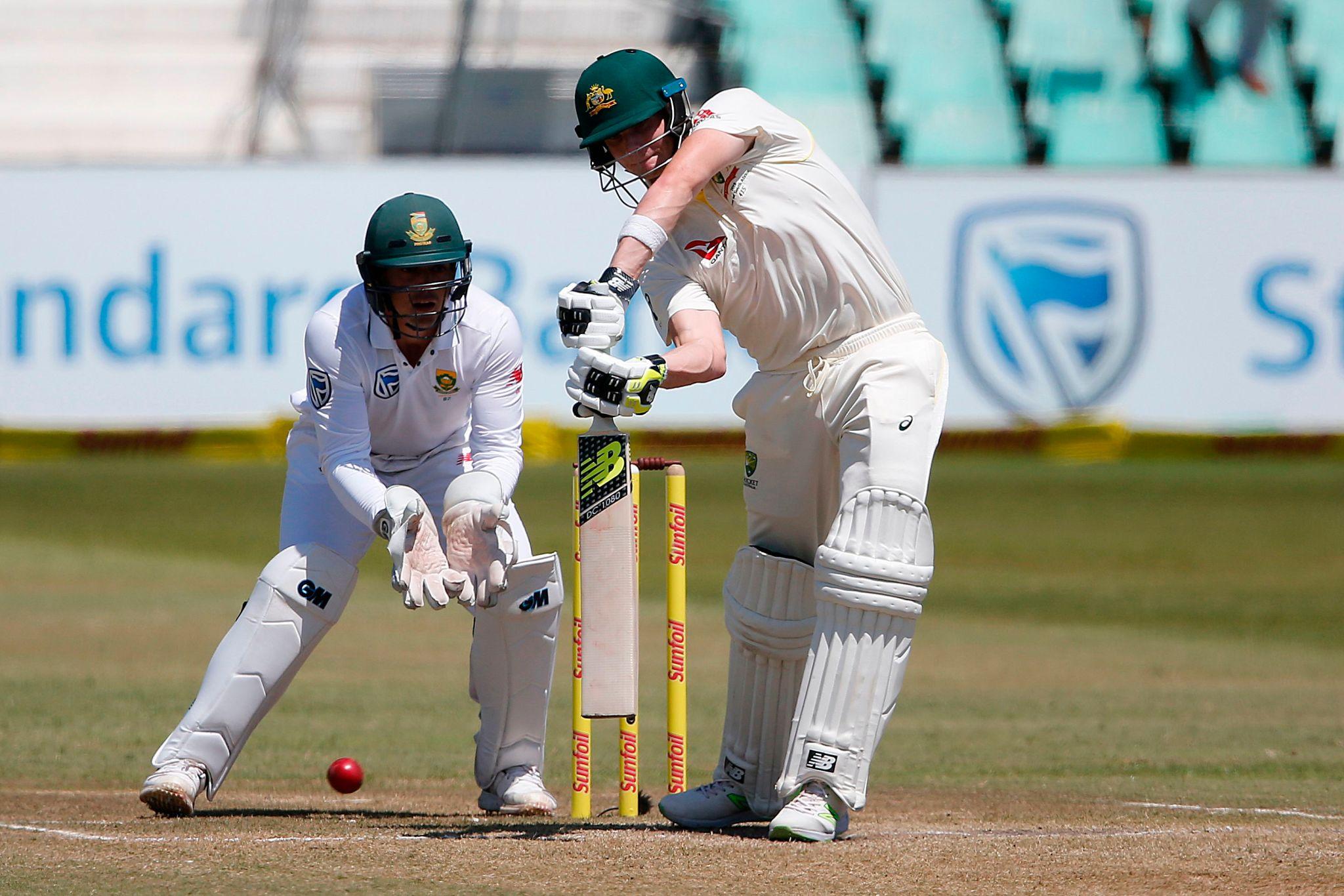
“Australia moved into a strong position against South Africa in the first Test after Steve Smith established a new record for catches by a fielder in men’s Test cricket, taking his tally to 223. South Africa were dismissed for 284 in response to Australia’s 390, leaving the visitors with a 139-run first-innings lead and 33 without loss in their second innings when bad light ended play early on the third day.”
Steve Smith’s Fielding Masterclass Gives Australia the Advantage as South Africa Fight to Stay Alive in Durban
South Africa face a demanding challenge in the opening Test against Australia at Kingsmead in Durban after a difficult third day left the visitors firmly in control of the match. Australia combined disciplined bowling, excellent fielding and valuable first-innings batting to establish an advantage, while Steve Smith delivered a historic performance that further strengthened his reputation as one of the outstanding fielders in Test cricket.
The defining moment of the third day came when Smith took his 223rd catch in men’s Test cricket, moving past England’s Joe Root, whose previous record stood at 220. Smith’s achievement came during a tense period of South Africa’s first innings, when the hosts were attempting to reduce Australia’s substantial first-innings total and prevent the visitors from controlling the remainder of the contest.
The result of the day’s play was a difficult position for the Proteas. Australia had scored 390 in their first innings, while South Africa managed 284, giving the tourists a lead of 106 runs. Australia then extended their overall advantage to 139 runs by reaching 33 without loss in their second innings before poor light forced an early finish.
With play scheduled to resume on Monday, 12 October, South Africa must find a way to create opportunities quickly. Their bowlers need to make early breakthroughs, while the batters must show greater discipline and patience if they are to prevent Australia from building an advantage that becomes increasingly difficult to overcome.
Smith creates history with outstanding fielding
Smith’s record-breaking display was the standout individual achievement of the third day. His 223 Test catches placed him ahead of Root and highlighted the importance of fielding in a format where individual moments can influence the outcome of a match.
Catching in Test cricket requires concentration over long periods, particularly when batters settle in and bowlers repeatedly test their defensive technique. Fielders must remain alert even during quiet spells, anticipating edges, reacting quickly to deflections and maintaining their positions as bowling plans change.
Smith demonstrated these qualities during South Africa’s innings. Among his catches were dismissals of captain Temba Bavuma and wicketkeeper-batter Kyle Verreynne, both of whom attempted reverse sweeps against Australia’s spin bowling. Smith also produced an important diving catch at slip to remove David Bedingham, who had been one of South Africa’s more productive batters.
His final catch ended South Africa’s innings, completing a memorable day for the Australian fielder. The performance was particularly notable because Smith is widely recognised for his batting, yet his contribution in Durban showed how his athleticism and awareness can influence a match without requiring him to score runs.
Smith’s appearance in South Africa also carried historical significance. His previous Test visit to the country in 2018 was overshadowed by the Australian ball-tampering scandal, which resulted in a one-year ban. Eight years later, his record-setting fielding performance offered a different sporting storyline, focused on achievement and technical excellence.
Nevertheless, individual records are only part of the larger contest. Australia’s priority will be converting their advantage into a match-winning position, while South Africa must ensure that Smith’s performance does not become a symbol of a broader failure to compete.
South Africa’s batting struggles prove costly
South Africa entered the third day having resumed at 27 for one, still needing substantial runs to approach Australia’s total. Instead, wickets fell at regular intervals, interrupting the team’s progress and placing pressure on the middle and lower order.
The home side eventually finished on 284, with David Bedingham top-scoring with 49 and Aiden Markram contributing 37. These efforts provided moments of resistance, but South Africa lacked the sustained partnerships required to challenge Australia’s first-innings total.
The pattern of dismissals was particularly concerning. South Africa’s batting coach, Ashwell Prince, acknowledged that whenever the team appeared ready to establish momentum, another wicket undermined its progress. The assessment underlined the problem facing the batting group: getting starts was not enough when the team needed players to turn promising positions into substantial scores.
Against a high-quality Australian attack, loose shots can quickly change the direction of a Test innings. Bowlers gain confidence when wickets arrive regularly, fielding positions become more aggressive, and incoming batters are forced to make decisions under increasing pressure.
South Africa will therefore need to review how they approached the conditions and the bowling. The answer is not necessarily to abandon attacking cricket, but to choose the right moments to accelerate. A batter who survives a challenging period can place pressure back on the opposition by extending a partnership, rotating the strike and capitalising on loose deliveries.
The contribution of the lower order also offered some encouragement. Simon Harmer finished unbeaten on 35, while Keshav Maharaj added 34. Their 87-run partnership for the final two wickets helped South Africa avoid an even smaller total and demonstrated that determined resistance remained possible even after the top and middle order had struggled.
That late stand could become important if South Africa’s bowlers can make early inroads into Australia’s second innings. A lower first-innings total might have left the hosts facing an even greater deficit; instead, the partnership gave their teammates at least some runs to work with.
Australia’s bowlers maintain pressure
Australia’s bowling unit played a major role in preventing South Africa from building a commanding innings. Captain Pat Cummins led the attack with three wickets for 54 runs, while Josh Hazlewood, Mitchell Starc and Nathan Lyon claimed two wickets each.
The distribution of wickets demonstrated Australia’s depth. Cummins supplied control and penetration, while Hazlewood and Starc offered pace and the threat of movement. Lyon provided a different challenge through spin, particularly as the pitch continued to develop during the match.
For South Africa, facing several different bowling styles made it difficult to settle into a consistent rhythm. Batters must adapt not only to changes in pace but also to the length, angle and field setting employed by each bowler. A small lapse in judgement can become expensive when the opposition maintains pressure from both ends.
Lyon’s potential influence could grow as the surface deteriorates. The Australian spinner indicated that conditions might offer greater assistance as the Test progresses, raising the prospect of increased turn and more difficult decisions for the South African batters in their next innings.
South Africa’s response will require a clear strategy. The batters need to identify which deliveries can be defended safely, which can be rotated into singles and which deserve an attacking response. Attempting to force the pace against a disciplined attack could expose the team to another collapse.
Australia, meanwhile, will be encouraged by the consistency of their bowlers and the athleticism of their fielders. The visitors have created a platform from which they can apply further pressure, but they must remain alert to the possibility of a South African recovery.
The second innings could determine the outcome
Australia ended the third day at 33 without loss, with Nic Maddinson unbeaten on 17 and Travis Head on 10. Their lead stood at 139 runs, leaving them well placed to strengthen their position if their opening batters establish a substantial partnership on the fourth day.
For Australia, the immediate objective will be to increase the lead without allowing South Africa to return to the contest through early wickets. A long second innings could exhaust the home bowlers and leave the Proteas with an increasingly difficult target to chase. However, aggressive batting carries its own risks, especially if the pitch begins to offer more assistance to the bowlers.
South Africa’s first priority must be to break the opening partnership. Early wickets would limit Australia’s scoring opportunities and could force the visitors to reconsider how long they want to bat before declaring, if they choose to do so. The hosts must also avoid conceding unnecessary boundaries and maintain pressure through disciplined lines and lengths.
The challenge is considerable because the Proteas cannot afford another extended period without wickets. Their attack needs to combine patience with creativity, using changes of pace, movement and spin to test Australia’s batters. Equally, the fielders must support their bowlers by taking chances when they appear.
Bad light complicates the contest
Weather and visibility have also influenced the Test. All three days of play leading into Monday ended early because of bad light, reducing the amount of cricket possible and complicating both teams’ planning. Additional playing time was scheduled for the sessions on Monday in an effort to recover some of the lost time.
Reduced playing time can affect the balance of a Test match. A team seeking to force a result needs enough overs to take 20 wickets, while the side under pressure may benefit if time runs out before its opponent can complete the task.
Nevertheless, neither side can rely on interruptions to determine the result. Australia will want to turn their lead into a position from which victory becomes realistic, whereas South Africa must use every available over to keep the match competitive.
The Kingsmead conditions, the possibility of increased spin and the time lost to poor light will therefore remain important factors as the match progresses.
What the result means for South African cricket
The opening Test is an important examination for the Proteas as they compete against one of the world’s leading cricket nations on home soil. South Africa’s recent achievements have raised expectations, but a difficult innings against Australia shows how quickly a Test match can become challenging when batting discipline breaks down.
The team will need to respond collectively rather than depend on one or two individual performances. The top order must build a foundation, the middle order must convert starts into meaningful scores, and the lower order must continue contributing when conditions become difficult.
The contest also offers valuable lessons about fielding standards. Smith’s record illustrates the difference that anticipation, concentration and athleticism can make over five days. South Africa will need comparable commitment in the field if they are to prevent Australia from extending their advantage.
Cricket South Africa’s published schedule confirms that the first Test is taking place at Kingsmead, with the second Test against Australia scheduled to begin in Gqeberha on 18 October. The opening match therefore carries importance beyond its immediate result: it provides both teams with an opportunity to assess their combinations and make adjustments before the next encounter.
Conclusion: The Proteas need an immediate response
Australia have taken control of the first Test through effective bowling, useful batting contributions and a historic fielding performance from Steve Smith. South Africa’s total of 284 left them 106 runs behind after the first innings, and Australia’s unbeaten start to their second innings increased the deficit to 139 by stumps on day three.
The Proteas are not necessarily out of contention, but the margin for error has narrowed. Early wickets, improved batting discipline and stronger partnerships will be essential if they are to challenge Australia’s position.
Smith’s record will remain one of the defining moments of the match, yet the final result will depend on what happens next. As play resumes on 12 October, Australia will seek to consolidate their advantage, while South Africa must find the resilience and tactical clarity required to turn a difficult situation into a genuine contest.
For South African supporters, the immediate hope is that the Proteas can respond with determination and give themselves a realistic opportunity to compete for victory. The next phase at Kingsmead will reveal whether the hosts can recover or whether Australia can turn their strong position into a decisive result.



