




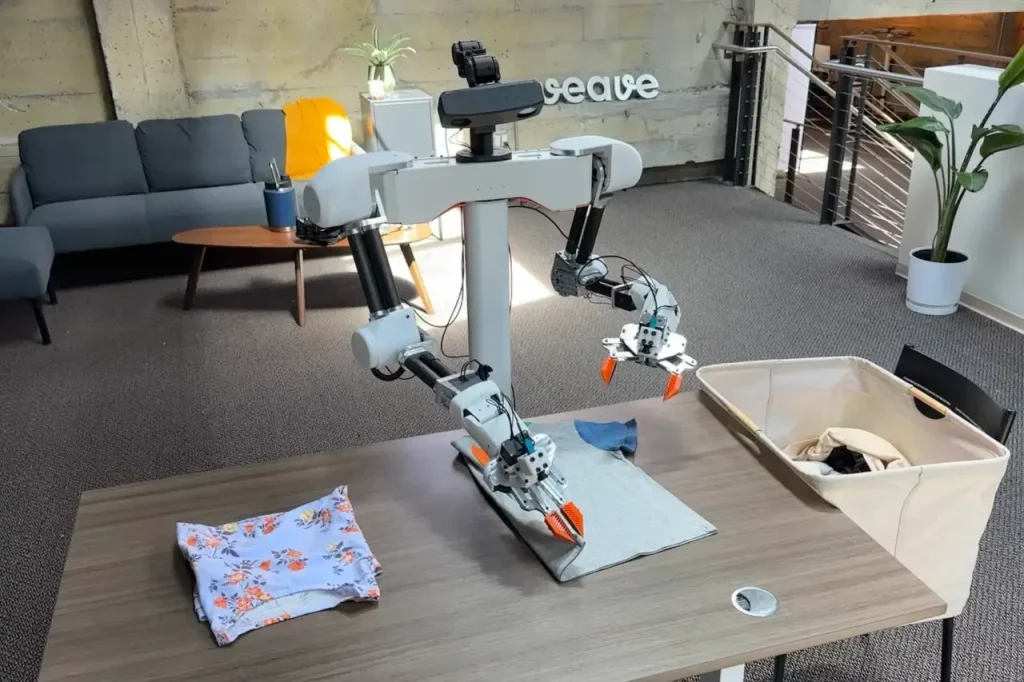
“Weave Robotics has announced plans to release Isaac 1, a humanoid-inspired home assistant robot, in South Africa later this year. Despite its futuristic promise, critics argue the robot’s limited dexterity and reliance on remote human operators make it an expensive experiment rather than a practical household solution.”
South Africa’s robotics landscape is witnessing a bold new entrant: Isaac 1, a home assistant robot developed by Weave Robotics. Announced on July 6, 2026, Isaac 1 is positioned as one of the first commercially available domestic robots in the country. With a price tag of R130,000 or a subscription model of R7,300 per month, the robot aims to bring futuristic automation into everyday households. Yet, its debut has sparked heated debate about affordability, practicality, and the broader implications of robotics in domestic life.
The Promise of Isaac 1
Isaac 1 is marketed as a vaguely humanoid robot capable of performing basic household tasks such as folding laundry and resetting daily living spaces. Equipped with claw-like hands, cameras, and sensors, the robot is designed to navigate home environments and interact with clothing, bedding, and small objects. Its eight-hour battery life allows for extended operation, though its speed and dexterity remain limited.
Weave Robotics emphasizes that Isaac 1 is “autonomous for Laundry Flow and Daily Reset by default, with teleoperation assistance when needed.” This means that while the robot can attempt tasks independently, remote human operators step in when it struggles. This hybrid autonomy model reflects the current state of robotics: promising but not yet fully capable of replacing human labor in complex, nuanced environments.
Market Context
South Africa has seen growing interest in robotics, particularly in industrial and mining sectors. Domestic robotics, however, remains largely experimental. Isaac 1’s launch represents a significant milestone, signaling a shift toward consumer-facing robotics. Yet, the high cost raises questions about accessibility. At R130,000, Isaac 1 is far more expensive than hiring domestic help or simply performing tasks manually. Even the subscription model, at R7,300 per month, is beyond the reach of most households.
Comparisons have been drawn to Neo, another home robot priced around R350,000, which also relies on remote operation. Both highlight the challenge of balancing innovation with affordability in emerging markets.
Technical Limitations
Critics argue that Isaac 1 is not ready for mass deployment. Demonstrations reveal slow task execution, incomplete operations, and limited dexterity. For example, while the robot can fold laundry, it does so at a pace that undermines its utility. Similarly, bed-making is possible only in simplified scenarios, without the precision required for tucking sheets.
The reliance on teleoperation introduces privacy concerns. Remote operators must access live camera feeds inside homes to complete tasks, raising questions about surveillance and data security. This trade-off between functionality and privacy is a critical issue for consumer robotics.
Public Reception
Public reaction has been mixed. Enthusiasts view Isaac 1 as a glimpse into the future, a stepping stone toward fully autonomous domestic robots. Skeptics, however, see it as an overpriced novelty. Social media commentary has highlighted the irony of paying thousands of rands for a robot that struggles with basic chores.
The debate reflects broader societal tensions around automation: excitement about technological progress tempered by concerns about cost, capability, and human displacement.
Strategic Implications
Isaac 1’s launch aligns with South Africa’s broader push toward digital industrialization under frameworks like the African Union’s Agenda 2063. While industrial robotics has already proven its value in mining and manufacturing, domestic robotics remains aspirational. Isaac 1 may not revolutionize households immediately, but it sets the stage for future innovation.
For Weave Robotics, the challenge lies in refining autonomy, improving dexterity, and addressing privacy concerns. Success will depend on balancing technological ambition with consumer trust and affordability.
Conclusion
Isaac 1 represents both the promise and pitfalls of domestic robotics in South Africa. Its launch is a landmark moment, signaling the arrival of consumer-facing robots in the local market. Yet, its limitations underscore the long road ahead before robots become practical household companions.
As South Africa embraces digital transformation, Isaac 1 serves as a reminder that innovation must be matched by usability, affordability, and ethical safeguards. Whether it becomes a household staple or a cautionary tale will depend on how Weave Robotics navigates these challenges in the years ahead.



