




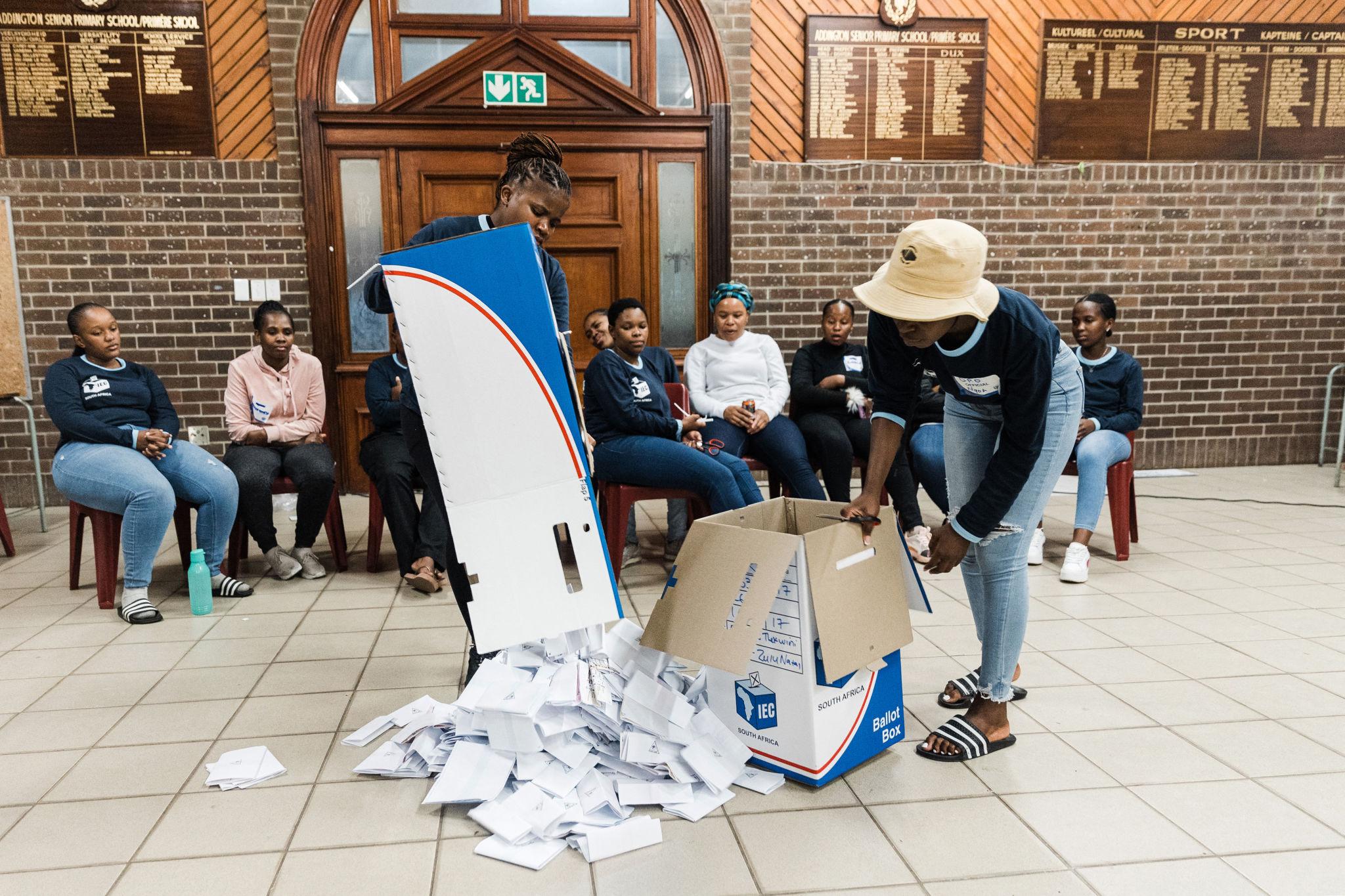
“South Africa’s African National Congress faces a significant political setback following the 4 November municipal elections, with preliminary results indicating declining electoral support and increasing competition from the Democratic Alliance and other opposition parties. The ANC’s upcoming coalition negotiations could intensify internal divisions as national leadership and regional structures struggle to agree on political partnerships, municipal leadership positions and strategies ahead of the 2029 national elections.”
ANC Faces Historic Electoral Decline as Coalition Negotiations Threaten Internal Party Unity
Johannesburg, South Africa – 5 November 2026
South Africa’s African National Congress (ANC) is confronting one of its most consequential political challenges following the country’s 4 November 2026 local government elections, as preliminary results point to a further erosion of electoral support and intensifying competition from opposition parties. Beyond the ballot count, the election has opened a potentially turbulent period of coalition negotiations that could expose deep divisions within the governing party and reshape its political strategy ahead of the 2029 national and provincial elections.
The immediate challenge facing the ANC is determining how to retain political influence in municipalities where it no longer commands an outright majority. According to Daily Maverick’s political analysis published on 5 November, the party’s national leadership faces difficult decisions about coalition partners across several metropolitan municipalities and numerous local councils. These decisions could create significant disagreements between national leaders and regional party structures over power-sharing arrangements, mayoral appointments and access to municipal leadership positions.
ANC Electoral Support Under Pressure
Preliminary election results have highlighted the increasingly competitive nature of South African politics. Reuters reported on 5 November that the ANC was polling at approximately 32% nationally in an early count, with the Democratic Alliance (DA) at approximately 27%. These figures remained provisional and were subject to change as additional voting districts were processed.
The early results nevertheless underscored the difficulties confronting the ANC following its reduced performance in the 2021 municipal elections and the 2024 national elections.
The party has traditionally relied on its historical liberation movement credentials, extensive organisational structures and nationwide political networks to maintain electoral dominance. However, growing dissatisfaction with municipal services, unemployment, infrastructure challenges and corruption allegations has increasingly complicated its relationship with voters.
The electoral environment has also become more fragmented. Opposition parties, including the DA, Economic Freedom Fighters (EFF), uMkhonto weSizwe (MK) Party, Inkatha Freedom Party (IFP), ActionSA and the Patriotic Alliance, are competing for support across different communities.
This fragmentation means that electoral victories no longer automatically translate into stable municipal administrations. Instead, parties must increasingly negotiate partnerships with political competitors to secure governing majorities.
Coalition Negotiations Become the ANC’s Immediate Priority
According to Daily Maverick’s Stephen Grootes, the ANC’s national leadership has indicated that coalition decisions will be coordinated centrally rather than left entirely to regional structures.
The approach reflects concerns that individual regions could pursue inconsistent political partnerships, potentially undermining the party’s national strategy.
Centralised negotiations could help establish a coordinated position on coalition governance. However, they also create the possibility of confrontation between national officials and provincial or regional leadership structures.
Municipal political interests frequently differ from national strategic considerations. Local party leaders may prioritise retaining mayoral positions, protecting regional influence and securing opportunities for party members.
National leadership, meanwhile, must consider the broader political consequences of coalition arrangements, including how partnerships could influence the party’s prospects in 2029.
The ANC’s decisions could therefore become a significant test of internal discipline and organisational authority.
Johannesburg and Gauteng Present Difficult Political Choices
Gauteng is particularly important because its metropolitan municipalities represent substantial economic, political and administrative influence.
Johannesburg, Tshwane and Ekurhuleni have become central battlegrounds in South Africa’s increasingly competitive political environment.
Coalition negotiations in these municipalities could require the ANC to consider partnerships with parties that have historically been its political opponents.
Daily Maverick’s analysis identifies potential negotiations involving the DA and other opposition parties as particularly sensitive.
In Johannesburg, national leadership could favour an arrangement involving the DA, while regional structures might prefer partnerships with the EFF or MK Party.
Such differences could complicate negotiations and potentially weaken the ANC’s ability to maintain a consistent coalition strategy.
The party must also consider whether supporting opposition candidates for mayoral positions could provide greater long-term political stability than attempting to retain leadership through smaller coalition partners.
These decisions will influence not only municipal governance but also the political relationships that shape future provincial and national contests.
Opposition Parties Strengthen Their Position
The Democratic Alliance has emerged as a major beneficiary of the changing electoral landscape.
Its campaign focused heavily on municipal service delivery, infrastructure maintenance, corruption and administrative accountability.
DA leaders presented the election as an opportunity to expand the party’s governing influence and challenge the ANC’s historical dominance.
Meanwhile, the EFF continued to emphasise economic transformation, public infrastructure, municipal accountability and the protection of working-class communities.
The MK Party also sought to strengthen its position, particularly in KwaZulu-Natal, where it competes directly with the ANC and IFP.
These developments indicate that opposition politics is no longer concentrated around a single alternative to the ANC.
Instead, South Africa is increasingly characterised by multiple political formations competing for influence across different geographical and ideological constituencies.
This creates opportunities for opposition parties to negotiate coalition agreements, although ideological differences and leadership rivalries may complicate cooperation.
Internal ANC Divisions Could Deepen
The most significant challenge facing the ANC may emerge from within its own organisational structures.
Coalition negotiations involve decisions about political leadership, municipal executive positions and influence over local administration.
For regional leaders, these positions can represent important sources of political authority and organisational influence.
Consequently, national decisions that require regional structures to surrender municipal leadership positions could generate resistance.
The ANC’s recent political history has demonstrated that disagreements between national and provincial leadership can affect governance and organisational cohesion.
The coalition process may therefore become an important test of whether the party can maintain internal unity while responding to declining electoral support.
If negotiations produce widespread dissatisfaction among regional leaders, the resulting tensions could influence leadership contests, policy debates and organisational restructuring.
The party’s ability to manage these disagreements will be crucial to its political recovery.
Voters Demand Better Municipal Governance
The election results also reflect broader concerns about municipal performance.
Communities across South Africa continue to raise concerns about unreliable water supplies, electricity infrastructure, deteriorating roads, waste collection and unemployment.
These challenges have become central political issues because municipalities are responsible for delivering many of the services that directly affect residents’ daily lives.
The ANC has acknowledged shortcomings in municipal governance and promised improvements in infrastructure investment, administrative accountability and service delivery.
However, voters increasingly expect measurable results rather than campaign promises.
Opposition parties have sought to capitalise on this dissatisfaction by presenting themselves as alternatives capable of improving municipal administration.
The election therefore represents not only a contest between political organisations but also a public assessment of local governance.
Coalition Stability Becomes a National Political Question
South Africa’s growing reliance on coalition governments has introduced new opportunities and risks.
Coalitions can broaden political representation and encourage cooperation between parties. However, unstable agreements can also undermine administrative continuity, delay decisions and weaken municipal accountability.
Political analyst Ongama Mtimka, speaking to Eyewitness News on 5 November, emphasised the importance of coalition viability and sustainability.
His analysis suggested that parties should evaluate coalition arrangements according to their ability to establish functioning administrations and maintain political cooperation over time.
This consideration is particularly important in municipalities where political parties have competing ideological priorities.
The ANC must therefore balance the immediate objective of retaining political influence with the longer-term requirement of establishing stable municipal governments.
Implications for the 2029 Elections
The outcome of coalition negotiations could significantly influence South Africa’s political direction before the next national elections.
If the ANC successfully manages its coalition arrangements and demonstrates improved municipal governance, it could strengthen its prospects of rebuilding electoral support.
Conversely, prolonged internal disagreements, unstable municipal administrations and continued service delivery failures could reinforce voter dissatisfaction.
The DA may seek to use its municipal gains to demonstrate governing competence and strengthen its national ambitions.
Other opposition parties could also use coalition participation to expand their political influence and establish stronger organisational networks.
For the ANC, the challenge extends beyond winning individual municipalities. It must demonstrate that it can adapt to a political environment in which electoral dominance can no longer be assumed.
Conclusion
South Africa’s 2026 municipal elections have opened a critical chapter in the country’s political development.
The ANC faces declining electoral support, increasingly competitive opposition parties and difficult coalition negotiations that could intensify internal organisational divisions.
The party’s national leadership must navigate competing regional interests while determining political partnerships capable of maintaining municipal influence and administrative stability.
Meanwhile, opposition parties are seeking to translate electoral gains into stronger governing positions and broader political credibility.
Ultimately, the most important test will be whether coalition negotiations produce administrations capable of addressing South Africa’s longstanding municipal challenges.
For the ANC, the coming weeks represent an opportunity to demonstrate organisational discipline, political adaptability and a renewed commitment to public accountability.
For South African voters, the emerging coalition landscape will provide another measure of whether political competition can translate into meaningful improvements in governance, infrastructure and everyday public services.



