




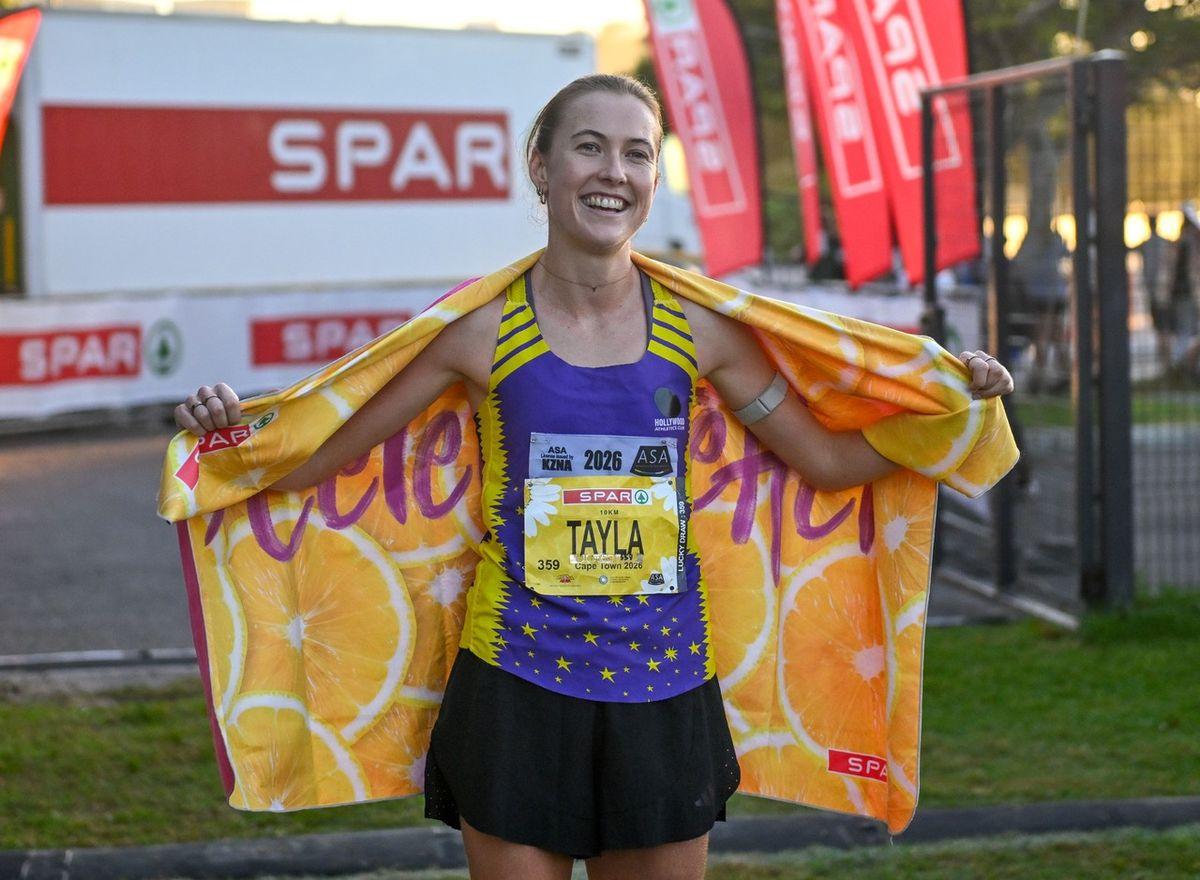
“South African distance runner Tayla Kavanagh set a new national women’s 10km record at the Brașov Running Festival in Romania, recording 30 minutes and 50 seconds and improving the previous record of 31:12 by 22 seconds. The Hillcrest-based athlete credited years of hard work and favourable racing conditions for the performance, and said she intended to rest before assessing possible world championship qualification opportunities.”
Tayla Kavanagh’s Record-Breaking Run Signals a Major Moment for South African Athletics
A historic performance on the European road-running circuit
South African athletics celebrated a significant achievement after Durban runner Tayla Kavanagh broke the national women’s 10km record at the Brașov Running Festival in Romania. Her time of 30 minutes and 50 seconds marked a new milestone for South African women’s distance running, placing her name in the national record books and highlighting the progress being made by local athletes competing internationally.
According to a report published by Caxton Network News on 6 October 2026, Kavanagh improved the previous South African record of 31:12 by 22 seconds. She also improved her personal best by 36 seconds, demonstrating the scale of her performance against a competitive international field.
The result is significant because breaking a national record requires more than simply running quickly. Athletes must combine physical preparation, race awareness, tactical discipline and the ability to maintain their pace when fatigue begins to affect performance.
Kavanagh’s achievement therefore represents both an individual success and an encouraging development for South African athletics, particularly in the increasingly competitive discipline of women’s road running.
A record achieved through years of dedication
Kavanagh’s performance did not happen overnight. The runner explained that her improvement had come through years of hard work and commitment, highlighting the importance of consistency in elite distance running.
Preparing for a 10km race at international level requires athletes to develop aerobic endurance, efficient running mechanics and the ability to sustain a demanding pace for the entire distance. Training programmes commonly combine long runs, threshold sessions, interval workouts, strength training and carefully managed recovery.
However, successful preparation also depends on knowing when to increase training intensity and when to allow the body to recover. Excessive training without sufficient rest can lead to fatigue, illness or injury, potentially undermining months of preparation.
Kavanagh’s record suggests that her preparation came together effectively on race day. She entered the competition determined to run as fast as possible and was pleased with the result, particularly because she could compete competitively against international opponents.
Her achievement also illustrates the value of setting ambitious goals while remaining focused on the process required to reach them. A national record is the visible outcome of many less visible hours spent training, recovering and refining technique.
The importance of the Brașov Running Festival
The Brașov Running Festival provided the setting for Kavanagh’s breakthrough. Competing in Romania gave the South African athlete an opportunity to measure herself against international opposition and benefit from conditions that she considered favourable for faster running.
According to the published report, Kavanagh specifically highlighted the European conditions as a factor that helped athletes pursue quicker times.
Road-running performances can be influenced by several environmental and course-related factors. Temperature, wind, elevation changes, road surfaces, course design and the quality of the competing field can all affect finishing times.
Cool conditions may help distance runners regulate their body temperature, particularly when compared with hot and humid environments. Nevertheless, weather alone does not explain a record-breaking result. Athletes still need the endurance, speed and pacing ability to take advantage of suitable conditions.
A competitive international race can also encourage runners to maintain their pace. When athletes are surrounded by opponents moving at a similar speed, the race becomes a test of concentration and tactical judgement as well as physical ability.
For Kavanagh, Romania offered the opportunity to compete in a strong field and produce a performance that surpassed her previous best. Her national record demonstrates how international competition can provide South African athletes with valuable opportunities to test their limits.
A demanding final kilometre
One of the most revealing details in the report was Kavanagh’s description of the final kilometre. She explained that the closing section was extremely difficult and required her to push hard to maintain her effort.
In a 10km race, the final kilometre can become a decisive test of physical conditioning and mental resilience. By this stage, runners have already spent considerable energy maintaining their pace, and even small changes in speed can feel demanding.
Athletes must resist the temptation to slow down unnecessarily while also avoiding an early surge that leaves them unable to finish strongly. Effective pacing requires an understanding of personal limits and the discipline to remain focused when discomfort increases.
Kavanagh’s account indicates that she continued to concentrate on the remaining distance and the importance of every second. That determination was especially important in a race in which the final time would establish a new national benchmark.
Her experience offers a useful lesson for developing runners: preparation must include the ability to handle difficult moments, not simply the ability to run fast when conditions are comfortable.
Coaches frequently emphasise that physical endurance and mental discipline work together. Runners must learn to interpret fatigue, remain composed and execute their race plans when their bodies begin to demand a reduction in effort.
Kavanagh’s record-breaking performance illustrates how these elements can combine when an athlete is adequately prepared for the challenge.
What the record means for South African women’s running
Breaking the 31-minute barrier is a notable achievement in women’s 10km road running. Kavanagh became the first South African woman to complete the distance in under 31 minutes, according to the published report.
The milestone gives South African athletics a new performance benchmark and provides other distance runners with a concrete example of what may be achievable through sustained development.
National records serve several purposes. They recognise exceptional performances, help measure progress across generations and provide athletes with targets against which they can assess their own development.
They can also encourage greater public interest in disciplines that do not always receive the same attention as major football, rugby or cricket competitions.
Women’s distance running has a particularly important role in broadening participation in athletics. Strong performances by elite competitors can encourage girls and young women to join running clubs, participate in school competitions and pursue more advanced training opportunities.
However, a national record should not be viewed as evidence that every athlete can achieve the same time. Development pathways differ, and progress depends on individual ability, access to coaching, training facilities, financial resources and opportunities to compete.
The broader significance lies in demonstrating the potential of South African athletes while encouraging a supportive environment in which more runners can develop.
The contribution of clubs and support networks
Kavanagh also acknowledged the support and encouragement she receives from her Hollywood Athletics Club. She explained that the backing of people around her helped her feel valued and motivated.
This acknowledgement highlights the contribution that athletics clubs make to competitive sport.
Behind an individual performance, there may be coaches, training partners, club officials, family members, medical professionals and supporters who help an athlete remain committed to long-term goals.
Training partners can provide motivation and help athletes maintain discipline during demanding sessions. Coaches can identify weaknesses, structure training programmes and adjust workloads as an athlete progresses. Family and community support can help runners balance competition with employment, education and other responsibilities.
Clubs also create opportunities for younger athletes to learn from more experienced competitors. Seeing someone progress from regular training to national-record level can make elite performance appear more attainable, even though the journey requires considerable commitment.
For South African athletics to continue producing strong distance runners, developing these support networks will remain important. Talent identification must be accompanied by consistent coaching, accessible competitions and appropriate opportunities for athletes to improve.
Recovery and the next stage of her career
Following the record, Kavanagh indicated that she planned to take an off-season break before beginning preparations for the following year. She also said she would examine world championship qualification times to determine whether qualification could be a realistic objective.
That approach reflects an important principle in high-performance sport: progress depends on recovery as well as training.
After an intense racing period, physical and mental rest can help athletes recover from accumulated fatigue. Returning to demanding workouts too quickly may increase the risk of injury and reduce the effectiveness of subsequent training.
A planned break also allows an athlete and coach to evaluate the season, identify areas for improvement and establish realistic targets for the next competitive cycle.
Kavanagh’s interest in world championship qualification provides a possible direction for her future ambitions, but the published report does not confirm that she has qualified for a particular championship. Qualification would depend on the relevant event’s standards, eligibility rules and selection arrangements.
Her next steps will therefore involve assessing the available opportunities and determining how her record-breaking performance fits into her longer-term plans.
What aspiring runners can learn from the achievement
Kavanagh’s result offers several lessons for athletes who want to improve their performances.
First, consistency matters. Significant improvements usually emerge from sustained preparation rather than a single exceptional training session.
Second, competition experience is valuable. Racing against strong opponents can help athletes develop tactical awareness, learn to manage pressure and understand how their performances compare with those of other competitors.
Third, athletes need realistic goals. Personal-best targets, intermediate milestones and carefully planned training cycles can help runners track progress without becoming discouraged by temporary setbacks.
Fourth, recovery should be treated as part of preparation. Sleep, nutrition, hydration and appropriate rest help support training adaptations and reduce the likelihood of excessive fatigue.
Finally, athletes benefit from recognising the contribution of their support networks. A coach, club or training group can provide structure and encouragement during difficult periods.
These principles apply to recreational runners as well as elite competitors, although training intensity and individual goals must be appropriate to each person’s experience and physical condition.
The outlook for South African athletics
Kavanagh’s national 10km record provides a positive talking point for South African athletics as the sport continues to develop across road running, track and field, cross-country and trail running.
South Africa has a substantial running community, with organised clubs, mass-participation races and competitive events offering different routes into the sport. Sustaining this environment requires investment in coaching, competition opportunities, athlete welfare and development programmes.
International performances can help raise the profile of South African distance running, but long-term success also depends on building a broad foundation of participation and identifying promising athletes early.
Kavanagh’s achievement is a reminder that national-level breakthroughs can emerge from years of steady work supported by a strong club environment and the willingness to compete against the best available opposition.
Her record does not guarantee future championship qualification or additional records. Nevertheless, it gives her a new benchmark from which to plan her next season and provides South African athletics with a significant performance to celebrate.
As she takes time to recover and consider her future goals, attention will turn to how she builds on this result. For now, her 30:50 performance in Romania stands as the central achievement: a national record earned through determination, preparation and a successful international racing experience.
For aspiring athletes, the message is straightforward. Progress requires patience, commitment and the courage to test personal limits. For South African athletics supporters, Kavanagh’s achievement offers a reason to follow the next chapter of her career with interest.



