




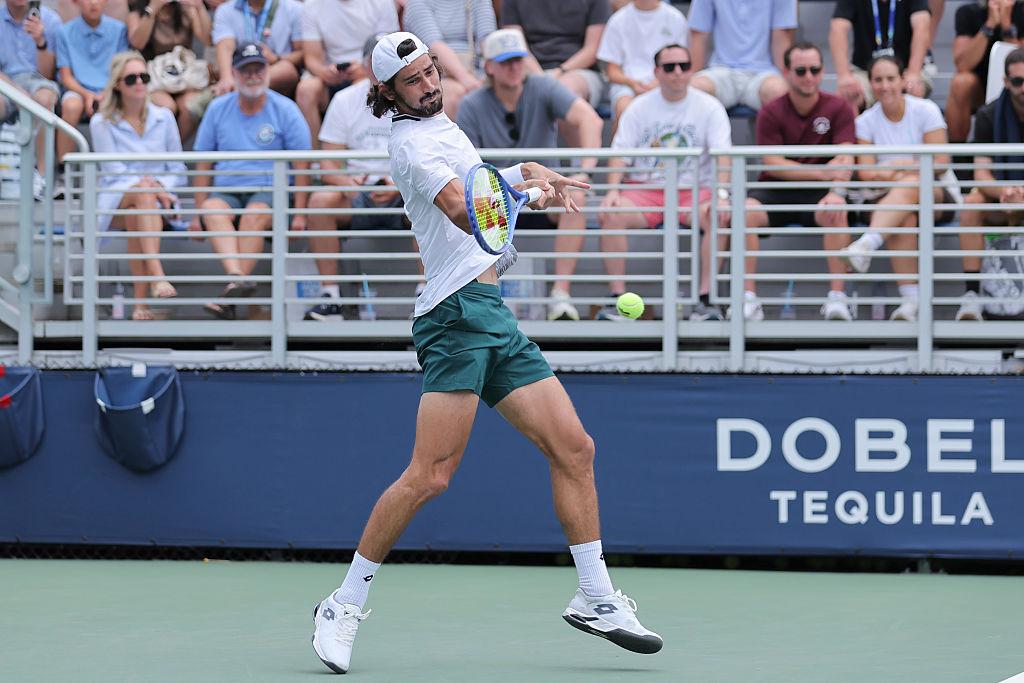
“South African tennis player Lloyd Harris captured the Jingshan Open title in China on 4 October 2026, recovering from a difficult opening set to defeat Italy’s Mattia Bellucci 1–6, 6–3, 7–6(4) in a dramatic final. The victory, secured after Harris saved two championship points, highlighted his determination and strengthened his recent run of results on the international circuit.”
Harris delivers a remarkable comeback in China
South African tennis received an encouraging boost after Lloyd Harris produced an impressive comeback to win the Jingshan Open title in China. The 29-year-old defeated Italian opponent Mattia Bellucci in three sets on Sunday, 4 October, turning a challenging start into a memorable championship victory.
The final ended 1–6, 6–3, 7–6(4), reflecting the dramatic change in momentum during a contest that tested the South African’s technical ability, physical endurance and mental strength. Harris recovered after losing the first set convincingly, gradually finding his rhythm before prevailing in a tense deciding-set tiebreak.
According to tournament coverage, Harris also faced two championship points during the final set. His ability to survive those moments and eventually secure the trophy made the victory particularly significant.
For South African tennis supporters, the achievement provided another reason to follow Harris’s progress on the international professional circuit. His victory demonstrated how persistence and tactical adjustments can change the outcome of a match, even when an opponent appears to have established control.
A difficult opening set tests the South African
The final began with Bellucci dictating much of the action. The Italian played aggressively and applied pressure during the early baseline exchanges, leaving Harris struggling to establish the patterns needed to compete consistently.
Bellucci took the opening set 6–1, giving himself a substantial advantage and placing the South African under immediate pressure. At that stage, Harris needed to change the match’s rhythm, improve the effectiveness of his serve and prevent his opponent from controlling rallies.
Such situations are familiar in professional tennis, where a player can quickly lose ground when an opponent finds the right combination of placement, power and consistency. However, a poor opening set does not necessarily determine the outcome of a best-of-three-set contest.
Harris responded by working his way back into the match rather than allowing the early setback to dictate his performance. His recovery showed the importance of remaining composed, assessing an opponent’s tactics and making adjustments when an initial strategy is unsuccessful.
The second set became an opportunity for the South African to re-establish himself. Better execution and more effective service games helped him challenge Bellucci’s control, eventually allowing Harris to take the set 6–3 and level the match.
That response changed the contest from a seemingly one-sided encounter into a closely fought championship battle.
Mental resilience proves decisive
The deciding set provided the most dramatic portion of the final. Both players understood that the championship was within reach, and the pressure increased as the contest moved towards its conclusion.
Bellucci continued to challenge Harris, forcing the South African to defend his position under difficult circumstances. At a crucial stage, Harris faced two championship points, leaving him on the brink of defeat.
Saving championship points requires more than a powerful serve or an effective groundstroke. Players must manage nerves, select their shots carefully and avoid allowing the importance of the moment to interfere with their decision-making.
Harris responded under pressure, surviving the immediate danger and keeping his title hopes alive. His recovery demonstrated the composure required to compete at a high level, particularly when a match can be decided by a handful of points.
The players eventually reached a deciding tiebreak, where Harris secured victory 7–4. That final sequence completed his comeback and confirmed him as the tournament champion.
The result was particularly impressive because Harris had been unable to establish control in the opening set. Instead of accepting the early disadvantage, he adapted and continued competing until he created an opportunity to win.
His performance under pressure was therefore central to the championship story. It illustrated how patience, confidence and the ability to respond to setbacks can prove decisive in professional tennis.
A strong run through the tournament
Harris’s title was not the product of one successful final alone. The South African built his campaign through a series of victories against opponents from different countries.
He began by defeating Canada’s Alexis Galarneau 6–2, 6–3. He then progressed past France’s Luka Pavlovic with another straight-sets result, winning 6–2, 6–3.
In the quarter-finals, Harris overcame American Andre Ilagan 7–5, 6–1. The result demonstrated his ability to remain competitive through a challenging opening set before establishing greater control.
The semi-final against Australia’s Alex Bolt proved more complicated. Harris lost the first set 5–7 but responded to win the second-set tiebreak 7–2. Bolt subsequently retired, sending Harris through to the championship match.
These results showed a player capable of managing different match situations. Some victories came through consistent performances across both sets, while others required him to recover from setbacks or negotiate difficult stretches of play.
His progression through the draw also meant that the final tested skills he had needed throughout the week: serving effectively, maintaining concentration and finding solutions when opponents applied pressure.
Winning a tournament requires consistency as well as individual moments of brilliance. Harris’s successful campaign reflected both elements, culminating in his comeback against Bellucci.
Harris’s achievement is an encouraging development for South African tennis because international success provides visibility for the country’s players and demonstrates that they can compete effectively in demanding overseas tournaments.
South Africa has a long history of producing professional tennis players, but maintaining a strong presence on the international circuit requires consistent investment in coaching, competition opportunities, fitness and player development.
For professionals, tournament victories can help build confidence and provide valuable ranking points, prize money and competitive experience. The exact ranking impact depends on the points earned, the player’s existing results and the points being defended from the previous season.
The Jingshan title was Harris’s second Challenger trophy of 2026, following his victory in Brownsburg in August, according to the tournament coverage. His recent performances in China also included a quarter-final appearance at the Chengdu Open shortly before the Jingshan championship.
Those results suggested that Harris was building momentum during the Asian hard-court swing. However, one title alone does not guarantee a sustained rise in the rankings. Continued performances against strong opponents will determine how much the run contributes to his longer-term position.
Nevertheless, the victory provides a useful example for young South African players. It demonstrates that international opportunities can produce meaningful results when athletes combine preparation, adaptability and resilience.
The importance of Challenger tournaments
The ATP Challenger Tour occupies an important position in men’s professional tennis. It gives players opportunities to compete for ranking points and titles while working towards higher-level events.
For players seeking to establish themselves or rebuild their positions, Challenger tournaments can be especially valuable. They provide regular competitive matches and opportunities to test their games against opponents with different playing styles.
Success at this level can help players improve their rankings and qualify for stronger tournaments. It can also give them confidence when competing against higher-ranked opponents.
Harris’s victory in Jingshan therefore mattered beyond the trophy itself. It formed part of a broader campaign in which he was seeking to translate strong performances into more opportunities at major events.
The transition between Challenger competitions and the ATP Tour is demanding. Players must manage travel, recovery, training schedules and the pressure of competing against increasingly difficult opposition.
A successful tournament can help establish momentum, but sustaining that momentum requires careful preparation and continued performance. Harris’s challenge following Jingshan was to build on his success while maintaining the physical and mental condition needed for the remainder of the season.
Shanghai provides another competitive test
Harris subsequently turned his attention to the Shanghai Masters qualifying competition. After winning in Jingshan, he defeated Australia’s Alex Bolt 7–5, 6–4 in the opening round of qualifying on 5 October.
However, he did not progress into the main draw. He lost to Hong Kong’s Chak Lam Coleman Wong 4–6, 6–3, 2–6 in the qualifying round on 6 October, according to published match records.
The outcome underlined the unpredictable nature of professional tennis. A player can win a demanding tournament and then face another difficult challenge only days later, often while managing travel and recovery.
Although Harris did not secure a place in the Shanghai main draw, his Jingshan title remained an important achievement. The two events illustrated the difference between celebrating a tournament victory and maintaining performance across a demanding international schedule.
For Harris, the next objective will be to use the experience gained from these matches to prepare for future competitions. His recent results offer encouraging evidence of his ability to compete, but continued progress will depend on the quality and consistency of his performances.
Developing the next generation of South African players
Harris’s success also brings attention to the wider development of tennis in South Africa. Sustained international competitiveness depends on a pathway that allows children and teenagers to progress from introductory programmes into provincial, national and professional competition.
Tennis South Africa’s RCS Rising Star Tennis programme, for example, includes school competitions across the country’s nine provinces, with opportunities for young players and a wheelchair tennis division. The programme’s 2026 national finals are scheduled for 30 October to 1 November.
Initiatives of this kind can help expand participation and identify promising players. However, long-term development requires more than competitions. Access to suitable courts, qualified coaches, equipment, travel support and regular match experience can influence whether talented young athletes progress.
Professional successes can help attract attention to the sport, encourage participation and provide young players with examples of what sustained training can achieve.
At the same time, the development of future champions cannot rely on one player’s results. It requires collaboration between schools, clubs, provincial associations, national administrators, sponsors, coaches and families.
Harris’s international victory provides a timely reminder of why those pathways matter. Behind every professional performance is a longer process of training, competition and preparation.
What comes next for Harris and South African tennis?
The immediate significance of Harris’s Jingshan triumph is clear: he recovered from a set down, survived two championship points and won a closely contested final against Bellucci.
The wider significance will depend on what follows. Future tournament results, ranking developments and performances against stronger opposition will provide a clearer picture of whether his recent success becomes a sustained period of progress.
For South African tennis, the priority is to turn individual achievements into broader opportunities for the sport. Supporting junior development, improving access to competition and maintaining investment in professional players can help strengthen the country’s international presence.
Harris’s comeback offers an encouraging example of the determination required to compete at the highest levels. His victory did not eliminate the challenges of professional tennis, but it demonstrated that a difficult start need not determine the final result.
As the international season continues, South African supporters will have reason to follow his next appearances closely. His Jingshan title has already delivered a memorable moment, and future performances will determine how far that momentum carries him.
The bottom line: Lloyd Harris’s Jingshan Open victory was a significant recent achievement for South African tennis. Although the championship was won on 4 October rather than today, 9 October, it remains a well-supported recent story suitable for a tennis news article, provided its publication date is clearly distinguished from the date of the article.



