




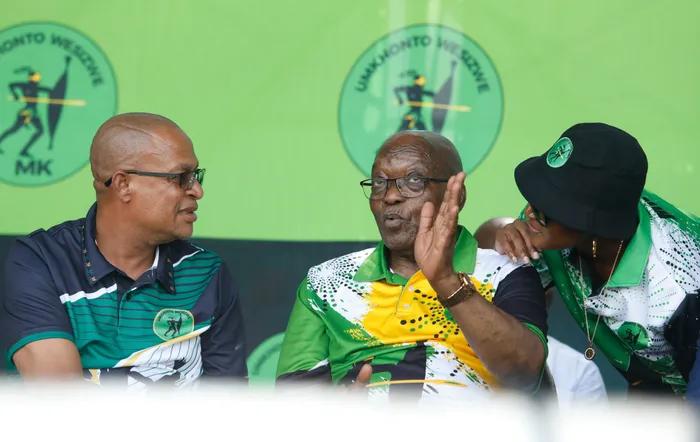
“South Africa’s Electoral Court has dismissed the uMkhonto weSizwe Party’s challenge to the integrity of the Electoral Commission of South Africa’s digital vote-capturing and results-reporting system used during the 2024 national and provincial elections. The ruling found that the MK Party had not established that the temporary disappearance of the public results dashboard affected vote capturing, verification or the final results, leaving the 2024 election outcome intact.”
South Africa’s Electoral Court has dismissed the uMkhonto weSizwe Party’s challenge to the integrity of the Electoral Commission of South Africa’s digital vote-capturing and results-reporting system used during the 2024 national and provincial elections. The ruling found that the MK Party had not established that the temporary disappearance of the public results dashboard affected vote capturing, verification or the final results, leaving the 2024 election outcome intact.
South Africa’s political landscape has been given another significant legal development after the Electoral Court dismissed the uMkhonto weSizwe Party’s challenge to the integrity of the 2024 national and provincial election results. The judgment, delivered on Friday, 25 September 2026, concerned the MK Party’s allegations that a technical incident involving the Electoral Commission of South Africa’s digital results system compromised the credibility of the election. The decision comes as political parties prepare for the 4 November 2026 local government elections, making the dispute particularly relevant to the country’s current electoral environment.
The case centred on an incident on 31 May 2024, when the public-facing election results leaderboard and dashboard temporarily displayed zero results. According to reporting by Eyewitness News, the MK Party argued that the disappearance of the information from the public display created an opportunity for manipulation of election results. The party maintained that the incident raised questions about the reliability of the electronic system used during the counting and reporting process.
The Electoral Commission disputed the interpretation of the incident. Evidence presented to the court indicated that the wider election results system continued operating even though the public-facing dashboard temporarily failed to display information. The commission maintained that the problem affected the display of information rather than the underlying process of capturing, editing, verifying and storing election results.
The court ultimately accepted the Electoral Commission’s account based on the evidence before it. According to the judgment and reporting on the decision, an audit trail showed that election results continued to be captured and edited during the period in which the public leaderboard was unavailable. The court also accepted that no election data was lost and that the incident did not interfere with the verification of results.
This distinction is important because the MK Party’s case depended heavily on the argument that the temporary disappearance of the public results display demonstrated a broader problem with the election system. The court, however, found that the evidence did not establish that the results themselves had been manipulated or that the electronic system lacked integrity. The judgment therefore rejected the legal relief sought by the party.
Another important element of the judgment concerned electoral procedure. The court found that the MK Party had not followed the mandatory procedure required for challenging the declaration of election results. Eyewitness News reported that the court held the party’s application to review the declaration was not competent in law because the required objection process had not been followed within the applicable legal timeframe.
The Electoral Court’s decision means that the official results of the 2024 national and provincial elections remain in place. The ruling therefore closes another major legal chapter surrounding the disputed technical incident at the National Results Operations Centre. TimesLIVE reported that the court found the audit trail showed that results continued to be processed during the incident and that there was no data loss or manipulation of the results system.
The case has significance beyond the MK Party because confidence in electoral institutions is an important component of democratic politics. Political parties rely on the Electoral Commission to administer elections, while voters depend on established procedures for registering, casting, counting and verifying votes. Disputes about election technology can therefore have consequences beyond the individual party involved, particularly when they concern the reliability of nationally conducted elections.
The judgment also arrives at a politically important time. South Africa is approaching the 4 November 2026 local government elections, when political parties will compete for control of municipalities and council seats. The electoral environment has already been marked by disputes involving candidate lists, party nominations and the interpretation of electoral rules. The MK Party’s legal challenge was therefore being followed against the wider background of preparations for the upcoming municipal elections.
MK Party leader Jacob Zuma has continued to dispute the 2024 election outcome. Daily Maverick reported that Zuma said the party would abide by the rules during the upcoming local elections while continuing to maintain that the MK Party was denied votes during the 2024 election. The distinction between the party’s political position and the Electoral Court’s legal findings is important: the court ruled on whether the legal case and evidence established grounds for setting aside the election results, rather than making a general political assessment of the party.
The court’s ruling also illustrates the importance of evidence and legal procedure in electoral disputes. Allegations concerning election administration must be supported through the mechanisms provided by electoral law. In this case, the court found that the MK Party’s version relied on inferences, while the Electoral Commission’s account was supported by what the court regarded as proven and undisputed facts.
The decision follows other recent disputes involving political parties and the Electoral Commission. For example, the Electoral Court separately dismissed an African National Congress appeal concerning candidate nominations for the 2026 local elections. That case concerned whether candidate information uploaded to the Electoral Commission’s Online Candidate Nomination System had been validly submitted before the statutory deadline. The court dismissed the ANC’s appeal.
Political parties have also been contesting how candidate lists should be presented ahead of the municipal elections. Eyewitness News reported that several parties, including the EFF, MK Party and ActionSA, submitted only one candidate on certain proportional-representation lists. The issue has generated debate about transparency and the practical implications of municipal election rules.
At the same time, the Electoral Commission has been emphasising the need for parties to comply with electoral conduct requirements. In the Western Cape, parties signed an updated code of conduct that includes responsibilities relating to disinformation, while the IEC warned parties against attacks on journalists and the media during campaigning.
The Electoral Court’s MK Party judgment therefore forms part of a much wider period of electoral activity in South Africa. With the municipal elections approaching, political organisations are campaigning, finalising candidates and engaging with electoral rules, while courts continue to adjudicate disputes arising from the electoral process.
For the MK Party, the immediate consequence is that its legal challenge to the 2024 national and provincial election results has failed. For the IEC, the ruling provides judicial confirmation of its position that the 31 May 2024 leaderboard incident did not compromise the underlying election-results system. The court’s findings are now part of the legal record governing the dispute.
The wider political significance will depend partly on how political parties and voters respond to the ruling ahead of the November municipal elections. The judgment does not eliminate political disagreement over the 2024 election, but it does establish the Electoral Court’s findings on the specific legal challenge brought by the MK Party. As South Africa moves towards another national electoral contest at local-government level, the dispute highlights the continuing importance of transparent procedures, evidence-based challenges and confidence in electoral administration.



