




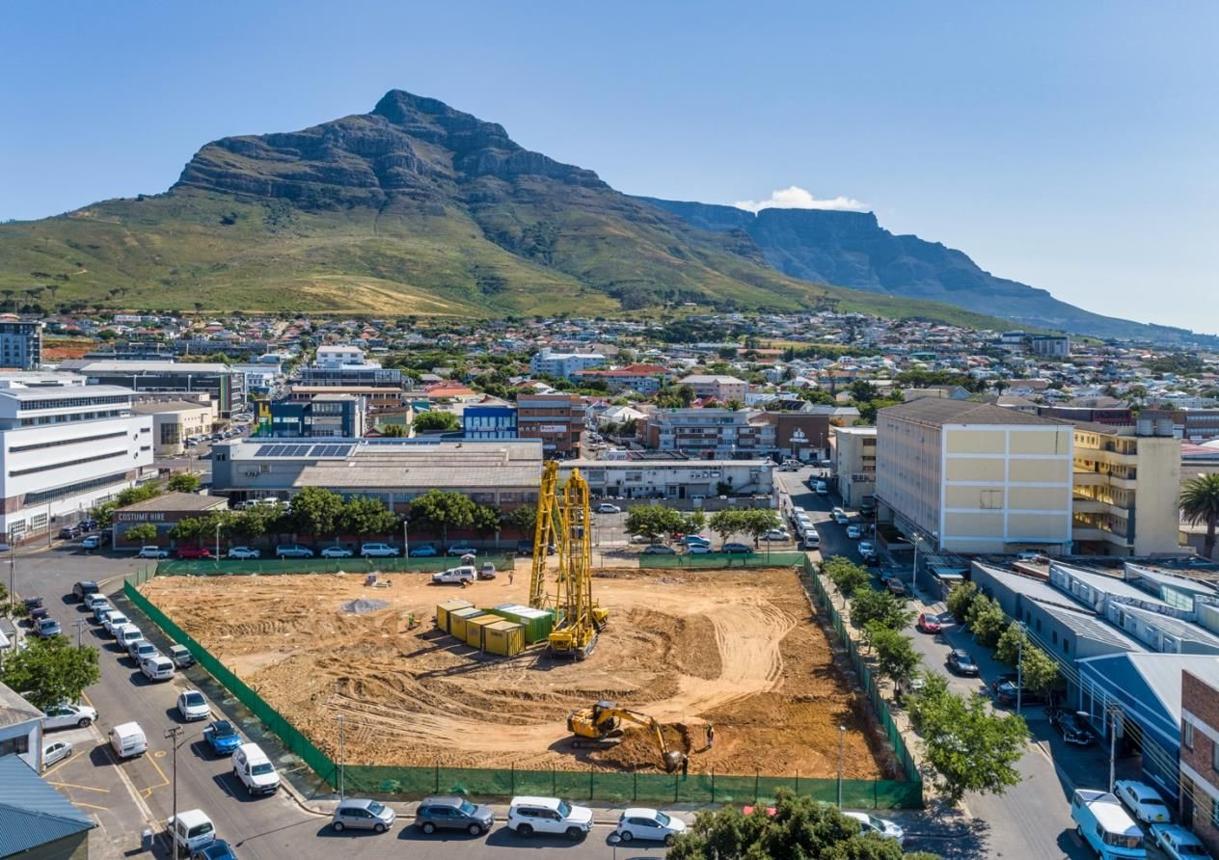
“A delay in finalising a R127-million government funding agreement is threatening the planned delivery of 300 subsidised social housing units at the Salt River Market development in Cape Town, despite demolition and preliminary construction work already being under way. The situation reflects a wider national housing delivery challenge, with 17 social housing projects involving 9,378 housing units reportedly blocked or delayed and the Social Housing Regulatory Authority estimating that approximately R1-billion is needed to address the outstanding projects.”
Funding Delays Threaten Cape Town Social Housing Development as 9,378 Units Face National Construction Challenges
Introduction: A major setback for affordable housing development
South Africa’s affordable housing development sector is facing renewed pressure following revelations that government funding delays are threatening a major social housing project in Salt River, Cape Town. The proposed development, which is expected to deliver 300 subsidised rental housing units, has encountered uncertainty despite the approval of R127 million in funding by the Social Housing Regulatory Authority (SHRA).
The development is particularly important because it aims to provide accommodation for lower-income households in an established urban area where access to affordable rental properties remains a significant challenge. However, the failure to finalise the funding agreement has raised concerns about whether the subsidised housing component can proceed as originally planned.
The issue extends beyond Cape Town. According to information presented by the SHRA to Parliament, 17 social housing projects involving 9,378 units across South Africa are currently blocked or delayed. The authority estimates that approximately R1-billion will be required to address the outstanding project challenges.
The situation highlights the difficulties facing South Africa’s property development industry, particularly projects that depend on cooperation between government institutions, municipalities, social housing organisations and private-sector construction partners.
The Salt River development and its importance
The Salt River Market property has been identified for social housing development for more than a decade. Its location makes it strategically important because it offers an opportunity to increase access to accommodation within Cape Town’s established urban environment.
The property was previously owned by the City of Cape Town before being released to Communicare earlier in 2026. Communicare, a social housing institution, is responsible for advancing the residential development.
The proposed project includes 300 subsidised social housing apartments intended for households earning less than R22,000 per month. These units are designed to address the accommodation needs of people who may struggle to afford market-related rental properties but do not necessarily qualify for traditional fully subsidised housing programmes.
In addition to the subsidised units, the development is expected to include another 670 apartments without state subsidies. These homes are intended for households earning up to R34,400 per month.
Consequently, the overall development has the potential to deliver 970 residential units, creating a substantial new rental housing opportunity in Salt River.
The combination of subsidised and non-subsidised accommodation is significant because it allows a single development to serve households across different income categories. It also creates an opportunity to establish a more financially sustainable residential project while contributing to the broader objective of inclusive urban development.
R127-million funding agreement remains unresolved
The central challenge concerns the R127-million grant approved by the SHRA council in October 2025.
Although the funding was approved, the final grant agreement has not been signed. Communicare CEO Anthea Houston indicated that a draft agreement was finalised in December 2025, but the process subsequently failed to progress.
This delay creates uncertainty for the development because the subsidised housing component depends on the government contribution to achieve the intended rental affordability.
Communicare has already committed R40-million of its own funding towards the project. Nevertheless, the organisation cannot simply assume that its contribution will replace the outstanding government grant without changing the project’s financial structure.
If the funding does not materialise, the organisation may have to reconsider the development and proceed with non-subsidised affordable rental accommodation instead.
Such a change could significantly affect the households originally expected to benefit from the subsidised units.
The concern is that lower-income families could find themselves excluded if rental prices increase beyond their financial capacity.
For property developers, this situation demonstrates how funding uncertainty can undermine project planning, particularly when developments depend on blended financing arrangements.
Construction preparations continue despite uncertainty
Despite the funding challenges, physical preparations at the Salt River site have already started.
Demolition and earthworks commenced in October 2026, demonstrating that the development has moved beyond the initial planning stages.
According to the reported construction programme, the demolition contractor is expected to leave the site before the end of 2026. A piling contractor is scheduled to take over in January 2027, followed by the appointment of the main construction contractor in early March 2027.
The main construction phase is expected to take approximately two years.
These milestones demonstrate the importance of coordinating construction schedules with financial approvals. When funding agreements remain unresolved, developers face the possibility of increased costs, changes to procurement arrangements and adjustments to project delivery timelines.
The longer the uncertainty continues, the more difficult it may become to maintain the original development budget.
This is particularly relevant in South Africa’s construction environment, where building materials, labour, equipment, financing and professional services contribute significantly to overall project costs.
A delayed project may therefore become more expensive even when the original design and number of housing units remain unchanged.
National housing development crisis raises further concerns
The Salt River project is part of a much larger challenge affecting social housing delivery across South Africa.
The SHRA reported that 17 developments involving 9,378 housing units were blocked or delayed nationally.
These projects form part of an overall SHRA portfolio comprising 65 projects and 32,016 housing units.
The difference between the total portfolio and the delayed developments demonstrates the scale of the authority’s responsibilities and the importance of improving project implementation.
The SHRA has indicated that it wants the affected projects resolved by December 2028. Possible outcomes include completing and occupying the developments, transferring them to capable institutions or formally terminating projects that cannot be recovered.
The authority estimates that approximately R1-billion will be needed to address the outstanding challenges.
This is an important indication that South Africa’s housing development problems are not limited to a shortage of construction sites or property investment opportunities. Financial administration, institutional capacity and project management also influence whether planned homes eventually become available to residents.
The authority has also acknowledged that construction cost increases following the COVID-19 pandemic contributed to difficulties across several projects.
In some cases, funding was reportedly released before projects had reached sufficient levels of readiness.
These challenges underline the need for stronger feasibility assessments and more effective coordination before construction projects receive financial approval.
Government funding and affordability remain closely connected
One of the most important lessons from the Salt River development is the relationship between government subsidies and affordable rental prices.
Social housing projects often require more than conventional private-sector investment because their primary objective is not simply to generate commercial returns.
They must also provide accommodation at rental levels that households with limited incomes can reasonably afford.
Government grants can help bridge the gap between construction costs, financing requirements and the rental income that qualifying tenants can pay.
Without that support, developers may need to charge higher rents to cover the cost of developing and maintaining residential properties.
Cape Town’s Mayoral Committee member for Human Settlements, Carl Pophaim, explained that these developments rely on substantial land discounts and SHRA grants.
The municipality may continue offering discounted land, but the absence of the grant would weaken the affordability structure.
This creates an important policy question: how can municipalities and national government ensure that well-located residential developments remain accessible to lower-income residents?
The Salt River example demonstrates that providing land alone is not necessarily enough. Funding commitments must also be translated into signed agreements and reliable financial support.
Implications for property developers and investors
The funding uncertainty has implications for organisations operating throughout South Africa’s property development industry.
Developers considering social housing projects must evaluate the reliability of funding sources, the financial strength of their partners and the risks associated with lengthy approval processes.
A project can have a suitable location, strong housing demand and an experienced development organisation but still encounter difficulties when essential funding is unavailable.
For investors, this highlights the importance of evaluating the complete financial structure of a residential development rather than focusing exclusively on projected rental income or property demand.
Construction contractors may also face uncertainty when project schedules depend on government funding decisions.
Delays can affect procurement, workforce planning, material orders and contractual commitments.
For municipalities, stalled developments can represent missed opportunities to use publicly owned land to address housing shortages and encourage more inclusive urban growth.
Consequently, improving the delivery of social housing projects could benefit several parts of the property industry simultaneously.
The importance of institutional accountability
The delays have also raised questions about institutional coordination.
The SHRA indicated that the process falls within the responsibility of the National Department of Human Settlements and that it could not communicate outcomes or timelines on the department’s behalf.
The department referred questions back to the SHRA.
This exchange illustrates how unclear communication between public institutions can make it difficult for development organisations to obtain definitive answers about funding decisions.
The issue is particularly concerning when a project has already received approval and preliminary construction activities have begun.
Clear accountability is essential because developers need reliable information to make financial and operational decisions.
The SHRA has recommended limiting or suspending new project approvals in certain circumstances while redirecting available capital funding towards recovering delayed developments.
This approach could help ensure that existing commitments receive attention before additional projects place further pressure on limited resources.
The authority’s leadership challenges have also contributed to wider concerns about its operational stability. Its chief executive returned to the organisation on 16 November 2026 following a CCMA arbitration award, after a period involving acting leadership arrangements.
Restoring institutional stability and strengthening administrative processes will be important for improving confidence among housing partners.
What the development means for Cape Town residents
For residents, the most immediate concern is whether the planned 300 subsidised units will eventually become available at the intended rental levels.
Salt River’s established location makes the project important for households seeking access to urban opportunities.
Affordable accommodation in established neighbourhoods can help residents remain closer to employment opportunities, public transport, education, healthcare and commercial facilities.
However, when subsidised developments fail to materialise, households may have to consider more distant locations or spend a greater proportion of their income on accommodation.
The proposed 970-unit development could therefore make a meaningful contribution to the local rental housing market if all components proceed as intended.
The challenge is to ensure that financial difficulties do not undermine the original social objectives.
Outlook: Funding certainty will determine the project’s future
The future of the Salt River social housing development will depend significantly on whether the outstanding R127-million funding agreement is finalised.
The continued progress of demolition and earthworks offers some evidence of project activity, but the subsidised housing component remains financially uncertain.
The planned construction programme provides an important framework for moving the development forward in 2027. Nevertheless, funding certainty is essential to maintaining the original affordability commitments.
At national level, the estimated R1-billion recovery requirement for delayed social housing projects presents a significant challenge for government and the SHRA.
Addressing the problem will require stronger project preparation, more effective financial administration, transparent communication and closer cooperation between public institutions and development organisations.
Conclusion
The Salt River development illustrates both the opportunities and challenges facing South Africa’s real estate development sector. Its proposed 970 apartments could contribute to Cape Town’s affordable rental housing supply, but the unresolved government grant threatens the delivery of the 300 subsidised units.
More broadly, the 9,378 delayed or blocked social housing units demonstrate the need to strengthen the institutions and financing mechanisms responsible for turning housing plans into completed residential developments.
For South Africa, the priority must be ensuring that approved projects receive timely funding, construction programmes remain financially viable and affordable housing commitments translate into actual homes for residents.



