




“South African property giant Growthpoint Properties is accelerating its property portfolio restructuring, having sold and transferred 11 properties worth R832 million during the first quarter of its 2027 financial year, while projecting total disposals of approximately R2.8 billion for the full year. The company plans to redirect capital towards modern logistics facilities, retail developments and strategically located properties, with approximately R2 billion allocated to development and capital expenditure in its South African portfolio.”
Growthpoint’s R2.8 Billion Property Investment Strategy Signals a New Direction for South Africa’s Real Estate Market
A major restructuring of South Africa’s property investment landscape
South Africa’s real estate investment sector is entering an important period of strategic repositioning as major property companies reassess their portfolios, identify stronger investment opportunities and redirect capital towards assets with better long-term income potential. One of the most significant developments reported on 26 November 2026 concerns Growthpoint Properties, which has announced plans to dispose of approximately R2.8 billion worth of property assets during its 2027 financial year.
The announcement represents an important development for institutional investors, property developers, commercial landlords and individuals interested in the South African property market. Rather than simply expanding its portfolio by acquiring additional buildings, Growthpoint is pursuing a strategy that involves selling older or less competitive properties and reinvesting capital in modern developments and strategically positioned real estate assets.
The company had already sold and transferred 11 properties worth R832 million during the first quarter of its financial year. This progress places it on course to exceed its original R2 billion disposal target, with the revised projection increasing to R2.8 billion.
The development highlights an important investment principle: successful property investment is not necessarily about owning the largest possible number of properties. Instead, it involves selecting assets that can generate sustainable rental income, maintain occupancy, attract reliable tenants and preserve their value over time.
Growthpoint’s R2.8 billion disposal programme
Growthpoint’s property disposal programme forms part of its wider portfolio optimisation strategy. The company is reviewing the performance and competitiveness of its existing assets to determine which properties should remain within its investment portfolio and which should be sold.
According to its November 26 investor update, the company completed the sale and transfer of 11 properties during the first quarter, generating R832 million.
Its projected R2.8 billion disposal programme represents a substantial increase from the original R2 billion target established for the financial year ending June 2027.
This approach allows the company to release capital tied up in properties that may no longer offer attractive growth opportunities. The proceeds can then support investment in modern buildings, redevelopment projects and property developments located in areas experiencing economic and commercial expansion.
However, property disposals do not automatically translate into higher profits. Growthpoint has acknowledged that selling properties before identifying and completing replacement investments could temporarily reduce distributable earnings. This is particularly relevant when assets are sold at yields higher than the company’s current borrowing costs.
Consequently, the timing of disposals and reinvestment decisions will be important in determining the financial benefits of the programme.
For investors, the central question will be whether the properties acquired or developed using released capital can eventually generate stronger and more sustainable income than the properties sold.
R2 billion investment in South African property development
Alongside its disposal programme, Growthpoint is targeting approximately R2 billion in development and capital expenditure within its core South African portfolio during FY2027.
This allocation demonstrates that the company is not withdrawing from the local property market. Instead, it is attempting to improve the quality and competitiveness of its investments.
Its priorities include modern logistics facilities, retail properties in growing economic areas and competitive mixed-use developments.
During the first quarter, development and capital expenditure, including tenant installations and developments, amounted to R429.5 million across the South African portfolio.
Major projects included:
-
Indlovu Logistics Park in Montague Gardens, Cape Town, receiving R66.8 million.
-
Olympus in Sandown, Johannesburg, receiving R45.2 million.
-
Cornubia in Durban, receiving R38.6 million.
-
Chain Avenue in Montague Gardens, Cape Town, receiving R25.1 million.
-
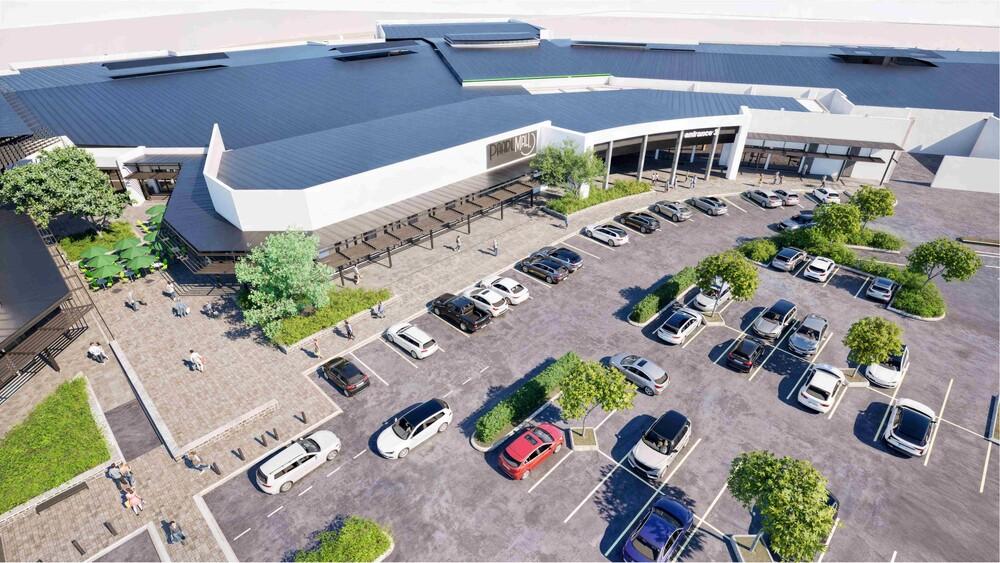
Paarl Mall redevelopment in Paarl, receiving R71.6 million during the quarter.
These investments demonstrate how capital is being directed towards different property categories rather than concentrated in one geographical market or property type.
Logistics and industrial property attract investment attention
One of the most encouraging aspects of Growthpoint’s latest update is the performance of its logistics and industrial property portfolio.
Industrial and logistics properties have become increasingly important to commercial property investors because they support distribution networks, manufacturing operations, storage, transportation and the growing requirements of modern businesses.
South Africa’s strategic position as an important regional trade and distribution market creates opportunities for well-located industrial developments.
Facilities located near major highways, ports, airports, manufacturing centres and distribution networks can provide significant advantages to tenants.
Growthpoint reported that its logistics and industrial portfolio remained its strongest-performing property sector during the first quarter.
Performance was supported by improved leasing indicators, stronger tenant retention, positive rental renewal growth and higher lease escalation rates.
Although some vacancies and arrears remained areas requiring attention, the overall operating environment in this sector was more encouraging than in certain other property categories.
For investors, these developments reinforce the importance of considering tenant demand and the economic function of a property before committing capital.
An industrial building with modern infrastructure, convenient transportation access and reliable tenants may offer different income characteristics from an older office property facing declining demand.
Nevertheless, industrial property investment also carries risks, including construction costs, tenant concentration, maintenance expenditure and the possibility of oversupply in particular locations.
Retail property investment faces changing consumer conditions
Retail remains another important component of Growthpoint’s investment portfolio. However, its first-quarter update showed that the sector continues to experience uneven trading conditions.
The company reported healthy tenant retention and largely maintained contractual rental escalations. Nevertheless, higher vacancies, weaker rental renewal growth, reduced trading density growth and lower customer footfall created pressure.
Retail property performance is closely connected to household spending, employment conditions, consumer confidence and the financial health of tenants.
When consumers reduce discretionary spending, retailers can experience weaker sales. This may affect their ability to meet rental obligations and renew leases on favourable terms.
These conditions make shopping centre investment more complicated because investors must consider more than the physical quality of a property.
They must also evaluate the surrounding population, household income levels, competing retail developments, accessibility, tenant mix and the centre’s ability to attract customers.
Growthpoint is responding through portfolio management and redevelopment.
The company has continued with upgrades at several shopping centres, including Paarl Mall, Walmer Park and Greenacres.
The redevelopment of Paarl Mall was a particularly important project. The R263 million investment increased its gross lettable area by more than 3,000 square metres and introduced new retail brands, including H&M and Country Road.
These improvements are intended to strengthen the centre’s competitiveness and support its long-term rental income potential.
The strategic importance of the V&A Waterfront
Another important element of Growthpoint’s investment strategy is its exposure to the V&A Waterfront in Cape Town.
The property remains one of the company’s highest-quality income sources and is expected to contribute meaningfully to its medium- and long-term growth.
The Waterfront is an important commercial, tourism, hospitality, entertainment and retail destination. Its appeal comes from its location, established reputation, visitor activity and combination of different property-related businesses.
For real estate investors, such developments demonstrate the potential benefits of owning property within established economic and tourism destinations.
Unlike a conventional single-purpose building, a mixed-use destination can attract different categories of customers and tenants.
Retail businesses, hotels, restaurants, offices and leisure operators can contribute to a broader income-generating environment.
However, tourism-related investments remain exposed to changes in travel demand, operating costs, consumer spending and economic conditions.
Growthpoint’s intention to maintain the Waterfront as a core investment suggests that it sees considerable long-term value in the asset and its development pipeline.
Office property investment shows signs of stabilisation
The South African office property market has experienced considerable changes as businesses reconsider their workplace requirements and property costs.
Growthpoint’s latest update indicates that the office sector is showing signs of stabilisation.
Overall South African portfolio vacancies improved from 7.2% to 7.1% during the first quarter, supported mainly by new office lettings.
However, the improvement should be interpreted carefully.
Office vacancies, tenant retention, rental reversions and outstanding rental payments remain important considerations for commercial property owners.
Regional differences are also significant.
Growthpoint reported positive rental growth in the Western Cape, while its Gauteng portfolio continued to experience pressure from negative rental reversions and weaker tenant retention.
These developments demonstrate why investors should avoid treating the entire South African office market as one uniform investment opportunity.
An office property in a well-connected business district with modern facilities and reliable tenants may perform differently from an older building in an area experiencing weaker demand.
Investors should therefore assess each property’s location, condition, accessibility, operating expenses and tenant profile.
What the investment strategy means for South African investors
Growthpoint’s announcement provides several important lessons for investors considering South African real estate.
First, portfolio quality matters. Investors should evaluate the long-term income-generating capacity of properties rather than focusing exclusively on acquisition prices or the number of buildings owned.
Second, location remains essential. Industrial facilities near distribution routes, retail centres in growing communities and offices in established commercial districts may have different opportunities and risks.
Third, property redevelopment can create investment value. Improving an existing asset may increase its attractiveness to tenants, strengthen occupancy and support rental growth.
Fourth, investors must consider financing costs. Property assets are capital-intensive, and interest rates can influence borrowing costs, development feasibility and investment returns.
Finally, diversification remains important. Investors who concentrate their capital in one property category or geographical area may face greater exposure to sector-specific economic pressures.
Growthpoint’s strategy of reallocating capital between different assets illustrates how major institutional investors approach these considerations.
Financial outlook and shareholder considerations
Despite the changing investment environment, Growthpoint maintained its full-year FY2027 guidance.
The company expects distributable income per share to grow by between 1% and 3%.
This is an important measure for property investors because distributable income provides an indication of the recurring income available to support distributions to shareholders.
However, the expected growth remains modest and reflects the need to manage operating conditions, financing costs and portfolio restructuring.
The company’s next important financial milestone will be its half-year results, scheduled for 10 March 2027.
Investors will be watching the progress of property disposals, development expenditure, vacancies, rental growth and the contribution of newly completed projects.
The extent to which the company successfully reinvests disposal proceeds will be particularly important.
If replacement investments generate attractive income and improve the overall quality of the portfolio, the strategy could strengthen long-term performance.
If reinvestment takes longer than expected, temporary income pressure could become more noticeable.
Risks and opportunities in South Africa’s property investment market
Although Growthpoint’s announcement demonstrates continued investment activity, South Africa’s real estate market still faces several challenges.
Consumer affordability, economic growth, interest rates, municipal infrastructure, electricity costs and construction expenses can all influence property performance.
For developers, delays in obtaining approvals and connecting essential services can increase project costs.
For landlords, weak tenant finances can lead to rental arrears, vacancies and expensive lease incentives.
For investors, changing market conditions can affect property valuations and the ability to sell assets at attractive prices.
Nevertheless, opportunities remain in well-selected logistics developments, modern retail centres, mixed-use precincts and strategically located commercial buildings.
The strongest investment opportunities are likely to be those supported by demonstrable tenant demand, sustainable operating costs and realistic long-term financial projections.
Investors should also distinguish between announced investment budgets and completed projects. Capital expenditure targets do not guarantee successful developments or predetermined investment returns.
Conclusion: A significant development for South Africa’s property investment industry
Growthpoint Properties’ projected R2.8 billion property disposal programme is one of the most significant South African real estate investment developments reported on 26 November 2026.
The strategy demonstrates how a major property investor is seeking to improve portfolio quality by selling selected assets while directing substantial capital towards modern logistics facilities, retail redevelopment and strategically positioned property investments.
Its R2 billion South African development and capital expenditure target further demonstrates continued confidence in selected local property opportunities.
However, the company’s performance will depend on successful asset disposals, disciplined reinvestment, tenant demand, rental growth and the management of financing costs.
For the wider South African property market, the announcement highlights an important shift towards selective investment, asset optimisation and sustainable income generation.
The central message for property investors is clear: future opportunities will depend not simply on owning real estate, but on owning the right real estate in locations where businesses, households and economic activity can support long-term property demand.



