




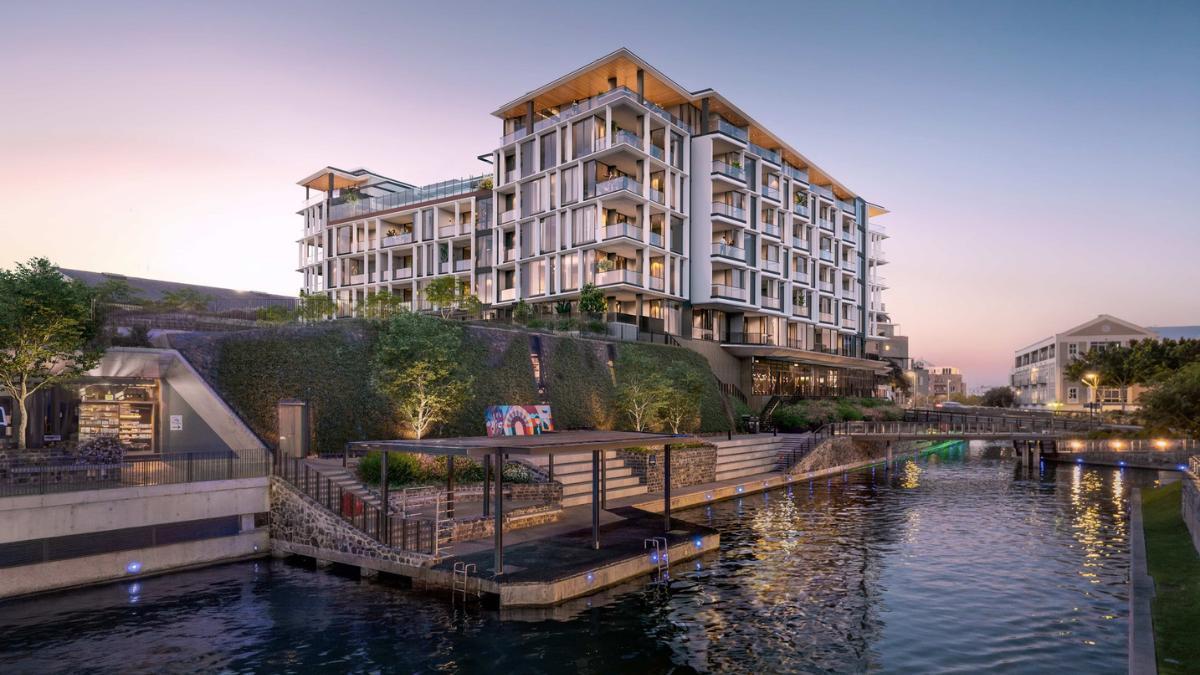
“Growthpoint Properties, which owns a stake in Cape Town’s prestigious V&A Waterfront, expects to dispose of approximately R2.8 billion in property assets during its 2027 financial year as it restructures its investment portfolio and redirects capital towards modern logistics and retail developments. Despite these disposals, the company identifies the V&A Waterfront as one of its highest-quality income-generating investments, reinforcing the importance of premium, strategically located property assets in South Africa’s real estate sector.”
Growthpoint’s R2.8 Billion Property Restructuring Highlights the Strategic Importance of South Africa’s Premium Real Estate Market
South Africa’s luxury property sector remains strategically important
South Africa’s property industry is entering another period of strategic repositioning as major property investment companies reconsider their portfolios, dispose of selected assets and direct capital towards developments with stronger long-term potential. One of the latest developments is Growthpoint Properties’ announcement that it expects to sell approximately R2.8 billion worth of property assets during its 2027 financial year.
The announcement, published on 26 November 2026, is particularly relevant to South Africa’s premium real estate sector because Growthpoint has identified Cape Town’s V&A Waterfront as one of its highest-quality income-generating investments. Although the planned disposals do not represent a sale of the iconic waterfront development, they demonstrate the importance of protecting and strengthening valuable property investments in an increasingly competitive real estate environment.
According to the company’s latest financial update, Growthpoint has already disposed of 11 properties during the first quarter of its 2027 financial year. These transactions had a combined value of R832 million. The company had previously targeted more than R2 billion in disposals but now expects the total to reach approximately R2.8 billion.
This development provides an important indication of how large property investment companies are adjusting their portfolios to respond to changing market conditions, investment opportunities and financial priorities.
Growthpoint’s R2.8 billion disposal strategy
Growthpoint’s planned property disposals form part of a broader strategy to reposition its real estate portfolio. Rather than maintaining every property within its investment collection, the company is reviewing its assets and considering how capital can be redeployed into sectors offering attractive development and income opportunities.
The expected R2.8 billion in disposals represents a substantial property transaction programme. It also illustrates the scale of capital movement taking place within South Africa’s commercial property industry.
Property disposals can serve several strategic purposes. Companies may sell properties to reduce debt, improve liquidity, finance new developments or concentrate investment on assets that better support their long-term objectives.
However, selling income-producing properties can also affect earnings. Growthpoint acknowledged that disposals completed before replacement investments generate income could temporarily dilute distributable earnings, particularly where the properties sold produce returns higher than the company’s current borrowing costs.
Consequently, the success of this strategy will depend partly on how efficiently the company redeploys its capital.
For investors, the important consideration is not simply the value of properties sold but also the quality of replacement investments and their contribution to sustainable future earnings.
Why the V&A Waterfront remains strategically valuable
One of the most significant aspects of Growthpoint’s announcement concerns its positive outlook for the V&A Waterfront.
Situated in Cape Town, the V&A Waterfront is among South Africa’s most recognisable premium property and tourism destinations. Its combination of retail facilities, hospitality businesses, restaurants, entertainment attractions, commercial premises and waterfront infrastructure gives it a distinctive position within the national property market.
Unlike an ordinary commercial development, the Waterfront benefits from several interconnected sources of economic activity. Tourism supports hospitality and retail businesses, while its location attracts residents, investors, international visitors and commercial tenants.
These characteristics contribute to its investment appeal.
Growthpoint specifically described the V&A Waterfront as one of its highest-quality income sources and expects it to contribute meaningfully to growth over the medium and long term. The company also identified its development pipeline and debt leverage as factors supporting its outlook.
This statement is particularly important for investors evaluating South Africa’s premium property market. It suggests that strategically located developments with multiple income streams can remain valuable components of major property portfolios even when companies are disposing of other assets.
Implications for Cape Town’s luxury property market
Cape Town has established itself as one of Africa’s most attractive destinations for high-end residential property investment.
Its coastal location, international airport connectivity, tourism industry, lifestyle attractions and established premium neighbourhoods have contributed to demand for luxury apartments, exclusive homes and prestigious developments.
The V&A Waterfront occupies a particularly interesting position within this market because it connects luxury accommodation, premium shopping, hospitality and waterfront living.
Recent transactions demonstrate the strength of the city’s upper property market. A separate report published on 16 November 2026 highlighted a R60 million apartment transaction at the V&A Waterfront and substantial activity across the Atlantic Seaboard and City Bowl.
Real Estate Investor Magazine
These developments illustrate how premium properties can attract substantial investment even when other parts of the residential market experience affordability pressures.
However, luxury real estate performance should not be measured exclusively through headline transactions. Rental demand, maintenance costs, operating expenses, property management, financing conditions and resale liquidity are equally important considerations.
For investors, the ability of a premium development to generate consistent income can be just as important as the potential appreciation of its market value.
Capital expenditure and the future of property development
Alongside its disposals, Growthpoint plans approximately R2 billion in development and capital expenditure across its core South African portfolio during the 2027 financial year.
The company intends to focus particularly on modern logistics and retail assets in growing economic locations.
Its announced projects include developments in Montague Gardens in Cape Town, Sandown in Johannesburg and Cornubia in Durban. It is also undertaking retail redevelopment projects, including the Paarl Mall upgrade.
The Paarl Mall redevelopment involved approximately R263 million over nine months and increased the centre’s gross lettable area by more than 3,000 square metres. The expanded centre also introduced retailers including H&M and Country Road.
Although these developments are not exclusively luxury residential projects, they demonstrate how capital investment is being used to improve the quality and competitiveness of South African property assets.
BusinessTech
The broader lesson for luxury developers is that successful property investment requires more than attractive architecture. Location, infrastructure, accessibility, tenant quality, security and long-term operational performance all influence the sustainability of premium developments.
International investment and premium property demand
International interest remains an important consideration in South Africa’s luxury residential market.
Cape Town attracts overseas buyers who value its coastal environment, lifestyle opportunities and comparatively attractive property prices relative to several established international luxury markets.
The V&A Waterfront benefits from this international visibility because it is closely associated with Cape Town’s tourism and investment identity.
International purchasers may consider waterfront apartments, luxury holiday accommodation and residential properties as lifestyle investments. However, buying decisions are influenced by currency movements, financing arrangements, taxation, legal requirements and confidence in the local economy.
The continued development of premium destinations can strengthen the attractiveness of South Africa as an investment location.
Nevertheless, international demand should not be interpreted as guaranteed price appreciation. Property investors must assess individual developments, ownership costs, rental conditions and future resale opportunities before committing capital.
Economic conditions and property investment decisions
South Africa’s property industry operates within a wider economic environment shaped by interest rates, inflation, consumer spending, employment and business confidence.
These factors influence both commercial and residential property performance.
For luxury homeowners, higher borrowing costs can affect purchasing decisions, particularly when acquiring expensive properties that require substantial financing.
For developers, financing costs influence construction budgets, project feasibility and expected returns.
Commercial property companies face additional considerations, including tenant retention, rental growth, vacancies and operating expenses.
Growthpoint reported that vacancies across its South African portfolio declined slightly from 7.2% to 7.1% during the first quarter of its 2027 financial year.
However, its retail performance remained mixed, with higher vacancies, weaker trading density growth and lower footfall in some areas.
These figures demonstrate why property investment companies must continuously review their assets and adapt to changing market conditions.
For luxury property investors, the same principles apply. Premium buildings must remain attractive to buyers, tenants and visitors while maintaining appropriate operational standards.
The importance of premium developments to South Africa
South Africa’s luxury property sector contributes to several interconnected economic activities.
High-value residential developments support construction employment, professional property services, architecture, engineering, interior design, landscaping and facilities management.
They also generate demand for security services, hospitality, retail businesses and specialist maintenance providers.
Premium destinations such as the V&A Waterfront demonstrate how different property-related industries can operate together within one location.
For Cape Town, these developments also contribute to the city’s international reputation as a destination for tourism, investment and high-end residential living.
However, the expansion of luxury property must be considered alongside broader housing challenges.
Rising property prices can make established neighbourhoods increasingly inaccessible to ordinary households. Development decisions therefore need to consider infrastructure capacity, transport accessibility, environmental sustainability and the relationship between premium investment and inclusive urban development.
A healthy property sector requires opportunities across different income groups, rather than growth concentrated exclusively in the luxury segment.
What property investors should watch next
Growthpoint’s latest announcement creates several important issues for property investors to monitor.
First, investors will want to establish which properties are included in the remaining disposals and whether the company achieves its R2.8 billion target.
Second, attention will turn to how effectively the proceeds are reinvested into logistics, retail and other strategic developments.
Third, the performance of the V&A Waterfront will remain important because Growthpoint expects the development to contribute meaningfully to medium- and long-term growth.
Finally, investors should monitor vacancy rates, rental performance, development expenditure and financing conditions.
For prospective luxury residential buyers, Cape Town remains an important market to investigate, particularly in established coastal locations and developments offering security, accessibility and strong lifestyle amenities.
However, every investment should be evaluated individually, with independent property valuations and appropriate legal and financial due diligence.
Conclusion: A significant development for South Africa’s property investment landscape
Growthpoint’s projected R2.8 billion in property disposals represents an important development in South Africa’s real estate industry.
The announcement highlights how major property investment companies are restructuring their portfolios, selling selected assets and directing capital towards developments they consider strategically important.
For the luxury real estate market, the most notable element is Growthpoint’s continued confidence in the V&A Waterfront as a high-quality income-generating investment.
The Waterfront’s combination of retail, tourism, hospitality and premium property opportunities illustrates the potential value of established mixed-use destinations.
Although the latest announcement does not confirm a new luxury residential development or a sale of the Waterfront itself, it provides valuable insight into the investment priorities shaping South Africa’s premium property environment.
Ultimately, the long-term performance of the luxury property sector will depend on the quality of developments, financial discipline, infrastructure, investor confidence and sustainable demand.
As Growthpoint implements its restructuring strategy, the performance of its retained assets and its ability to redeploy capital successfully will be important indicators of the direction of South Africa’s wider property investment market.



