




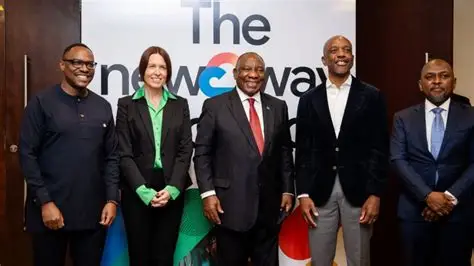
“Google has unveiled Africa’s first Digital Exchange Port in South Africa’s Eastern Cape, a high-capacity AI-powered hub designed to integrate subsea cables, ISPs, and cloud platforms. This landmark project is expected to revolutionize connectivity, accelerate AI adoption, and strengthen South Africa’s role as a digital gateway for the continent.”
South Africa has taken a historic leap in artificial intelligence and digital infrastructure with Google’s announcement of Africa’s first Digital Exchange Port (DEP) in the Eastern Cape. This facility, powered by advanced AI systems, is designed to serve as a continental gateway, linking subsea cables, internet service providers (ISPs), and cloud platforms into a unified ecosystem. The development marks a turning point in Africa’s digital transformation, promising to reshape connectivity, commerce, and innovation across the region.
Strategic Importance
The DEP is not just a technical installation—it represents a strategic investment in Africa’s digital future. By consolidating subsea cable traffic and optimizing data routing through AI-driven systems, the hub will reduce latency, improve bandwidth efficiency, and lower costs for ISPs. This is particularly significant for South Africa, which has long struggled with uneven internet access and high data prices compared to global standards.
AI Integration
Unlike traditional exchange ports, Google’s DEP leverages machine learning algorithms to dynamically manage traffic flows. These AI systems can predict demand spikes, reroute data to avoid congestion, and optimize energy consumption. This ensures not only faster internet speeds but also a more sustainable infrastructure model.
Economic Impact
The project is expected to generate thousands of jobs during construction and operation, while also attracting foreign investment in cloud services, fintech, and AI startups. Analysts predict that the DEP could add billions of rand to South Africa’s GDP over the next decade by enabling industries such as mining, healthcare, and finance to adopt AI-driven solutions more effectively.
Regional Connectivity
South Africa’s DEP will serve as a continental hub, linking countries across Southern and Eastern Africa to global networks. This will reduce reliance on European exchange points and strengthen Africa’s digital sovereignty. For Uganda, Kenya, and Tanzania, the hub promises faster access to cloud services and AI platforms, boosting regional competitiveness.
Political and Policy Dimensions
The South African government has hailed the project as a milestone in digital governance, aligning with its national AI strategy. Policymakers emphasize that the DEP will support initiatives in education, healthcare, and smart cities, while also raising questions about data privacy, cybersecurity, and equitable access.
Challenges and Risks
Despite its promise, the DEP faces challenges. Cybersecurity threats remain a major concern, as AI-driven infrastructure could become a target for sophisticated attacks. Additionally, there are fears that rural communities may not benefit equally, reinforcing existing digital divides. Policymakers must ensure inclusive access and robust regulatory frameworks to mitigate these risks.
Global Context
Google’s investment in South Africa reflects a broader trend of Big Tech expanding into emerging markets. Africa, with its young population and growing digital economy, is seen as the next frontier for AI adoption. The DEP positions South Africa as a leader in this transformation, comparable to Singapore’s role in Asia or Dubai’s in the Middle East.
Expert Perspectives
Industry experts argue that the DEP could accelerate AI adoption in critical sectors. In healthcare, AI-powered diagnostics could become more accessible through cloud platforms. In mining, predictive analytics could improve safety and efficiency. In education, AI-driven platforms could democratize access to quality learning resources.
Conclusion
Google’s Digital Exchange Port in South Africa is more than an infrastructure project—it is a symbol of Africa’s digital awakening. By harnessing AI to optimize connectivity, the hub promises to transform economies, empower communities, and redefine Africa’s place in the global digital order. The coming years will reveal whether policymakers, businesses, and citizens can fully leverage this opportunity to build a more inclusive and innovative future.



