




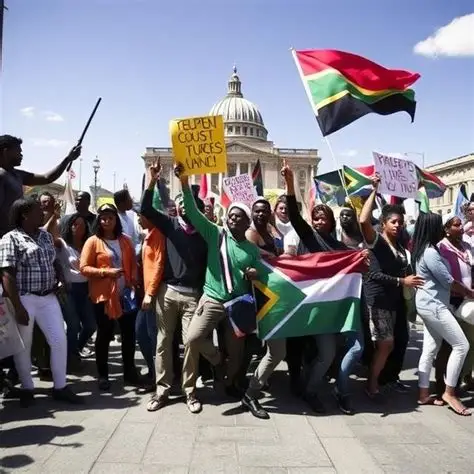
“Jacinta Ngobese-Zuma, leader of the March and March movement, has dismissed claims that the July 30 Limpopo protest was cancelled, asserting that the demonstration will proceed as planned. The controversy underscores the struggle between grassroots activism and misinformation, as media personality Ngizwe Mchunu attempted to undermine the movement’s authority.”
South Africa’s political landscape continues to be shaped by grassroots activism, with the March and March movement at the forefront of mobilizing communities around issues of economic justice, governance, and accountability. On July 30, 2026, the movement’s planned protest in Limpopo became the subject of heated debate after rumors circulated online suggesting the march had been cancelled. Jacinta Ngobese-Zuma, the movement’s leader, swiftly denied these claims, reaffirming the group’s commitment to demonstrating despite attempts to delegitimize their efforts.
Background of the Movement
The March and March movement was founded by Ngobese-Zuma as a platform for ordinary South Africans to voice frustrations over unemployment, inequality, and corruption. Rooted in the tradition of civic protest, the group has organized demonstrations across multiple provinces, often drawing significant crowds. Its guiding principle is persistence: to continue marching until tangible social and economic reforms are achieved.
The Cancellation Rumors
On July 28, graphics circulated online showing official promotional material for the Limpopo march stamped with “FAKE/CANCELLED.” These posts quickly gained traction, sowing confusion among supporters. Ngobese-Zuma responded via X (formerly Twitter), stating unequivocally: “We definitely have not cancelled our Thursday March in Limpopo.” Her post garnered nearly 10,000 views within hours, reflecting both the movement’s reach and the urgency of clarifying misinformation.
Ngizwe Mchunu’s Role
Media personality Ngizwe Mchunu was identified as the source of the cancellation claims. According to movement representative Sandile Dube, Mchunu has no official role within March and March and lacks authority to cancel its activities. Dube emphasized that Ngobese-Zuma founded the movement and that its legitimacy rests on collective action, not individual agendas. The leadership expressed surprise at Mchunu’s public comments, which contradicted official communications and risked undermining the credibility of grassroots activism.
Significance of the Limpopo March
The Limpopo protest carries symbolic weight. Critics had previously suggested that March and March would never demonstrate in the province, but Ngobese-Zuma framed the event as a direct rebuttal to such claims. Scheduled to begin at 08:00 from SARS Park in Polokwane, the march is expected to draw participants from across the province and beyond. Additional demonstrations are planned in Tshwane and the North West, underscoring the movement’s national scope.
Activism vs. Misinformation
The controversy highlights a broader challenge facing activism in South Africa: the spread of misinformation. Grassroots movements often rely on social media to mobilize supporters, but these platforms also enable the rapid dissemination of false narratives. In this case, the cancellation rumor threatened to weaken turnout and erode trust. Ngobese-Zuma’s swift response illustrates the importance of proactive communication in safeguarding activist credibility.
Broader Context of Activism in South Africa
South Africa has a long history of protest, from anti-apartheid mobilizations to contemporary demonstrations against inequality and corruption. In recent years, activism has increasingly intersected with issues of migration, housing, and employment. While movements like March and March emphasize economic justice, others have veered into xenophobic territory, sparking violence and displacement. The Limpopo protest thus exists within a complex ecosystem of activism, where legitimate grievances coexist with dangerous populist currents.
Government Response
Authorities have acknowledged the right to protest but remain wary of potential unrest. Police presence is expected at the Limpopo march, though past demonstrations have drawn criticism for inadequate enforcement. The government faces a delicate balancing act: respecting constitutional freedoms while preventing violence.
Civil Society Perspectives
Civil society organizations have praised Ngobese-Zuma’s clarity in dismissing misinformation, noting that grassroots activism plays a vital role in holding leaders accountable. At the same time, they caution against the risks of fragmentation, where competing voices and false claims can dilute collective action.
Conclusion
The July 30 Limpopo protest represents more than a single march; it is a test of resilience for South African activism. By confronting misinformation head-on, Jacinta Ngobese-Zuma has reinforced the legitimacy of grassroots mobilization and underscored the importance of unity in the face of external interference. As the march unfolds, its success will depend not only on turnout but on the movement’s ability to maintain credibility and focus amid the noise of political contestation.



