




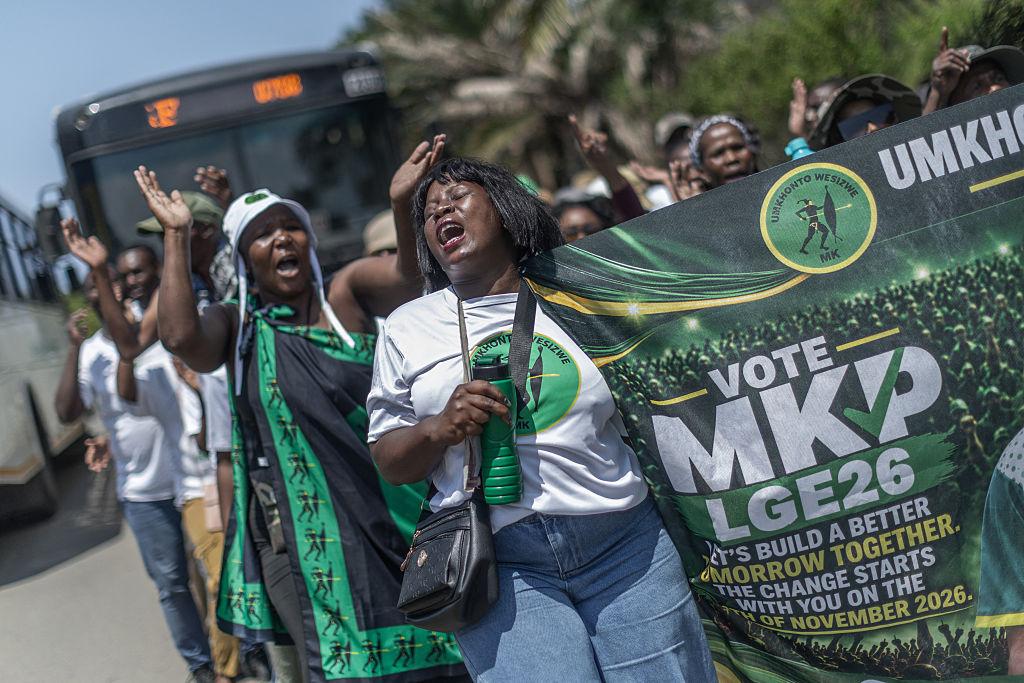
“The uMkhonto weSizwe Party (MK Party) has ruled out forming a coalition with the Democratic Alliance (DA) in Johannesburg, sharpening the contest over who will govern South Africa’s largest city following the local government elections scheduled for 4 November 2026. With the African National Congress (ANC), Economic Freedom Fighters (EFF), ActionSA and smaller parties also competing for influence, coalition negotiations could determine whether the next municipal administration achieves stability or continues the political uncertainty that has disrupted service delivery.”
Johannesburg’s Political Future Hangs on Coalition Negotiations
South Africa’s approaching local government elections are intensifying competition among political parties, with Johannesburg emerging as one of the country’s most consequential battlegrounds. The decision by the uMkhonto weSizwe Party to rule out a coalition with the Democratic Alliance has added another complication to an already crowded political contest. As parties prepare for voting on 4 November 2026, the central question is whether the next city administration can achieve the political stability required to address Johannesburg’s persistent municipal challenges.
The dispute is significant because Johannesburg is not merely another municipality. As South Africa’s largest city and a major commercial centre, it plays an important role in employment, investment, financial services and economic activity. Disruptions to municipal administration can affect households, businesses, infrastructure projects and investor confidence. Consequently, the political arrangements formed after the election could have implications extending well beyond the city itself.
The MK Party’s Coalition Position
According to reporting published on 28 October, the MK Party has made clear that it will not enter a coalition with the DA in Johannesburg. The party’s spokesperson, Sifiso Mahlangu, said that future partnerships would be considered after the election, with negotiations guided by political principles, policy compatibility and an agreed programme of government.
This position narrows the possible combinations available to parties seeking control of the municipal council. If no party secures an outright majority, elected representatives will need to negotiate with other parties to establish a governing arrangement capable of electing a mayor and passing budgets.
The MK Party has also emphasised governance priorities, including improved revenue collection, credible budgeting and stronger financial controls. These priorities indicate that coalition negotiations will involve more than deciding which party receives executive positions. The parties will also need to agree on how the city is managed, how municipal resources are allocated and how public services are improved.
Nevertheless, refusing cooperation with one major political competitor does not automatically establish which alternative coalition will emerge. The MK Party has left open the possibility of working with other parties, subject to negotiations after voters have made their choice. The composition and durability of any future alliance therefore remain uncertain.
The ANC and DA Face a Difficult Choice
The African National Congress and the Democratic Alliance remain central to the Johannesburg contest, but their political differences complicate possible cooperation.
The ANC has historically played a dominant role in South African politics, while the DA has sought to expand its support by campaigning on municipal administration, infrastructure and service delivery. Their participation in South Africa’s national Government of National Unity has demonstrated that cooperation between former political rivals is possible, although it does not guarantee agreement at municipal level.
Reuters reported on 26 October that Johannesburg was among several closely contested metropolitan areas where election outcomes could produce difficult coalition negotiations. The city had experienced seven mayors since 2021, illustrating the instability that can accompany fragmented council politics.
A potential ANC–DA coalition would require both parties to balance their public identities against the practical demands of governing. For the ANC, accepting a subordinate role in Johannesburg could be politically difficult. For the DA, cooperation with the ANC could create tensions with supporters who expect the party to offer a clear alternative to ANC governance.
However, rejecting cooperation outright could leave both parties dependent on smaller parties whose support might come with substantial political or policy demands.
The immediate challenge is therefore not simply identifying a preferred coalition partner. It is finding an arrangement that commands enough votes in council while maintaining the capacity to govern consistently.
Smaller Parties Could Become Kingmakers
Johannesburg’s coalition negotiations are also creating opportunities for smaller political parties to exercise considerable influence.
The EFF, ActionSA, Patriotic Alliance, Al Jama-ah, Build One South Africa and other parties could become important participants if the larger parties fall short of a majority. Their influence would depend on the final distribution of council seats and the willingness of competing parties to negotiate with them.
Political analyst Sandile Swana identified the MK Party, EFF, ActionSA and Patriotic Alliance as parties that could play influential roles in determining the next administration.
This situation illustrates a central feature of coalition politics: a party does not necessarily need to win the largest share of votes to influence government formation. Where council seats are divided among numerous competitors, a relatively small group of representatives can determine which larger party obtains the support needed to govern.
Smaller parties may use that bargaining position to seek policy commitments, oversight responsibilities or executive participation. Such demands are not inherently problematic. Coalition government requires negotiation, and parties are entitled to pursue the priorities on which they campaigned.
The danger arises when negotiations become dominated by political appointments and short-term competition rather than measurable improvements in municipal administration.
For Johannesburg’s residents, the important question is whether smaller parties use their influence to strengthen accountability or contribute to repeated changes in leadership.
Service Delivery Remains the Central Issue
Although coalition announcements attract political attention, municipal services are likely to be a more immediate concern for many voters.
Johannesburg faces longstanding challenges involving infrastructure maintenance, electricity, water, roads, municipal finances and the reliability of essential services. These issues affect residents’ daily lives and businesses’ operating costs.
Political parties can make ambitious promises during campaigns, but delivering those promises requires sound budgeting, effective procurement, competent administration and consistent oversight.
The coalition debate has increasingly acknowledged these practical requirements. BOSA deputy leader and Johannesburg mayoral candidate Nobuntu Hlazo-Webster has called for transparent appointments, financial accountability and measurable performance. The party has also emphasised protecting infrastructure projects and essential services from political interference.
Al Jama-ah has advocated a common programme addressing Johannesburg’s challenges, including economic development and employment opportunities for young people, women and people with disabilities. Other parties have called for public coalition agreements and commitments to improve electricity, water, roads and refuse collection.
These proposals reflect a broader recognition that residents need more than an administration assembled to secure political power. They need a government with a clear plan, identifiable responsibilities and mechanisms for measuring progress.
A coalition that cannot agree on priorities or resolve disagreements may struggle to implement infrastructure programmes. Conversely, an agreement supported by a workable majority and a transparent governing plan could improve continuity even when participating parties disagree on national political questions.
The Election Has National Political Implications
Johannesburg’s contest is unfolding amid wider changes in South African party politics.
Reuters has identified several metropolitan areas where the ANC faces competitive challenges and where coalition negotiations may determine who governs after the November election. These include Tshwane, Ekurhuleni and eThekwini, alongside Johannesburg.
The results could provide an indication of how voters assess the performance of established parties and newer political movements. They may also influence internal party debates about leadership, strategy and cooperation ahead of the 2029 national election.
For the ANC, losses in major urban centres could increase pressure to demonstrate that it can improve municipal performance and respond to voters’ concerns. For the DA, success in Johannesburg would strengthen its argument that it can govern a complex metropolitan administration. For the MK Party and EFF, the election offers an opportunity to demonstrate whether their support can translate into practical governing influence.
Smaller parties will also face a test. Their electoral performance may give them negotiating leverage, but they will need to show that participation in a coalition produces tangible benefits for the communities they represent.
These national implications should not obscure the distinct circumstances of each municipality. Local election outcomes will depend on individual candidates, community priorities, party organisation and the particular distribution of votes in each council.
Transparency Will Be Essential
As parties prepare for post-election negotiations, transparency will be crucial to maintaining public confidence.
Coalition agreements should clearly explain the parties’ shared policy commitments, the process for selecting municipal leaders, the allocation of responsibilities and the procedures for resolving disputes. Publishing these arrangements would enable residents to assess whether parties are honouring their promises.
Accountability should also extend to municipal budgets, procurement decisions, infrastructure projects and service delivery targets. Where political disagreements emerge, coalition partners should have established procedures for addressing them without unnecessarily disrupting essential services.
The Electoral Commission’s responsibility to administer credible elections remains equally important. Parties and candidates must respect the electoral process, while disputes should be handled through lawful and transparent channels.
For voters, evaluating a party’s coalition position should involve more than considering which rival it refuses to work with. Its proposed policies, record of performance, financial management and willingness to accept scrutiny are also important measures of its suitability for office.
Conclusion: Johannesburg Needs a Coalition That Can Govern
The MK Party’s decision to exclude a coalition with the DA has sharpened the political contest over Johannesburg, but it has not determined the city’s next administration. The outcome will depend on election results, the number of seats won by competing parties and the agreements they can reach afterward.
The November 4 election is therefore both a contest for political representation and a test of whether South Africa’s parties can translate fragmented electoral support into effective municipal government.
For Johannesburg, the stakes are substantial. Continued political instability could undermine planning, delay projects and weaken public confidence. A durable coalition, by contrast, could provide the continuity required to improve municipal finances, maintain infrastructure and strengthen essential services.
Ultimately, voters will judge political parties not only by their campaign messages or negotiating positions, but also by what happens after the ballots are counted. The most successful coalition will be the one that turns its agreements into accountable leadership and measurable improvements in residents’ lives.



