




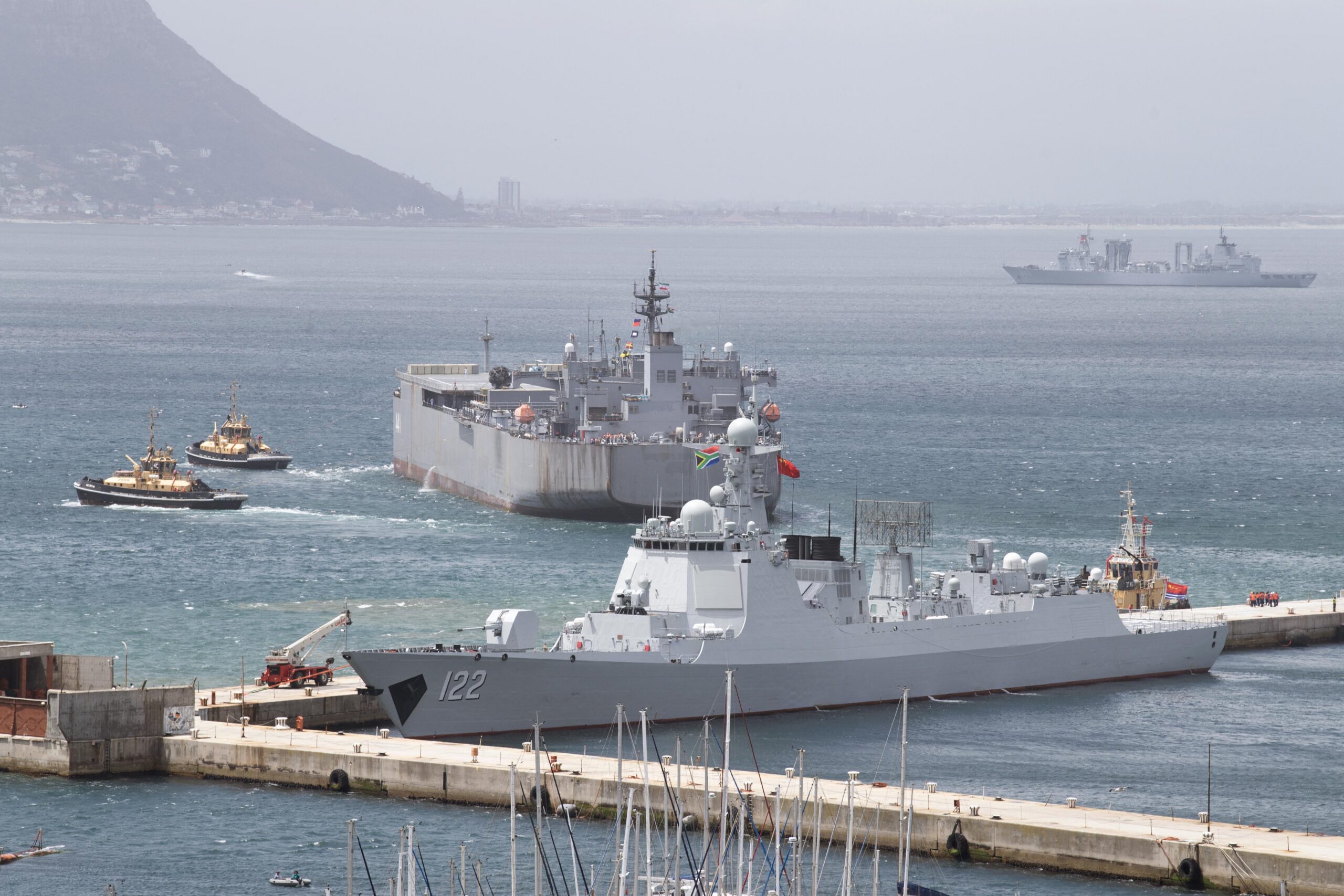
”South African President Cyril Ramaphosa has received an investigative panel’s report into how Iranian naval vessels remained involved in the January 2026 Exercise Will for Peace despite his instruction that Iran should no longer participate. The report remains confidential on national security grounds, leaving questions about military command, government accountability and the potential diplomatic consequences for South Africa’s relationships with the United States, China, Russia and Iran.”
A naval investigation with international consequences
PRETORIA, South Africa — South Africa’s handling of a controversial multinational naval exercise has returned to the centre of its international-relations debate following the completion of an investigation into Iran’s participation in military activities off the country’s coast earlier this year.
President Cyril Ramaphosa has received the report from an independent panel established in February 2026 to investigate circumstances surrounding Exercise MOSI III, also known as Will for Peace 2026. The Presidency confirmed on 27 October that Ramaphosa would consider the panel’s findings and recommendations, while the report and proceedings would remain confidential because of national security considerations. A further report published on 29 October renewed attention to the matter.
The investigation concerns a significant question for South Africa’s foreign policy: how did Iranian naval vessels remain involved in an exercise after the president instructed that Iran should no longer participate?
The issue extends beyond the conduct of a military event. It touches on civilian control of the armed forces, the implementation of presidential instructions, South Africa’s approach to international partnerships and its ability to manage relations with countries whose geopolitical interests frequently conflict.
The panel was chaired by Justice Bernard Ngoepe, assisted by Justice M.M. Leeuw and Rear Admiral P.T. Duze. Although the president had initially directed the panel to complete its work within one calendar month, the investigation was extended after the panel presented reasons for needing additional time.
The contents of the report have not been made public. Consequently, responsibility for the events, the precise sequence of decisions and any proposed disciplinary measures cannot yet be independently established.
What happened during Exercise Will for Peace?
The naval exercise took place in South African waters in January 2026 and involved vessels associated with China, Russia, Iran and South Africa, amid wider cooperation between BRICS countries and their partners.
The presence of Iranian warships attracted particular attention because of the deteriorating relationship between Washington and Tehran and the already strained relationship between Washington and Pretoria.
According to reporting by the Associated Press, Ramaphosa instructed that Iranian warships should not participate in the exercise. Nevertheless, Iranian vessels remained involved in the broader event, prompting an investigation into whether officials in the military or Defence Ministry had failed to implement the president’s direction.
Reports have also distinguished between Iranian vessels being present in South African waters and participating in the actual at-sea drills. The Citizen reported that three Iranian warships were present but were understood not to have joined the joint operations at sea. This distinction matters because the precise form of participation is relevant to assessing what instructions were issued and whether they were followed.
The inquiry was intended to establish the circumstances surrounding the apparent failure to heed the presidential instruction. However, without access to its findings, it would be premature to conclude that particular officials deliberately disobeyed orders or that any individual should face disciplinary action.
Confidentiality and the question of accountability
The Presidency has justified withholding the report on national security grounds. Ramaphosa is expected to consider its recommendations before deciding on any further action.
Confidentiality can be appropriate when an investigation contains sensitive military information, operational procedures or details that could compromise national security. Nevertheless, the decision also creates a challenge for public accountability, particularly because the investigation concerns the execution of an instruction from the country’s head of state.
South Africans may reasonably want to know whether the incident resulted from unclear communication, administrative failures, disagreements over the exercise’s arrangements or shortcomings in the military chain of command.
These are possibilities rather than established findings. The available public statements do not reveal which explanation, if any, the panel accepted.
A carefully prepared public summary, should the government consider one appropriate, could potentially explain the nature of any institutional failures and corrective measures without disclosing sensitive operational information. Whether such a summary will be released remains uncertain.
The government must also distinguish between explaining an institutional failure and prejudging the individuals involved. Fair procedures require that any disciplinary decisions be based on established evidence and applicable rules rather than speculation arising from incomplete information.
Ultimately, the report’s significance will depend not only on its conclusions but also on the actions taken to prevent similar problems in future military operations.
Implications for South Africa’s relationship with the United States
The investigation has particular diplomatic significance because South Africa’s relationship with the United States has faced considerable pressure in 2026.
The two countries have disagreed over South Africa’s domestic policies, its approach to racial inequality, its international legal action against Israel concerning Gaza and its relationships with countries including Iran. Washington has also imposed visa restrictions on certain South African nationals, citing concerns about policies it considers discriminatory, allegations Pretoria rejects.
Against this background, Iran’s presence in the naval exercise became another point of tension.
The United States criticised South Africa’s decision to permit Iranian participation, according to the Associated Press. Ramaphosa’s reported instruction to exclude Iran was intended to limit potential diplomatic fallout with Washington.
The episode illustrates the practical difficulties of maintaining diplomatic relationships with countries that have conflicting security priorities.
The United States is an important market for South African goods, while American investment, financial links and commercial relationships contribute to economic activity. At the same time, South Africa has repeatedly defended its right to pursue an independent foreign policy.
International Relations and Cooperation Minister Ronald Lamola said on 28 October that the government was preparing for uncertainty surrounding the renewal of the African Growth and Opportunity Act, or AGOA, while diversifying South African export markets. He also emphasised Pretoria’s intention to maintain constructive relations with Washington despite disagreements.
The naval controversy therefore unfolds alongside wider negotiations over trade and diplomatic cooperation. It is not evidence that the investigation itself will determine the future of AGOA, but it demonstrates how security decisions can become entangled with broader bilateral relations.
Relations with China, Russia and Iran
South Africa’s diplomatic position is complicated by its relationships with China, Russia and Iran, which differ considerably in economic significance, political priorities and international circumstances.
China is a major trading partner for South Africa and an important participant in multilateral forums that include emerging economies. Cooperation between the two countries encompasses trade, development, diplomacy and other areas of engagement.
Russia also maintains diplomatic and strategic relationships with Pretoria. Their interactions take place against the background of Russia’s war in Ukraine and continuing disagreements between Moscow and Western governments.
Iran’s participation in the naval exercise has generated a different set of concerns because of its contentious relationship with Washington and the broader international security disputes surrounding Tehran.
Iran joined BRICS in 2024, as the grouping expanded its membership. However, participation in the same multilateral grouping does not mean that all members share identical security interests or foreign-policy objectives.
South Africa must therefore navigate these relationships without assuming that cooperation with one partner necessarily requires hostility towards another.
Its approach to BRICS, for example, can provide opportunities for economic cooperation and diplomatic engagement. Nevertheless, participation in multinational military activities requires clear objectives, well-defined command arrangements and careful assessment of the consequences for other international relationships.
The central diplomatic challenge is to preserve meaningful cooperation while ensuring that individual decisions are consistent with South Africa’s stated policies and national interests.
Non-alignment and foreign-policy credibility
South Africa has historically sought to preserve room for independent decision-making in international affairs. Its foreign policy includes engagement with multiple global powers, support for multilateral institutions and advocacy for greater representation of developing countries in international decision-making.
Non-alignment, however, does not remove the need to make difficult choices. In practice, it requires the government to explain why particular partnerships serve national objectives and how it will respond when those partnerships create competing obligations.
The naval exercise controversy highlights the difference between declaring an independent foreign policy and implementing it consistently.
A government may decide to maintain diplomatic relations with countries that have difficult relationships with its other partners. That decision does not automatically establish that it endorses every policy pursued by those countries.
Equally, diplomatic independence does not eliminate the need to consider the economic and political consequences of military cooperation.
South Africa’s credibility will depend partly on whether it can explain its decisions clearly, communicate instructions effectively and demonstrate that its institutions operate according to established procedures.
The investigation may provide information relevant to these questions, but the confidential nature of the report currently limits independent assessment.
What happens next?
The immediate next step is for Ramaphosa to consider the report’s recommendations. The Presidency has not publicly disclosed the findings or announced specific consequences arising from the investigation.
Depending on the report’s conclusions, possible areas for institutional review could include communication between political leadership and military commanders, procedures for modifying multinational exercises, and mechanisms for confirming that presidential instructions have been implemented.
These are potential areas for review, not confirmed recommendations from the panel.
The government may also need to consider how future multinational exercises are planned and communicated to domestic institutions and international partners. Clearer procedures could help reduce misunderstandings and ensure that the scope of participation by individual countries is properly defined.
Any response should balance operational confidentiality with the public interest in knowing whether government instructions were followed. It should also avoid presenting unverified allegations as established facts.
For international partners, the handling of the report may offer insight into how South Africa manages disagreements involving defence cooperation and diplomatic pressure. However, the precise implications for individual bilateral relationships will depend on subsequent government decisions and reactions from the countries concerned.
Conclusion: A test of diplomatic and institutional coordination
The investigation into Iran’s participation in Exercise Will for Peace 2026 raises questions extending beyond one naval exercise. It brings together national security, executive authority, military accountability and the difficult task of maintaining diplomatic relations across competing geopolitical interests.
South Africa has an interest in preserving its freedom to engage internationally while protecting important trade and diplomatic relationships. Achieving that balance requires decisions that are clearly communicated, consistently implemented and supported by institutions capable of translating government policy into practice.
The confidential report gives Ramaphosa an opportunity to examine what happened and determine whether corrective measures are necessary. Its long-term significance will depend on the conclusions reached, the actions taken and the extent to which those actions address any institutional weaknesses identified.
For now, the central facts are clear: the investigation has concluded, the president has received the report, and the findings remain confidential. Claims about specific individuals’ responsibility or the exact causes of the incident should await further verified information.
As South Africa continues to navigate tensions with Washington while maintaining relationships with China, Russia, Iran and other international partners, the handling of this episode will remain relevant to debates about the practical meaning of its independent foreign policy.



