




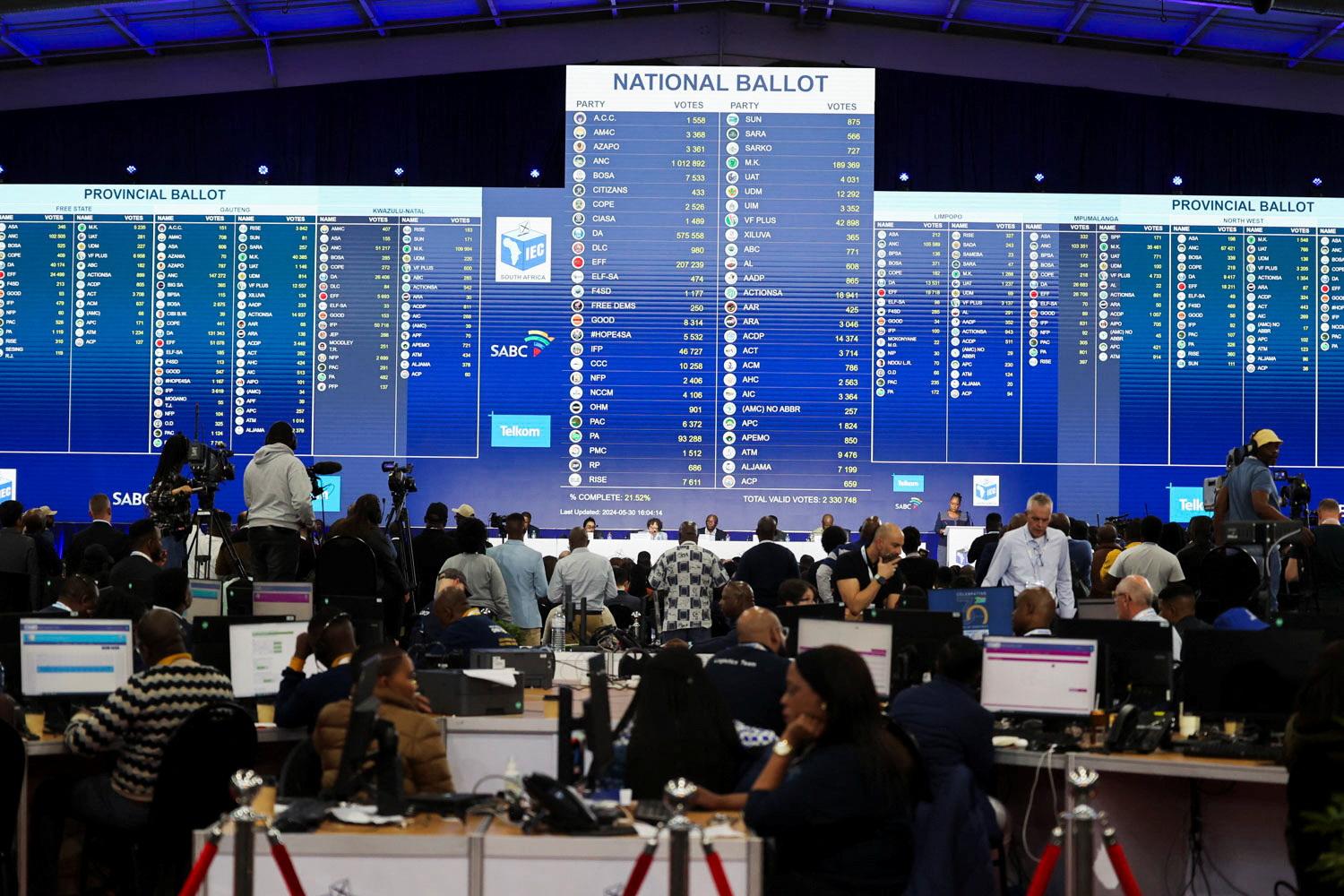
“South Africa’s 2026 local government elections are reshaping the country’s political landscape, with the African National Congress (ANC) facing its worst-ever electoral performance and opposition parties gaining influence across major municipalities. Meanwhile, the uMkhonto weSizwe (MK) Party has formally challenged the Electoral Commission’s handling of eThekwini results, demanding verification of alleged discrepancies before the final declaration of results.”
South Africa’s 2026 Elections Reshape Political Landscape as MK Party Challenges eThekwini Results
South Africa’s 2026 local government elections are emerging as a defining moment in the country’s democratic development, with the African National Congress (ANC) facing its most significant electoral setback since the end of apartheid. At the same time, opposition parties are strengthening their positions across major municipalities, coalition negotiations are becoming increasingly important, and disputes surrounding election results are placing additional attention on electoral transparency.
The uMkhonto weSizwe (MK) Party has become one of the central political developments following the elections after formally challenging the Electoral Commission of South Africa’s (IEC) handling of results in eThekwini. The party, led by former president Jacob Zuma, is demanding an investigation into alleged discrepancies in vote capturing and system failures before the final results are declared.
MK Party Demands Investigation Into eThekwini Election Results
The MK Party has requested that the IEC delay the final declaration of municipal election results because of alleged irregularities affecting the counting and electronic capturing of votes in eThekwini, KwaZulu-Natal.
According to a report published by Inside Politics on 7 November, the party submitted a formal objection dated 6 November, requesting an immediate audit of disputed results, suspension of further processing of affected results, and access for independent forensic analysis.
The party also called for outstanding verification disputes and discrepancies to be resolved before the final declaration of election outcomes.
The objection comes as the MK Party leads the eThekwini municipal contest, making the dispute particularly significant for the political future of Durban and surrounding communities.
The party has previously questioned the integrity of electoral processes. Following the 2024 national and provincial elections, it challenged aspects of the IEC’s electronic results system. However, the Electoral Court dismissed that challenge in September 2026, finding that the party had not established that the integrity of the election results had been compromised.
The latest objection therefore introduces renewed scrutiny of the electoral commission’s verification processes, although allegations raised by political parties do not independently establish that election results have been manipulated.
The IEC’s responsibility remains to investigate complaints, verify disputed information and ensure that legally valid results are declared.
ANC Faces Its Worst-Ever Electoral Performance
The most significant national development from the elections is the ANC’s dramatic decline in electoral support.
According to Reuters reporting on 6 November, approximately 90% of voting results had been counted, with the ANC receiving around 32% of the national vote and the Democratic Alliance (DA) approximately 24%.
The Council for Scientific and Industrial Research projected that the ANC could finish with approximately 31% of the vote, while the DA could secure approximately 24.5%.
These figures represent a major decline from the ANC’s 46% performance in the 2021 local government elections.
The party’s declining support follows years of public dissatisfaction with municipal governance, corruption concerns, unemployment and inadequate public services.
South Africans have repeatedly expressed frustration about water shortages, electricity disruptions, deteriorating roads, sanitation problems and limited economic opportunities.
Local government elections are particularly important because municipalities are directly responsible for delivering many of these essential services.
Consequently, the ANC’s declining support suggests that voters increasingly expect political parties to demonstrate practical improvements in municipal administration rather than relying exclusively on historical political loyalty.
The party’s performance also raises questions about its ability to rebuild public confidence before the next national elections.
Democratic Alliance Strengthens Its Position
The Democratic Alliance has emerged as one of the strongest beneficiaries of the changing electoral landscape.
With approximately 24% of the national vote, the DA is positioned to expand its influence in municipalities where electoral competition has intensified.
The party’s strong performance in several major urban centres reflects its ability to attract voters seeking alternative municipal leadership.
In Cape Town, the DA remains firmly positioned, while its performance in Johannesburg, Tshwane and other Gauteng municipalities has strengthened its bargaining position.
However, electoral gains do not automatically translate into governing majorities.
South Africa’s proportional representation municipal system means that political parties frequently need coalition partners to secure control of councils.
This creates opportunities for smaller political formations to influence mayoral appointments, municipal budgets and administrative priorities.
For the DA, the elections provide an opportunity to demonstrate that alternative municipal leadership can deliver improved public services and financial management.
MK Party Expands Political Influence
The MK Party’s performance represents another major development in South African politics.
Established by former president Jacob Zuma, the party has challenged the ANC’s traditional political dominance, particularly in KwaZulu-Natal.
The party’s strong showing in the province demonstrates the continued importance of regional political identities and changing voter preferences.
By Saturday morning, the MK Party was leading the KwaZulu-Natal provincial vote with approximately 34.54%, according to IOL reporting based on IEC results.
The party was also leading the eThekwini municipal contest, placing it in a potentially influential position as municipal leadership arrangements are negotiated.
Nevertheless, winning the largest share of votes does not necessarily guarantee control of every municipality.
In KwaZulu-Natal, the Inkatha Freedom Party (IFP) was leading in more municipalities despite the MK Party having the highest provincial vote share.
This distinction illustrates the complexity of South Africa’s municipal electoral system, where ward outcomes and proportional representation determine council composition.
Coalition Negotiations Become Central to Municipal Governance
The 2026 elections are expected to produce extensive coalition negotiations across South Africa.
Several municipalities have failed to produce outright majorities for individual political parties, requiring negotiations between competing political formations.
These negotiations will determine mayoral appointments, council leadership, executive arrangements and potentially the implementation of municipal programmes.
Coalition governments can create opportunities for broader political representation, but they also introduce challenges involving accountability, policy disagreements and leadership stability.
Municipal coalitions must agree on budgets, service delivery priorities and administrative appointments.
If political parties prioritise negotiations over governance, municipalities risk experiencing further instability.
However, agreements based on transparent commitments and measurable service delivery objectives could improve accountability.
Voters will ultimately judge coalition arrangements according to whether they improve everyday conditions.
Service Delivery Remains the Central Electoral Issue
One of the strongest messages emerging from the elections concerns the relationship between municipal performance and political support.
The ANC’s declining electoral position has been widely associated with public frustration over inadequate services.
Water shortages, electricity interruptions, poor sanitation, infrastructure deterioration and municipal financial problems have become major political concerns.
For many voters, municipal elections provide an opportunity to hold local leadership accountable for these failures.
The results suggest that dissatisfaction with local governance can influence voting decisions even in communities where political parties have historically enjoyed strong support.
Opposition parties therefore face pressure to demonstrate that they can improve municipal performance.
Campaign promises concerning clean water, reliable electricity, employment opportunities, safer communities and infrastructure maintenance will require practical implementation.
The elections have strengthened the importance of municipal accountability as a central feature of South African democracy.
IEC Faces Continued Pressure to Maintain Public Confidence
The MK Party’s objection in eThekwini highlights the importance of electoral transparency and public confidence.
The IEC has maintained that verification and assurance processes are necessary before results can be finalised.
According to SABC News reporting, the electoral commission has urged political parties, independent candidates and members of the public to exercise caution when interpreting partial results.
The commission has also reported progress in resolving electoral complaints through its issue-tracking systems.
Nevertheless, disputes involving major municipalities can attract significant public attention.
The credibility of the electoral process depends on complaints being handled consistently, evidence being assessed independently and final results being supported by appropriate verification procedures.
Political parties also have responsibilities to avoid presenting unverified allegations as established facts.
Where discrepancies are identified, transparent investigation and communication can help maintain confidence in democratic institutions.
Implications for South Africa’s Political Future
The 2026 municipal elections could influence South Africa’s political direction beyond local government.
The ANC’s reduced support raises questions about its future national electoral prospects, particularly as opposition parties seek to expand their political influence.
The DA’s improved position and the MK Party’s emergence as a major political force demonstrate that South Africa’s political competition is becoming increasingly fragmented.
Smaller parties may also become influential through coalition negotiations, especially in municipalities where no party secures a governing majority.
These developments could reshape political alliances ahead of the next national elections.
However, electoral success at municipal level does not automatically translate into national political dominance.
Parties must demonstrate organisational strength, credible leadership and consistent policy implementation to sustain voter support.
Conclusion
South Africa’s 2026 local government elections represent a significant political turning point.
The ANC’s historic decline, the DA’s stronger electoral position, the MK Party’s expanding influence and the increasing importance of coalition negotiations demonstrate that the country’s political landscape is changing.
The MK Party’s objection to eThekwini results has added another important dimension to the election aftermath, highlighting the need for transparent verification and credible electoral administration.
Ultimately, the most important test for political parties will be their ability to translate electoral victories and coalition agreements into better municipal governance.
South Africans have demonstrated that political support cannot be taken for granted. As municipalities prepare for the next five years, voters will increasingly expect reliable public services, responsible leadership and measurable improvements in their communities.
The elections have therefore reinforced a central democratic principle: political authority must remain accountable to the people who exercise their right to vote.



