




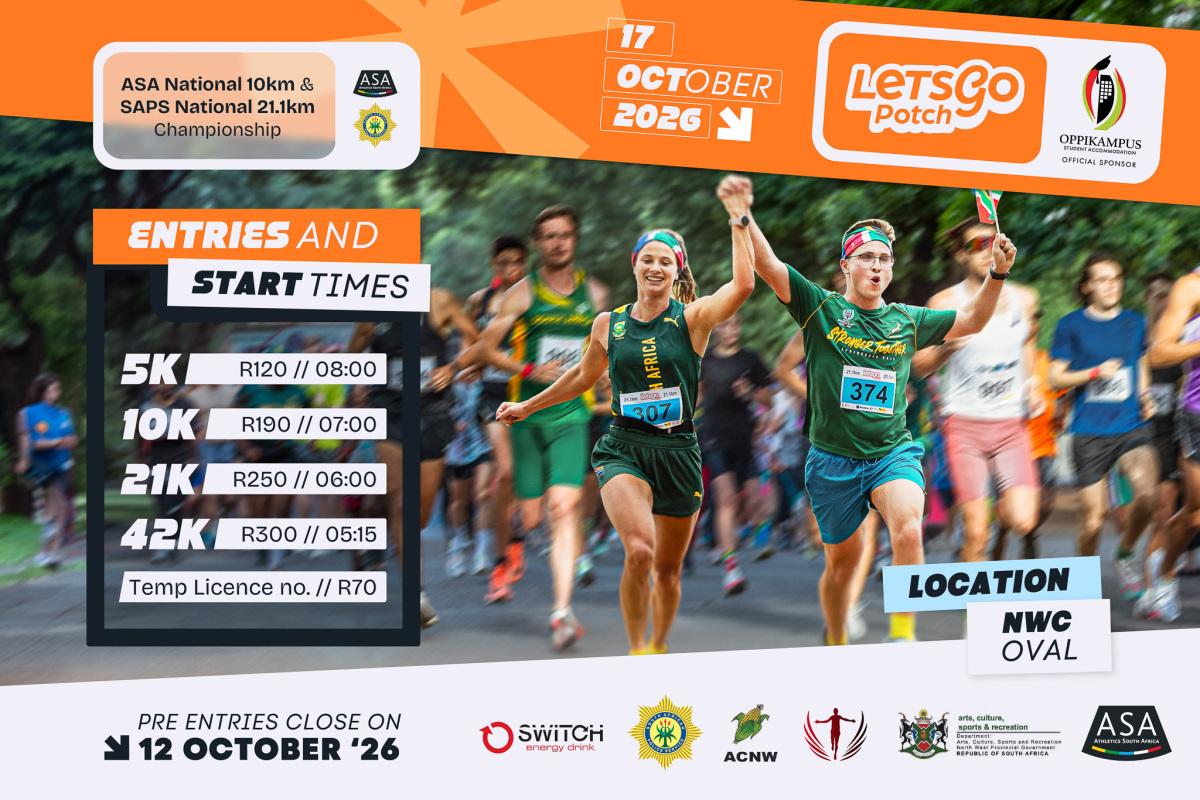
“South Africa’s national 10km road-running championships are set to produce new men’s and women’s champions, with defending champions Chris Mhlanga and Tayla Kavanagh absent from the competition. Ntsoaki Molahloe, Carina Swiegers, Jerry Motsau and Pakiso Mthembu are among the leading contenders in a race that brings together 320 athletes representing 17 teams.”
South African 10km Championships Open the Door for New National Champions in Potchefstroom
South African road running takes centre stage on Saturday, 17 October 2026, as the Athletics South Africa (ASA) 10km Championships are incorporated into the LetsGoPotch 10km event at the North West Cricket Oval in Potchefstroom. With the reigning champions absent from the title race, the competition presents a significant opportunity for emerging talents and experienced distance runners to establish themselves among the country’s leading athletes.
The championships arrive at an important moment for South African athletics, as road running continues to provide a platform for elite competitors, provincial teams and developing athletes to test their preparation against strong national opposition. The absence of defending champions Chris Mhlanga and Tayla Kavanagh means that neither national title can be defended on the day, guaranteeing new champions in both the men’s and women’s categories.
A national championship with everything to prove
The ASA 10km Championships form part of the wider LetsGoPotch running festival, bringing together competitors from across South Africa. According to the event information published by Athletics South Africa, the championships are scheduled for Potchefstroom on 17 October, with the national federation overseeing the competition.
The reported entry includes 320 athletes representing 17 teams. These include provincial athletics bodies, as well as competitors representing the South African Police Service and the South African National Defence Force. Such participation highlights the broad organisational structure supporting competitive athletics in the country.
For the athletes, however, the central objective remains straightforward: produce the strongest possible performance over 10 kilometres and compete for national recognition.
Unlike ordinary road races, national championships carry additional significance because the field is competing for official titles. Athletes must balance ambition with tactical discipline, managing their pace, assessing their opponents and responding to changing conditions throughout the race.
Potchefstroom provides the setting for this contest, with the event also offering local supporters an opportunity to watch leading South African runners compete on home soil.
Women’s race becomes an open contest
The women’s competition has attracted particular attention following the withdrawal of defending champion Tayla Kavanagh. Kavanagh won the national title in Bloemfontein in 2025 and has enjoyed an impressive 2026 season, including a reported South African 10km record of 30 minutes and 50 seconds in Romania.
Her absence changes the competitive picture considerably. Rather than facing a reigning champion with recent national success, the remaining contenders have an opportunity to claim the title and establish their own place in South African distance-running history.
Another notable absentee is Glenrose Xaba, the 2024 national champion, who has chosen to compete in the Boxer Super Run in Durban this weekend. Xaba’s decision further opens the field, leaving several other runners with realistic ambitions of finishing at the top.
Ntsoaki Molahloe of KwaZulu-Natal Athletics is identified as one of the leading contenders. At 26, Molahloe enters the championship with a reported personal best of 33:34 over 10km and experience from national track competitions.
For Molahloe, the race represents an opportunity to translate that experience into a senior national title. A personal best provides an indication of an athlete’s potential, but championship racing introduces additional challenges. Competitors must decide when to conserve energy, when to follow a rival’s pace and when to commit to a decisive move.
Molahloe also has provincial teammates Bathobile Mkhize and Banele Mabizela in the wider competitive picture. Their presence illustrates the strength of the KwaZulu-Natal contingent, although individual performances on the day will ultimately determine the finishing order.
Carina Swiegers presents a serious challenge
Among the runners expected to challenge Molahloe is Carina Swiegers of Athletics Gauteng North. The 31-year-old has established herself in the national athletics scene through three consecutive national titles in the 3,000m steeplechase, according to the pre-race report.
Her experience over the steeplechase distance could be valuable in a 10km contest. The events require different pacing strategies, but both demand endurance, efficient movement and the ability to maintain concentration while fatigue increases.
Swiegers’ challenge will be to translate her track experience into a sustained road-running performance. The 10km distance rewards athletes who can maintain a strong rhythm while remaining alert to tactical changes. An early surge can create an advantage, but an athlete who responds too aggressively may pay for the effort in the closing stages.
The women’s race is therefore more than a contest between the fastest published personal bests. It is a test of preparation, judgement and the ability to execute a race plan under championship pressure.
For the winner, the reward will be a national title earned against a field in which several competitors have the opportunity to make a breakthrough.
Men’s championship offers Jerry Motsau a home opportunity
The men’s race is similarly open following the absence of defending champion Chris Mhlanga. One of the principal contenders is Jerry Motsau, a 36-year-old athlete representing the host province, Athletics Central North West.
Motsau has already secured the national 5,000m track title in Stellenbosch earlier in 2026. The Potchefstroom championship gives him an opportunity to add a road-running crown to his season’s achievements.
Winning national titles on the track and road requires athletes to adapt to different racing environments. Track races take place on a measured oval, while road events introduce different surfaces, course characteristics and environmental conditions. Even when the distances are comparable, competitors must adjust their approach.
Motsau’s experience could be particularly important in a championship where patience and decision-making may prove decisive. As a seasoned runner, he will be familiar with the need to judge his effort carefully, particularly if the leading group remains together during the opening stages.
Competing in the host province also gives him a clear local connection to the event. Nevertheless, home surroundings cannot guarantee victory. Motsau must still manage the demands of the race and contend with challengers capable of producing strong performances.
A victory would represent another significant achievement in a season that has already included a national track title.
Pakiso Mthembu threatens the local favourite
Motsau’s leading expected opposition includes Pakiso Mthembu of KwaZulu-Natal Athletics. The pre-race coverage describes Mthembu as a consistent sub-29-minute performer over 10km, making him a serious contender for the men’s championship.
A performance below 29 minutes represents a demanding standard in distance running. However, the outcome of a championship cannot be predicted from a personal best or reputation alone. Race-day execution, pacing, conditions and the decisions made by the leading group can all influence the result.
Mthembu will need to balance his own race strategy against the ambitions of Motsau and other competitors. If the leading runners adopt a conservative opening pace, the contest could develop into a tactical battle decided in the final kilometres. Alternatively, an aggressive pace could force the field to separate earlier.
For spectators, this uncertainty is part of the attraction of road-running championships. The favourite may establish control, but a challenger who manages energy effectively can remain competitive until the decisive moments.
The men’s contest also demonstrates the value of competition between provincial programmes. Athletes representing different regions meet under the same championship conditions, allowing their preparation and performances to be assessed against a national field.
The importance of provincial representation
The participation of 17 teams gives the championships importance beyond the individual title battles. South African athletics depends on a network of provincial structures that organise competitions, develop talent and provide athletes with opportunities to progress from local events to national championships.
For developing runners, sharing a competitive environment with experienced national champions can provide valuable lessons. They can observe how elite athletes position themselves, manage changes in pace and maintain focus when a race becomes physically demanding.
The presence of athletes from the police service and defence force also demonstrates the variety of organisations represented in South African competitive running. These teams contribute to the wider sporting community while giving their athletes opportunities to compete at a high level.
The championship setting can also help identify runners who are ready to move beyond regional competitions. Strong performances may attract greater attention from coaches, sponsors and athletics supporters, although selection and sponsorship opportunities are not guaranteed by a single result.
For provincial teams, the competition offers an opportunity to measure their athletes against a national standard and assess the effectiveness of their development programmes.
Road running’s place in South African athletics
The Potchefstroom championship highlights the important relationship between road running and the broader athletics calendar. South Africa has a strong distance-running tradition, supported by road races, cross-country competitions and track events that give athletes different ways to develop their endurance and competitive abilities.
Road races can appeal to a broad audience because they bring competition beyond traditional athletics tracks and into communities. Elite athletes compete for titles and recognition, while organised running festivals can encourage participation and introduce spectators to the sport.
National championships add another layer of significance by giving runners a clear competitive objective. Preparing for a specific event encourages structured training, appropriate recovery and careful planning. The opportunity to win a national title can also motivate athletes to maintain their commitment throughout a demanding season.
Nevertheless, developing successful distance runners requires more than competition alone. Coaching, access to facilities, medical support, travel resources and financial assistance can influence whether promising athletes are able to reach their potential.
Events such as the ASA 10km Championships provide a visible stage on which athletic talent can be recognised. Continued investment in development pathways remains important if South Africa is to maintain a strong pipeline of competitive distance runners.
What spectators should watch for
The principal question entering Saturday’s championship is whether experience or emerging ambition will prove decisive. In the women’s race, Molahloe and Swiegers have opportunities to capitalise on the absence of Kavanagh and Xaba. In the men’s contest, Motsau faces the challenge of converting his track success into a road title while dealing with the threat posed by Mthembu.
The opening kilometres could reveal which athletes intend to control the pace and which prefer to remain behind the leading group. However, the final outcome will depend on what happens throughout the race rather than any single pre-race prediction.
Spectators should also look beyond the headline contenders. National championships often provide opportunities for less familiar athletes to demonstrate their ability against established competitors. A strong performance from a developing runner can become an important milestone in a longer sporting career.
As the race unfolds, the final standings will determine who leaves Potchefstroom with the national honours. Until official results are available, predictions must remain provisional.
A defining opportunity for South African runners
The 2026 ASA 10km Championships arrive with both national titles available and a competitive field ready to pursue them. The absence of the reigning champions creates uncertainty, but it also gives other athletes an opportunity to deliver defining performances.
For Molahloe, Swiegers, Motsau, Mthembu and their rivals, the challenge is to turn months of preparation into an effective race-day performance. Their success will depend on fitness, tactical judgement, resilience and the ability to respond when the competition intensifies.
The event also represents an opportunity for South African athletics to celebrate the depth of its distance-running community. The combination of established competitors, emerging talent and provincial representation reflects the broad foundations on which the sport depends.
Potchefstroom will provide the stage, but the athletes themselves must determine the outcome. With new men’s and women’s champions guaranteed, Saturday’s championships promise meaningful competition and the possibility of breakthrough performances.
The results will establish the new national title holders and provide another reference point for evaluating South Africa’s distance-running talent as the season progresses. For the athletes who seize the opportunity, a victory could become one of the most significant achievements of their 2026 campaigns.



