




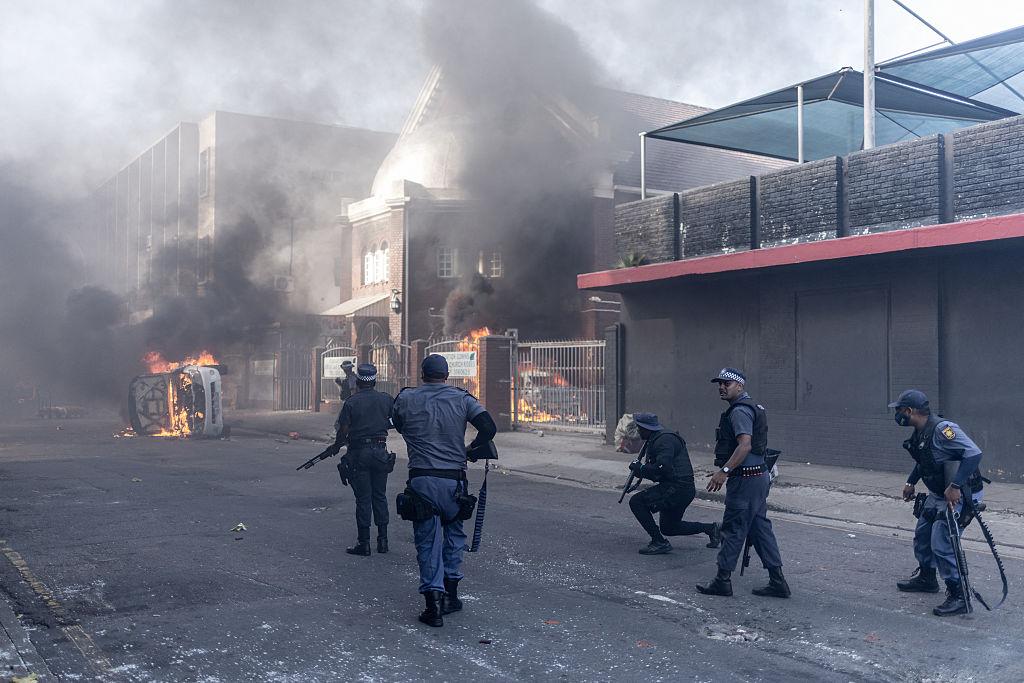
“South African police used stun grenades and rubber bullets to disperse protesters in Durban’s Umbilo area after demonstrators allegedly violated restrictions imposed by an interim court order and threw stones at officers. The confrontation, involving members associated with the March and March movement, highlights growing tensions surrounding immigration activism, asylum administration, public order, and the constitutional right to protest.”
Durban protest confrontation intensifies debate over immigration activism, policing and the right to demonstrate
A confrontation between protesters and South African police in Durban’s Umbilo area has brought renewed attention to the increasingly contentious relationship between immigration activism, public demonstrations, court restrictions and government efforts to manage the country’s asylum system.
Public Order Police fired stun grenades and rubber bullets to disperse demonstrators after a protest associated with the March and March movement allegedly escalated into violence on Tuesday afternoon. The incident occurred along Che Guevara Road, near the Home Affairs refugee reception facilities, where tensions over immigration administration have been building for months.
According to a report published by The Citizen on Wednesday, police intervened after demonstrators allegedly continued marching beyond restrictions established by an interim court order. Authorities said some protesters threw stones at officers during a confrontation, prompting the deployment of crowd-control measures.
The incident represents another significant development in South Africa’s politically sensitive immigration debate, which has increasingly become a subject of street mobilisation, legal disputes and public confrontation.
Police explain the circumstances surrounding the confrontation
South African Police Service spokesperson Colonel Robert Netshiunda said protesters moved away from their gathering area opposite Home Affairs offices in Umbilo and began marching shortly after 3pm.
Police reportedly stopped the marchers and reminded them of an interim court order regulating demonstrations in the area.
The restrictions included limitations on marching after 15:00, carrying dangerous weapons and concealing faces with masks or other materials. Protest organisers were also expected to ensure that marshals controlled the procession.
According to the police account, the demonstration lacked the required marshals, making it difficult to maintain order.
Netshiunda said the situation deteriorated during discussions between officers and protesters, with demonstrators allegedly throwing stones at police.
Authorities subsequently deployed stun grenades and rubber bullets to disperse the crowd.
Police described their intervention as an effort to manage the gathering and restore public order. Netshiunda said no injuries had been reported to police following the confrontation.
The authorities also confirmed that investigations were underway into possible violations of the court order and alleged assaults on police officers.
These allegations remain subject to investigation, and any criminal responsibility must be established through the appropriate legal process.
Immigration activism continues to shape political debate
The confrontation occurred against the background of sustained mobilisation by anti-illegal immigration activists in South Africa.
The March and March movement has become increasingly visible in public demonstrations calling for stronger immigration enforcement, greater border control and action against undocumented immigration.
Its supporters argue that immigration pressures contribute to competition for employment, strain public services and complicate access to government resources.
However, immigration remains a complex national issue involving constitutional protections, administrative responsibilities, economic realities and international obligations.
South Africa’s asylum system is particularly sensitive because people seeking international protection are entitled to procedures that determine whether they qualify for refugee status.
Consequently, immigration enforcement cannot simply disregard asylum applications or the legal protections available to people seeking protection.
This distinction has become central to the political debate surrounding demonstrations outside Home Affairs facilities.
Court restrictions and the constitutional right to protest
The Durban confrontation also raises important questions about the relationship between freedom of assembly and public safety.
South Africa’s Constitution protects peaceful and unarmed assembly, demonstrations, picketing and the presentation of petitions.
Nevertheless, the right to protest does not remove the responsibility of organisers and participants to comply with lawful restrictions intended to protect public safety and the rights of others.
The legal restrictions imposed on demonstrations in Durban followed disputes about the potential consequences of protest activity near refugee reception facilities.
The Associated Press previously reported that a KwaZulu-Natal High Court ruling permitted anti-illegal immigration demonstrations under specified conditions.
Those conditions included designated routes, restrictions on dangerous objects and face coverings, and limits on demonstration hours.
The court’s approach reflected an attempt to balance the constitutional right to demonstrate with concerns about violence, intimidation and disruption.
The latest incident illustrates the difficulties authorities face when attempting to enforce those restrictions during politically charged gatherings.
apnews.com+1
Home Affairs introduces digital asylum registration
The demonstrations have also coincided with changes to South Africa’s asylum administration.
On 10 November, Home Affairs launched its Digital Asylum System, designed to reduce pressure on physical refugee reception offices and improve the handling of applications.
The system allows asylum seekers to begin registration remotely by submitting information and supporting documents online before arranging an appointment for further verification.
The department has clarified that registering an intention to apply does not automatically grant immigration status, permanent residency or citizenship.
The digital initiative is intended to address administrative pressure while maintaining procedures for determining asylum eligibility.
However, the introduction of a new registration system has not immediately resolved the political disagreements surrounding immigration administration.
Activists continue to challenge the government’s approach, while authorities must simultaneously manage applications, protect vulnerable individuals and enforce immigration legislation.
The Durban demonstrations therefore reflect a broader struggle over how South Africa should manage migration while respecting the legal framework governing asylum seekers.
Political figures and movement leadership attract attention
The confrontation also drew attention to movement leadership.
The Citizen reported that March and March leader Jacinta Ngobese Zuma was allegedly present during the demonstration and appeared to intervene as tensions increased.
A video circulating on social media reportedly showed her husband, Xolani Zuma, engaging with police officers.
The presence of prominent activists at demonstrations can increase public attention and political pressure on authorities.
It can also intensify scrutiny of the messages communicated by movement leaders, particularly when immigration debates become associated with hostility towards foreign nationals.
South Africa’s immigration debate has repeatedly demonstrated the importance of distinguishing criticism of government policy from intimidation, discrimination or violence against individuals based on nationality.
Political activism remains a legitimate part of democratic participation, but campaigns must also recognise the rights and dignity of people affected by their demands.
Violence remains a major concern
The Durban confrontation highlights the risks associated with demonstrations that escalate beyond peaceful protest.
South Africa has experienced episodes of xenophobic violence, attacks on foreign-owned businesses and intimidation involving people perceived to be foreign nationals.
Such incidents have serious consequences for communities, businesses, public confidence and international relations.
Violence also threatens the credibility of legitimate advocacy campaigns.
When demonstrations involve attacks, threats or property destruction, public attention can shift away from policy demands towards criminal conduct and public safety concerns.
Police face the difficult responsibility of protecting demonstrators, nearby residents, businesses and officers while responding proportionately to unlawful behaviour.
The use of rubber bullets and stun grenades can itself attract scrutiny because crowd-control measures must be lawful, necessary and proportionate.
The latest incident therefore requires careful investigation into both the conduct of demonstrators and the actions of police officers.
Implications for government and civil society
The confrontation demonstrates that immigration activism is no longer confined to policy discussions or online campaigns.
It has become a visible political force capable of mobilising communities, attracting media attention and challenging government decisions through public demonstrations.
For government, the immediate challenge is maintaining public order while addressing legitimate concerns about administrative capacity, immigration enforcement and asylum processing.
For civil society organisations, the situation presents an opportunity to promote evidence-based debate, defend constitutional protections and challenge misinformation.
For political movements, the events underscore the importance of ensuring that demonstrations remain peaceful and that their demands are communicated without encouraging discrimination or violence.
The authorities must also ensure that court restrictions are applied consistently and that allegations against protesters are investigated fairly.
Public confidence depends on the ability of institutions to uphold the law without unnecessarily suppressing lawful political expression.
What happens next?
Police investigations into the Durban confrontation are continuing.
Authorities are examining whether demonstrators breached the interim court order and whether police officers were assaulted during the incident.
The outcome of those investigations could influence subsequent enforcement measures and the management of future demonstrations in the area.
The dispute also remains connected to the broader national debate about asylum administration, undocumented immigration and the government’s response to public pressure.
As Home Affairs implements its digital registration system, the effectiveness of the reforms will be assessed through their ability to reduce administrative congestion, improve access to procedures and maintain lawful immigration controls.
Meanwhile, political activists are likely to continue pressing their demands through public mobilisation and advocacy.
The central question facing South Africa is whether immigration disagreements can be addressed through democratic engagement, effective administration and lawful enforcement without escalating into violence or discrimination.
The Durban confrontation provides a clear reminder that constitutional freedoms, public safety and the protection of human dignity must remain central to that debate.
Ultimately, the sustainability of political activism in South Africa depends not only on the ability of citizens to challenge government policy, but also on their willingness to exercise that freedom responsibly while respecting the rights of others.



