




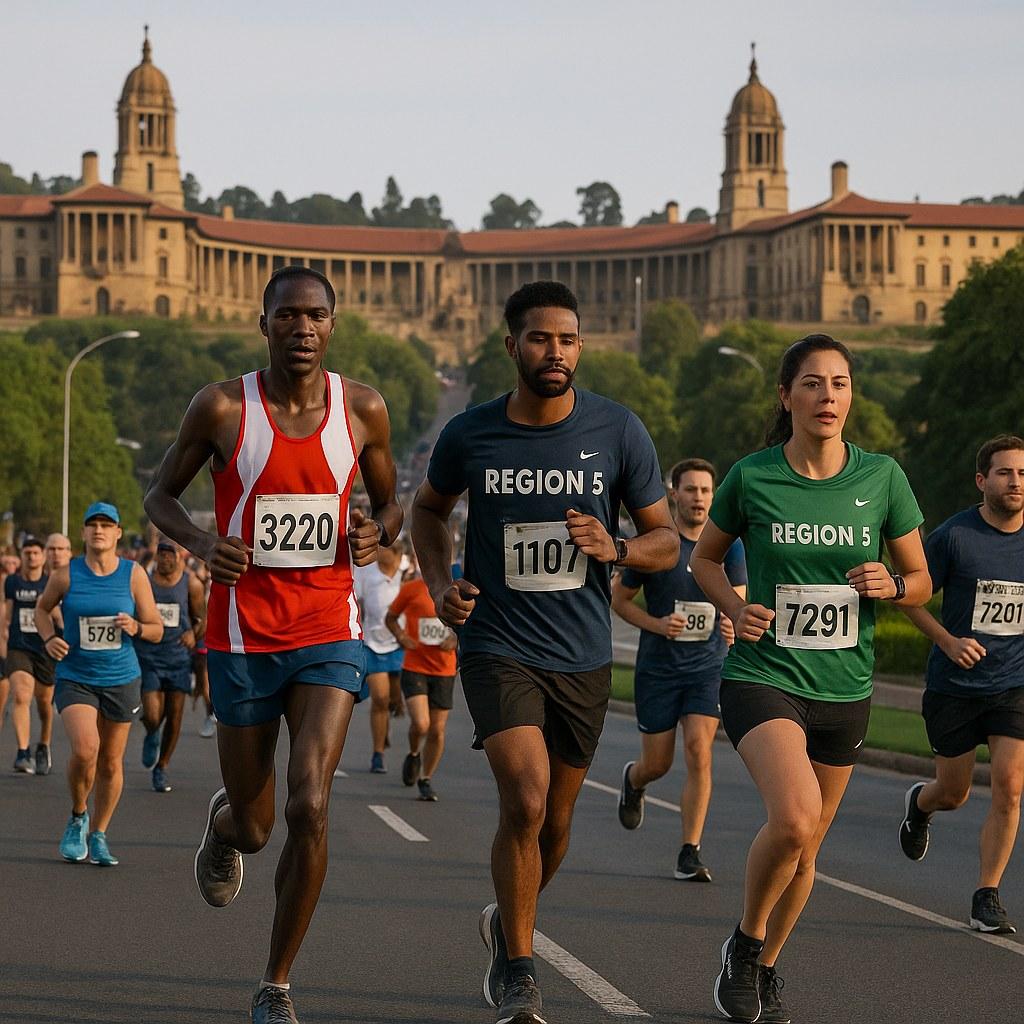
“Pretoria is hosting the sixth Region 5 Marathon and Road Running Championships on 1 November 2026, bringing together elite athletes from 10 Southern African countries alongside recreational runners. The competition features 21.1km, 10km, 5km and an invitation-only 1-mile event, with R437,000 in total prize money and R50,000 allocated to each of the men’s and women’s half-marathon winners.”
Region 5 Marathon puts South African athletics at the centre of Southern African road-running competition
PRETORIA, SOUTH AFRICA – 1 NOVEMBER 2026
Pretoria has become the focal point of Southern African road running as the Region 5 Marathon and Road Running Championships take place on Sunday, 1 November 2026. The competition brings together elite athletes, emerging runners, recreational participants and athletes with disabilities for a major regional sporting occasion at the Union Buildings.
The sixth edition of the Region 5 Marathon represents an important opportunity for South Africa to demonstrate its ability to organise international-standard athletics competitions while providing a platform for athletes from neighbouring countries to compete against one another. With competitors expected from across Southern Africa, the event also reinforces the importance of regional cooperation in developing athletics.
Hosted by Athletics South Africa (ASA), the competition features four race categories: the 21.1-kilometre half-marathon, 10-kilometre race, 5-kilometre race and an invitation-only one-mile competition for athletes with disabilities. The organisers have announced a total prize purse of R437,000, making the championship an attractive opportunity for elite competitors seeking both sporting recognition and financial rewards.
A major opportunity for Southern African athletes
The participation of athletes from different Southern African countries gives the Region 5 Marathon significance beyond an ordinary road-running event. It creates an opportunity for national teams to assess their competitiveness, measure their performances against regional opposition and identify athletes capable of progressing towards bigger international competitions.
The African Union Sports Council (AUSC) Region 5 has identified the marathon as an important platform for developing road running across its member states. Its chief executive officer, Stanley Mutoya, has highlighted the importance of creating competitive opportunities for elite athletes while encouraging broader participation among ordinary citizens.
The championship is designed to accommodate different levels of running experience. Professional athletes can compete for medals, prize money and recognition, while recreational runners can participate in the shorter distances and experience the atmosphere of an organised international sporting event.
This combination of elite competition and community participation is particularly important for athletics development. A strong national athletics programme requires more than a small group of professional runners. It also depends on accessible competitions, grassroots participation, coaching opportunities and consistent investment in young athletes.
For South Africa, hosting athletes from neighbouring countries provides an opportunity to strengthen its position as an important centre for road running on the continent. It also allows local competitors to experience international-level competition without necessarily travelling outside the country.
R437,000 prize money raises the competitive stakes
One of the major attractions of the 2026 Region 5 Marathon is its R437,000 total prize purse. The men’s and women’s half-marathon winners are each eligible to receive R50,000, providing a significant incentive for elite athletes to deliver competitive performances.
Prize money is an important component of professional road running because athletes invest substantial time and resources in training, travel, nutrition, coaching and competition preparation. Financial rewards can help successful runners sustain their careers and support their continued participation in major events.
However, the significance of the prize money extends beyond individual athletes. Competitive financial incentives can encourage stronger participation, attract quality fields and improve the profile of regional competitions.
The half-marathon is expected to attract particular attention because it represents the principal long-distance event of the championship. Athletes must demonstrate endurance, tactical awareness, pace management and the ability to maintain performance throughout the 21.1-kilometre distance.
The 10km competition also provides an important opportunity for runners who specialise in shorter road distances. Meanwhile, the 5km event creates space for developing athletes and recreational participants to experience organised competition.
Together, the four categories help make the championship relevant to a wide range of participants.
Pretoria provides a significant sporting venue
The Union Buildings in Pretoria provide a prominent setting for the championship. As one of South Africa’s most recognisable landmarks, the venue gives the event an important national identity while placing athletics within a setting associated with the country’s history and public institutions.
The decision to host the competition in Pretoria for a second consecutive year also demonstrates the organisers’ continued commitment to developing the event as an established regional sporting occasion.
Hosting an athletics competition of this scale requires coordination between sporting administrators, municipal authorities, event organisers, medical personnel, sponsors, volunteers and security teams.
Race organisers must consider athlete registration, course arrangements, road management, timing, medical assistance, water stations, spectator access and the overall safety of participants.
The event’s programme includes the 21.1km and 10km races starting at 07:00, followed by the 5km race at 07:20. The invitation-only one-mile event for athletes with disabilities is scheduled for 10:00, while the prize-giving ceremony is planned for 11:30.
These arrangements allow the organisers to accommodate different competition categories throughout the morning.
The event has also attracted attention because it is designed to combine competitive athletics with a broader celebration of sport, community participation and regional unity.
Inclusion becomes an important part of the championship
A particularly important feature of the 2026 competition is the inclusion of athletes with disabilities through the invitation-only one-mile race.
The organisers have placed particular emphasis on making athletics more accessible to participants with different physical abilities. The event currently provides opportunities for T53 and T54 wheelchair racing classifications.
This initiative highlights the importance of creating sporting environments where athletes with disabilities receive meaningful opportunities to compete, develop their abilities and gain recognition.
For many years, disability sport has faced challenges involving limited visibility, insufficient resources, inadequate facilities and fewer competitive opportunities. Events that deliberately incorporate disability athletics can help address these barriers.
Stanley Mutoya has emphasised the importance of expanding inclusion within the regional sporting environment. Organisers have also indicated that they are considering how additional disability categories could be incorporated into future editions.
The interest in expanding these opportunities demonstrates that inclusion is becoming an increasingly important consideration in the development of Southern African athletics.
It is also an opportunity for South African sporting institutions to demonstrate that successful athletics competitions should recognise performance across different categories rather than concentrating exclusively on conventional running events.
The one-mile competition therefore represents more than an additional race. It forms part of a broader effort to ensure that regional sporting opportunities are available to a wider community of athletes.
Preparing athletes for international competition
Another important objective of the Region 5 Marathon is to improve athletes’ preparation for future international competitions.
Athletics South Africa has identified the championship as an opportunity for local and regional runners to compete against quality opposition and earn valuable world-ranking points where applicable.
The event also contributes to preparations for the 2027 World Athletics Road Running Championships in China, providing an opportunity for athletes and administrators to assess their readiness for the next stage of international competition.
For elite athletes, competitions of this nature offer several important benefits. They provide opportunities to test race strategies, improve competitive confidence, evaluate endurance and gain experience against runners from different countries.
International exposure is particularly important for developing athletes who may eventually represent their countries at continental and global championships.
South Africa has a strong tradition of producing competitive distance runners, and continued investment in road running can help maintain that reputation.
Nevertheless, the development of successful athletes requires consistent opportunities throughout the year. National championships, regional competitions, road races and international events must work together to create a pathway through which emerging athletes can progress.
The Region 5 Marathon contributes to that pathway by bringing several countries together in a shared competitive environment.
It also allows coaches and national administrators to observe developing talent and assess how athletes perform under competitive pressure.
Regional cooperation strengthens athletics development
The organisation of the Region 5 Marathon involves several sporting and government institutions.
The event is a joint initiative involving the African Union Sports Council Region 5, South Africa’s Department of Sport, Arts and Culture, the Gauteng Department of Sport, Arts, Culture and Recreation, the City of Tshwane, the Southern African Confederation of Athletics and Athletics South Africa.
Toyota and aQuellé are also supporting the competition.
This cooperation demonstrates the importance of partnerships in delivering major sporting events. Athletics organisations may provide technical expertise and competition management, while government institutions can assist with infrastructure, public coordination and broader sporting development.
Sponsors also play an important role by providing financial and material support that helps make competitions possible.
Regional cooperation is especially valuable because athletics development does not stop at national borders. Athletes benefit from competing internationally, while coaches, administrators and sporting institutions gain opportunities to share knowledge and experience.
The Region 5 structure provides an opportunity for neighbouring countries to develop a stronger sporting relationship through regular competition.
It can also encourage young people to consider athletics as a pathway towards personal development, professional opportunities and international representation.
Community participation supports the future of road running
Although elite athletes attract considerable attention, recreational runners remain an important part of the Region 5 Marathon.
The availability of 21.1km, 10km and 5km events allows participants with different levels of fitness and experience to take part.
The organisers announced entry fees of R200 for the half-marathon, R150 for the 10km and R80 for the 5km, before any applicable additional licensing fees. The official entry information subsequently confirmed that online entries had closed and that no race-day entries would be accepted.
Department Sport, Arts and Culture+1
Community participation helps strengthen the future of athletics because it introduces more people to organised running and encourages healthier lifestyles.
It also creates opportunities for local running clubs, coaches, families and supporters to become involved in sporting activities.
For young athletes, watching experienced runners compete can provide inspiration and demonstrate the possibilities available through dedication and consistent training.
Road-running events can also generate economic activity through accommodation, transport, hospitality and other services used by athletes and visitors.
Consequently, the benefits of the championship extend beyond the finish line and contribute to the wider sporting and community environment.
South Africa’s responsibility as host nation
South Africa’s role as host places additional responsibility on Athletics South Africa and its partners to deliver a professionally managed championship.
Successful hosting can strengthen the country’s reputation as a destination for regional athletics competitions. It can also encourage international sporting organisations, sponsors and event promoters to consider South Africa for future championships.
However, maintaining this reputation requires more than organising a successful race. It involves building sustainable sporting structures, supporting athletes, maintaining transparent administration and ensuring that resources are used effectively.
Athletics South Africa has an important responsibility to ensure that athletes receive appropriate competitive opportunities and that road-running development remains accessible throughout the country.
The championship also comes at a significant time for the federation, which is facing international scrutiny over governance reforms. World Athletics issued Athletics South Africa with a six-month constitutional reform roadmap in October 2026, highlighting the importance of accountability and institutional stability. Strong administration will be essential to maintaining confidence among athletes, sponsors and international sporting partners.
What the championship means for Southern African athletics
The Region 5 Marathon provides an opportunity to strengthen the relationship between athletics federations across Southern Africa.
Regular regional competitions can help countries identify promising runners, exchange coaching knowledge and establish more consistent competitive standards.
Furthermore, the participation of recreational runners alongside elite athletes demonstrates that road running can serve both professional sporting objectives and public health interests.
The championship’s emphasis on inclusion also provides an opportunity for regional sporting authorities to improve opportunities for athletes with disabilities.
For South Africa, the long-term challenge will be to build on the event’s visibility by investing in grassroots development, school athletics, community running clubs and competitive opportunities for emerging athletes.
Conclusion: Pretoria showcases the potential of regional athletics
The 2026 Region 5 Marathon represents an important occasion for South African athletics and the wider Southern African sporting community.
With its combination of elite competition, community participation, disability athletics and substantial prize money, the championship demonstrates how road running can contribute to regional sporting development.
The participation of athletes from multiple countries, the involvement of sporting institutions and the support of commercial partners provide a foundation for developing the event into an even more significant international competition.
As the races take place at Pretoria’s Union Buildings, attention will focus on the athletes competing for regional honours and the opportunity to demonstrate their abilities on a major sporting stage.
Beyond the individual results, the championship’s greatest contribution could be its ability to inspire participation, strengthen regional cooperation and create better competitive opportunities for the next generation of Southern African runners.
Editorial update: This article covers the championship taking place on 1 November 2026. The available results source had not yet published official race results at the time of research. Therefore, no winners, finishing times or final positions have been invented.



