




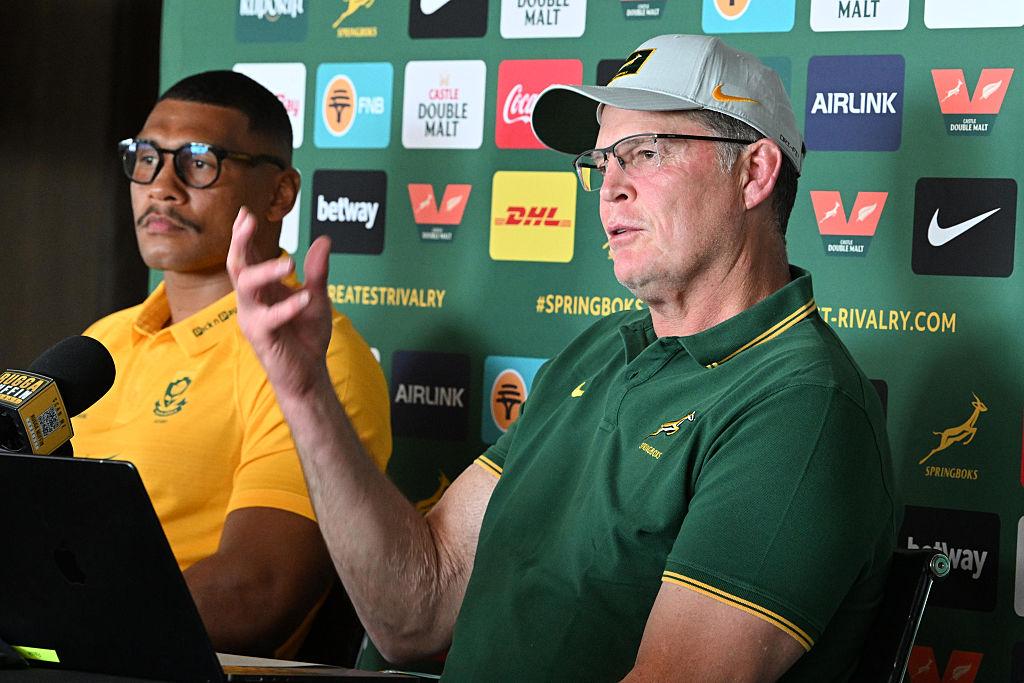
“Springbok coach Rassie Erasmus has named a strong, experienced team for South Africa’s opening November Nations Championship Test against Italy, with lock Salmaan Moerat returning to the starting XV for his first appearance of the season. The selection combines established international leaders with emerging talent as the Springboks prepare for a demanding European tour and pursue a place in the competition’s inaugural Finals Weekend.”
Springboks’ Experienced Line-Up Signals Serious Nations Championship Ambitions
Springboks prepare for crucial Italian challenge
South Africa’s Springboks have entered the decisive November phase of the 2026 Nations Championship with renewed determination after coach Rassie Erasmus selected an experienced 23-man squad for Saturday’s encounter against Italy in Turin. The announcement, made on Monday, 2 November, has placed the defending Rugby World Cup champions firmly in the spotlight as they prepare to navigate three demanding Northern Hemisphere fixtures before the competition’s inaugural Finals Weekend.
The selection reflects Erasmus’s preference for stability, experience and carefully managed competition within the squad. With South Africa currently leading the Southern Hemisphere standings, the upcoming matches represent an opportunity to strengthen their position and demonstrate their readiness for another major international campaign.
The Springboks will face Italy on 7 November before travelling to France and Ireland later this month. Each encounter carries significant implications for their ambition to reach the Nations Championship final, scheduled for the final weekend of November.
According to SuperSport, Erasmus has selected a largely settled team, with lock Salmaan Moerat returning to the starting lineup for his first Springbok appearance of the season.
Salmaan Moerat’s return strengthens the forward pack
One of the most significant developments in the selection is the return of Moerat, whose previous international appearances were interrupted by neck and toe injuries.
The lock will partner Ruan Nortje in the second row, providing South Africa with a combination of physical presence, mobility and lineout experience. Moerat’s inclusion also represents an important personal milestone after spending considerable time recovering and working towards his return to international rugby.
The second-row partnership will be expected to contribute significantly to South Africa’s set-piece performance. Against Italy, the Springboks will need dependable lineout execution, disciplined defensive organisation and sufficient physical strength to compete throughout the match.
The forward pack also includes Ox Nche, Thomas du Toit and Malcolm Marx in the front row. Their collective experience should provide a strong foundation at scrum time while helping South Africa establish territorial control through powerful carries and effective breakdown support.
Behind the front row, captain Siya Kolisi will lead a loose-forward combination featuring Pieter-Steph du Toit and Jasper Wiese.
The trio offers a mixture of leadership, defensive intensity and ball-carrying ability. Kolisi’s presence remains particularly important because his influence extends beyond individual performances to communication, organisation and emotional leadership.
Du Toit provides considerable defensive work and versatility, while Wiese brings physicality and direct attacking contributions.
Together, the forwards will be central to South Africa’s strategy of imposing pressure through controlled possession, territorial kicking and aggressive defensive work.
Erasmus maintains confidence in established combinations
The Springbok backline also reflects continuity, with Morne van den Berg and Sacha Feinberg-Mngomezulu selected as the halfback combination.
Van den Berg will operate at scrumhalf, while Feinberg-Mngomezulu assumes responsibility at flyhalf. Their partnership will be important in determining how effectively South Africa converts possession into attacking opportunities.
Feinberg-Mngomezulu’s decision-making, distribution and kicking will be closely monitored during the Italian encounter. His ability to manage the tempo of the match could influence whether the Springboks dominate through structured phases or exploit opportunities in open play.
The midfield combination of Damian de Allende and Jesse Kriel provides experience and defensive reliability.
De Allende is recognised for his powerful running and ability to challenge opposition defensive structures. Kriel complements those qualities through his defensive organisation, communication and attacking support.
On the wings, Ethan Hooker and Kurt-Lee Arendse bring speed, finishing ability and attacking threat.
Damian Willemse completes the starting backline at fullback, offering versatility in counterattacking situations and additional kicking options.
The combination gives Erasmus several tactical possibilities, including attacking through the midfield, exploiting space on the wings and using tactical kicks to create pressure.
Experienced replacements provide additional flexibility
South Africa’s replacements bench has also attracted attention because it combines established international players with younger talent.
Jan-Hendrik Wessels, Gerhard Steenekamp and Wilco Louw provide front-row cover. Their responsibilities will include maintaining scrum stability and supporting the forward pack during the second half.
Lood de Jager offers experienced second-row reinforcement, while Cameron Hanekom and Paul de Villiers provide additional options among the forwards.
Grant Williams and Manie Libbok complete the replacements, bringing different qualities to the backline.
Williams offers speed and attacking energy at scrumhalf, while Libbok provides creative attacking opportunities and additional kicking options.
The bench composition demonstrates Erasmus’s emphasis on maintaining physical intensity and tactical flexibility throughout the full 80 minutes.
The Springboks have frequently relied on their replacements to influence matches during the second half, particularly when opponents begin struggling under sustained forward pressure.
Nations Championship standings increase the stakes
The November series is particularly important because South Africa enters the Northern Hemisphere phase near the top of the Southern Hemisphere standings.
The Springboks and New Zealand are level on 15 championship points, with South Africa holding first place because of a superior points difference.
This position creates an important incentive to maintain consistency during the remaining pool fixtures.
The Nations Championship provides an opportunity for leading teams from the Northern and Southern Hemispheres to compete within a structured international competition.
For South Africa, success would demonstrate the effectiveness of their preparation and strengthen their position ahead of the 2027 Rugby World Cup.
The Italian match therefore represents more than another international fixture. It is an opportunity to establish momentum, improve cohesion and reinforce confidence before facing increasingly challenging opposition.
Erasmus has acknowledged the importance of the three upcoming matches, emphasising that the Springboks must execute their plans accurately and maintain their performance throughout the entire contest.
Italy presents a determined challenge
Although South Africa enters the contest with an impressive historical record against Italy, Erasmus has warned against underestimating the hosts.
Italy has continued developing its international rugby programme and possesses players capable of challenging established opponents.
The Italian team will also have the advantage of playing in front of its home supporters, creating an atmosphere that could increase pressure on the visiting Springboks.
Their forwards are expected to compete aggressively at the set pieces and breakdowns, while their backline could exploit opportunities created through quick ball and counterattacking situations.
The Springboks will therefore need to approach the encounter with discipline rather than relying exclusively on historical superiority.
Maintaining defensive structure, avoiding unnecessary penalties and controlling possession will be essential.
Italy’s motivation is also strengthened by preparations for the 2027 Rugby World Cup, which will place additional importance on international performances during the coming months.
South Africa’s coaching staff will consequently be evaluating both the immediate result and the team’s ability to execute its tactical approach against determined opposition.
Six uncapped players offer future opportunities
Another important aspect of the November campaign is the inclusion of six uncapped players in the travelling squad.
Markus Muller, Emmanuel Tshituka, Luan Giliomee, Riley Norton, Sebastian de Klerk and Yaqeen Ahmed have joined the national setup as South Africa continues expanding its player development programme.
Their selection reflects the growing importance of developing depth across the Springbok squad.
Erasmus has indicated that the newcomers will be introduced to the team’s structures and monitored during training before opportunities are considered against international opposition.
The presence of these players also demonstrates the value of domestic and overseas competitions in preparing rugby athletes for the highest level.
South African franchises and international clubs continue contributing to the development of players who may eventually become regular Springbok selections.
The opportunity to train alongside established internationals can accelerate their understanding of tactical expectations, professional standards and preparation routines.
However, their progression will depend on performances, adaptation and the coaching staff’s assessment of their readiness.
A demanding European schedule awaits
After Italy, South Africa will travel to France for another challenging encounter before concluding its pool campaign against Ireland.
The French fixture is scheduled for 14 November, while the Ireland match is set for 21 November.
Both opponents are expected to provide demanding examinations of South Africa’s defensive organisation, attacking execution and ability to manage pressure.
The Springboks will also need to manage player workloads carefully across the tour.
International rugby schedules require careful balancing of recovery, training intensity and tactical preparation.
The coaching staff will therefore be responsible for ensuring that the squad remains physically prepared while preserving sufficient continuity in key combinations.
The Finals Weekend, scheduled for 27 to 29 November, offers the possibility of competing for the inaugural Nations Championship title.
South Africa’s performances during the pool phase will determine whether they reach that final stage and how effectively they can challenge the strongest international teams.
Leadership and preparation remain central
Kolisi’s captaincy continues to provide an important foundation for South Africa’s preparations.
His experience in major international tournaments, combined with the leadership contributions of senior players throughout the squad, creates a strong environment for maintaining discipline and confidence.
Erasmus’s selection also suggests that the coaching staff considers experience particularly valuable during a demanding international period.
The squad includes numerous players familiar with the expectations associated with Springbok rugby, allowing preparation to focus on tactical execution rather than rebuilding basic combinations.
Nevertheless, the team must continue adapting to the specific challenges presented by each opponent.
The Italian match will require accurate execution, strong communication and an ability to respond quickly when momentum changes.
These qualities will be particularly important if the contest remains close during the closing stages.
South African rugby supporters await the opening Test
The announcement has generated considerable interest among South African rugby supporters, who will be watching closely as the Springboks begin their November campaign.
The team combines experienced international performers with players seeking to establish themselves within the national setup.
For supporters, the tour provides another opportunity to assess the squad’s development and its prospects ahead of the next Rugby World Cup.
The Italian encounter will also offer an important indication of how effectively South Africa has prepared for the competition’s second phase.
With the Springboks occupying a leading position in the standings, expectations remain high.
However, the coaching staff understands that maintaining that position requires sustained performance rather than reliance on reputation.
Conclusion: Springboks prepare to strengthen their championship ambitions
South Africa’s experienced selection for Italy represents a clear commitment to pursuing success in the Nations Championship.
Moerat’s return strengthens the forward pack, while established combinations across the backline provide continuity and attacking potential.
The replacements bench offers additional flexibility, and the inclusion of uncapped players reinforces the team’s commitment to developing future international talent.
As the Springboks prepare for Italy, France and Ireland, their priorities remain straightforward: accurate execution, disciplined defence, effective set pieces and consistent performance across the full 80 minutes.
The opening match in Turin will provide the first major test of those ambitions.
For South African rugby, the November campaign represents an important opportunity to strengthen international momentum, develop squad depth and pursue another prestigious championship achievement.
The Springboks now have the selection, experience and motivation required to make a serious challenge for the Nations Championship title. Their performances on the field, beginning against Italy, will ultimately determine whether those ambitions become reality.



