




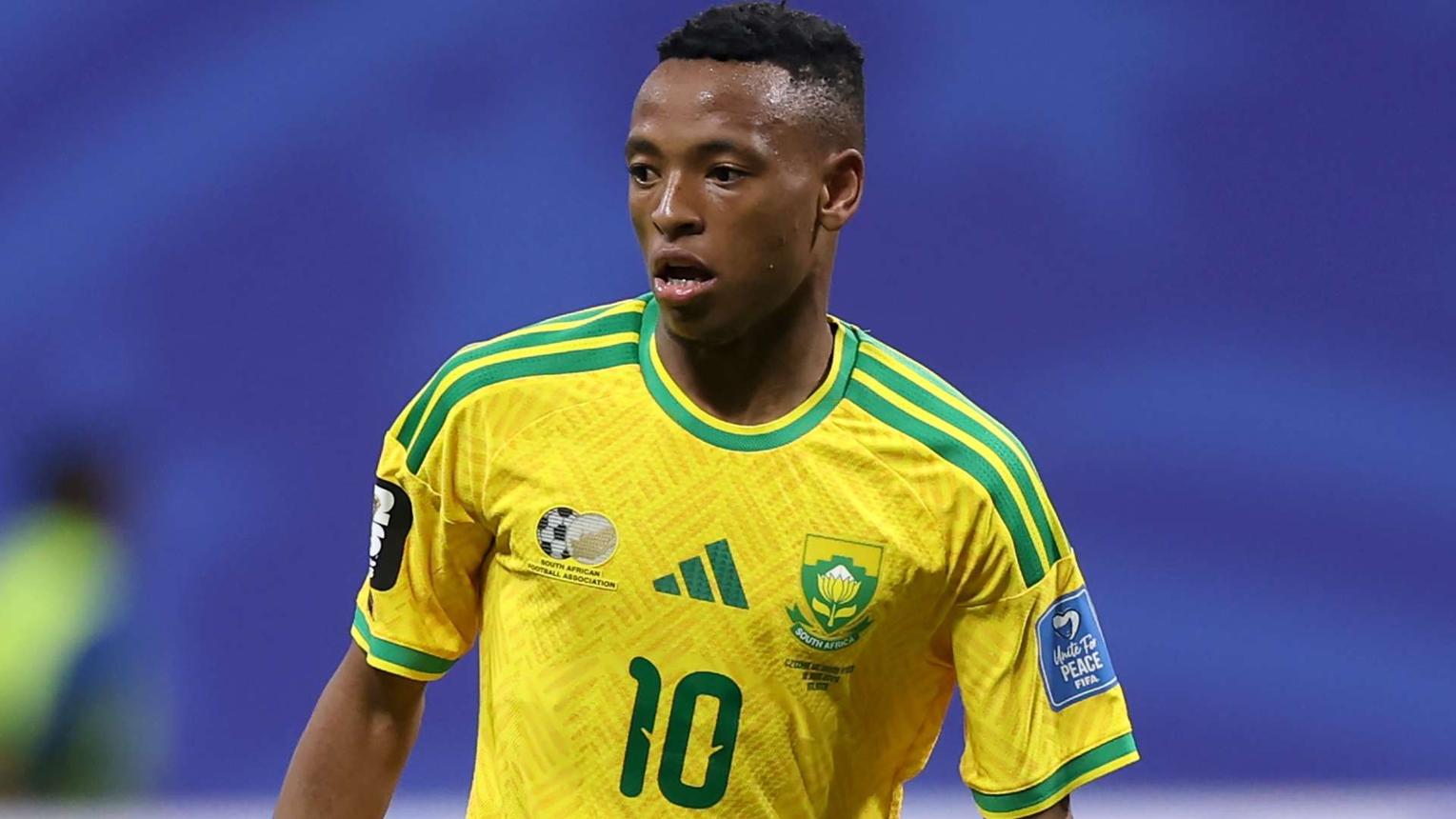
“Puso Dithejane marked his Bafana Bafana debut with the winning goal as South Africa defeated Egypt 1–0 at Cairo International Stadium, completing a perfect three-match international camp under returning coach Pitso Mosimane. The victory is particularly significant because Mosimane made nine changes from the side that defeated Eritrea 5–0, giving several emerging players an opportunity to impress against an experienced Egyptian team.”
South Africa’s senior men’s national football team produced one of the most significant results of the latest international window by defeating Egypt 1–0 in Cairo, with debutant Puso Dithejane scoring the decisive goal in the second half. The victory, played at the Cairo International Stadium on Sunday night and reported prominently on 5 October, gave Bafana Bafana a third consecutive victory under returning coach Pitso Mosimane and capped an exceptionally productive international camp.
The result carries considerable weight because South Africa did not field the same starting XI that had produced a commanding 5–0 victory over Eritrea in their previous match. Instead, Mosimane made nine changes, deliberately giving less experienced players an opportunity to demonstrate that they could compete at international level. Only Ime Okon and Sphephelo Sithole retained their places from the Eritrea match.
Dithejane was among those handed a starting opportunity, and the young forward responded in the best possible way. His goal five minutes after half-time not only decided the match but also provided an early landmark in his international career. The forward showed composure after an error from Egypt goalkeeper Mostafa Shobeir, intercepting the loose ball before rounding an Egyptian defender and finishing into an unguarded net.
The goal was the product of pressure rather than simply luck. South Africa had introduced Shandre Campbell at half-time, replacing Luther Singh, and Campbell’s forward ball created uncertainty for the Egyptian defence. Shobeir rushed from his goal in an attempt to deal with the danger, but his clearance was poorly executed. Dithejane applied pressure, benefited from the resulting deflection and then kept his composure when the opportunity presented itself.
For Mosimane, the victory represented another encouraging beginning to his second spell in charge of Bafana Bafana. His return had already produced victories against Guinea and Eritrea in the 2027 Africa Cup of Nations qualifying campaign. South Africa defeated Guinea 2–1 before dismantling Eritrea 5–0, meaning the win against Egypt gave Mosimane a perfect record at the beginning of his new tenure.
The Egypt match was nevertheless a considerably different challenge from the AFCON qualifiers. Egypt entered the contest with an experienced side and had themselves recently defeated South Sudan 5–0. The hosts included Tottenham Hotspur forward Omar Marmoush, while several other established players retained their positions from previous matches.
Egypt began positively and created some of the early opportunities. Marmoush cut inside and curled an effort wide, while Mohamed Hany later found space for a long-range attempt that went over the crossbar. South Africa initially had to withstand that pressure before gradually becoming more comfortable and finding ways to threaten the Egyptian defence.
Thabang Matuludi was one of the players who helped South Africa settle into the contest. Operating from right-back, he provided an attacking outlet and came close with an effort after combining with Tashreeq Matthews. Shortly before the interval, Matuludi tested Shobeir again as Bafana began to establish greater confidence.
Dithejane was also increasingly influential before scoring. He created an opportunity for Cassius Mailula, although the Egyptian goalkeeper dealt comfortably with the resulting effort. At the other end, Lebone Seema was important in maintaining South Africa’s defensive organisation, producing several clearances and an important block as Egypt searched for openings.
The second half therefore began with both teams still capable of taking control. South Africa’s decisive moment arrived in the 51st minute. The sequence was messy from Egypt’s perspective but expertly exploited by Dithejane, whose determination to challenge for the ball ultimately produced his first senior international goal.
Egypt responded by increasing its attacking pressure. Coach Hossam Hassan made changes designed to inject additional energy into the attack, including the introduction of Ahmed “Zizo” Sayed and Hamza Abdelkarim. Egypt subsequently created opportunities that could have changed the result.
South Africa, however, defended with increasing discipline. Mosimane also made a change in goal, bringing Ricardo Goss on for Sipho Chaine. Goss eventually became one of the key figures in protecting the narrow advantage, producing important saves as Egypt pressed for an equaliser.
One of the most dramatic moments came late in the match. Abdelkarim threatened with a header that Goss managed to save, while Ibrahim Adel also came close. In stoppage time, Goss again intervened, keeping out a dangerous effort before Abdelkarim struck the crossbar with the rebound. South Africa survived the late Egyptian pressure and secured the clean sheet.
The narrow scoreline should therefore not obscure the significance of the performance. South Africa were playing away from home against a team containing considerably more experienced players, yet Mosimane’s younger selection showed the organisation and resilience required to protect a lead in difficult circumstances.
The victory also underlined the depth available to the Bafana coach. Mosimane had promised opportunities for players who had not started the earlier matches of the camp, and he followed through on that approach. Dithejane, Matthews, Poggenpoel, Matuludi, Seema and others were given meaningful opportunities to demonstrate their value.
For Dithejane in particular, the match could become a defining moment. Scoring on a senior international debut immediately puts his name into discussions about future selections. The goal also demonstrated a valuable quality: the willingness to pressure opponents and remain alert when mistakes occur.
The result has broader implications for South African football. Bafana have recently been building greater confidence in continental competition, and the latest run suggests that the national team may possess both established quality and a promising group of younger players. Mosimane now has more evidence from which to construct his preferred team as the 2027 AFCON campaign develops.
The three-match camp was particularly impressive because of its variety. South Africa began with a competitive AFCON qualifying victory against Guinea, followed it with a 5–0 demolition of Eritrea and then defeated Egypt in a friendly. That combination provided both competitive points and valuable experimentation.
The Cairo victory was also watched by South African President Cyril Ramaphosa, who was in Egypt for the African Union Mid-Year Coordination Meeting and attended the match. His presence added an unusual political and national dimension to an already significant sporting occasion.
For Egypt, the defeat will be frustrating because the team had opportunities to equalise and controlled portions of the match. Ahram Online described Shobeir’s mistake as decisive, while also noting that Egypt had several late chances, including an effort that struck the woodwork.
For South Africa, however, the headline is much more positive: Bafana Bafana are winning, new players are emerging and Mosimane’s second tenure has begun with three victories from three matches.
Dithejane’s debut goal will naturally receive the most attention, but the victory was ultimately a collective achievement. South Africa had to defend under pressure, take advantage of a crucial opportunity and maintain concentration during a tense finish.
As Bafana return home, Mosimane faces the more difficult task of turning this promising start into sustained progress. Friendly victories can provide confidence, but competitive matches will ultimately determine whether the new momentum can translate into major tournament success.
For now, though, the message from Cairo is unmistakable. South Africa travelled to Egypt with an experimental team, faced a strong home side and returned with a 1–0 victory. Puso Dithejane supplied the decisive moment, Ricardo Goss protected the lead and a youthful Bafana Bafana side demonstrated that South Africa’s next generation is ready to compete.
The win therefore stands as the top South African football story for 5 October 2026: a debut goal, a perfect Mosimane start and an important away victory that could have lasting consequences for the national team’s future.



