




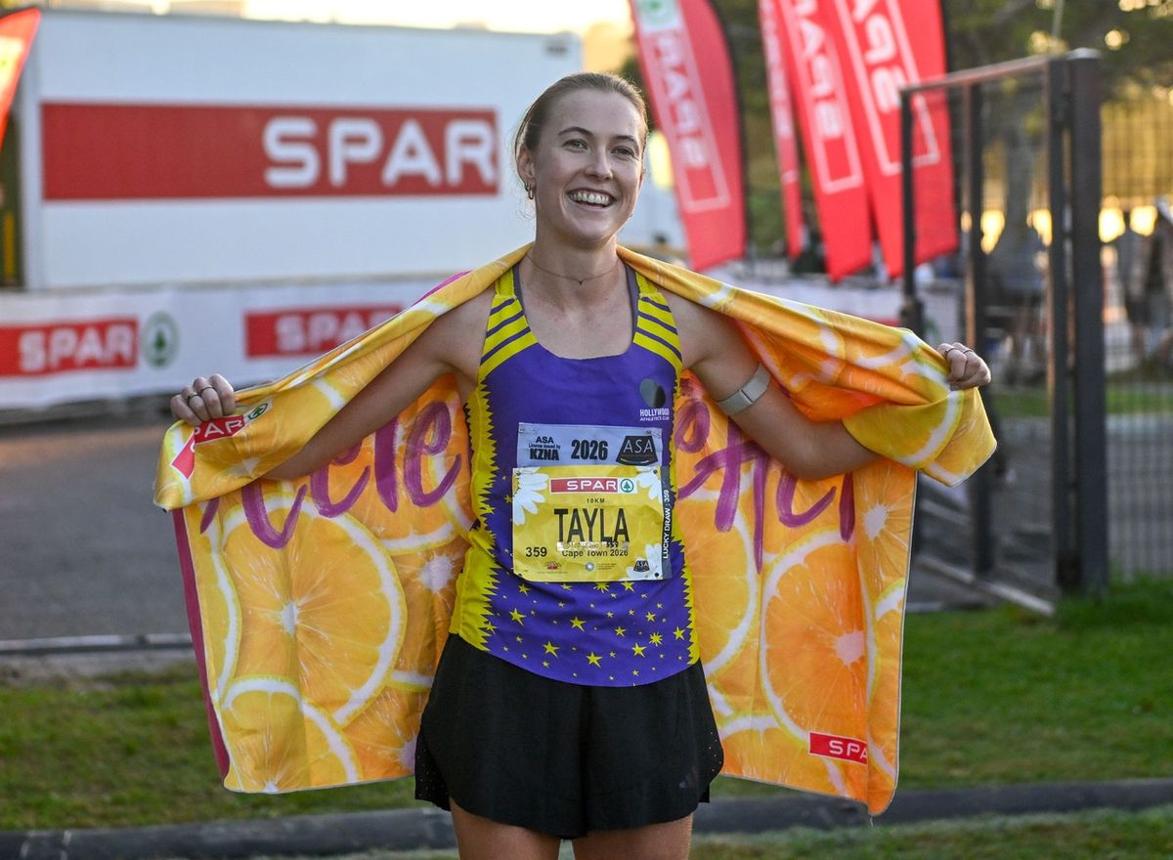
“South African distance runner Tayla Kavanagh has broken the national women’s 10km road record with a sensational 30:50 at the tRUNsylvania 10K in Brasov, Romania. The 25-year-old finished fifth in a world-class field, cutting 22 seconds from Glenrose Xaba’s previous record and securing her second South African road-running record in just 15 days.”
Tayla Kavanagh Shatters South African 10km Record in Romania
South African distance running has another new benchmark after Tayla Kavanagh produced a remarkable 30:50 at the tRUNsylvania 10K in Brasov, Romania, on Sunday, October 4. The performance made the 25-year-old the first South African woman to break 31 minutes for a road 10km, while also giving her a second national record in only 15 days.
For South African fans, the timing is particularly striking because the record arrived immediately after a major championship breakthrough, turning an already impressive season into a defining one.
Kavanagh finished fifth in a world-class women’s field, but her position tells only part of the story. Her time was the major headline because it removed 22 seconds from the previous South African record of 31:12, set by Glenrose Xaba in Durban in July 2024. World Athletics lists Kavanagh’s 30:50 as her current 10km personal best, dated October 4, 2026. The performance is subject to the normal ratification process for a national record.
A breakthrough in Romania
Kavanagh entered the Brasov race with confidence built from an extraordinary September. On September 19, she finished fourth at the World Athletics Road Running Championships in Copenhagen in the women’s 5km, recording 14:51. That mark broke Elana Meyer’s long-standing South African 5km road record of 15:10 from 1994 and made Kavanagh the first South African woman to go under 15 minutes for the distance.
Less than three weeks later, she produced another national-record performance. At the tRUNsylvania 10K, she improved her previous 10km best of 31:26 by 36 seconds and moved the national record from 31:12 to 30:50. Athletics South Africa and World Athletics records confirm the scale of the improvement.
The race itself was exceptionally fast. Ethiopia’s Asefu Abreha won in 30:16, followed by Aynadis Mebratu in 30:19. Yenenesh Shimket was third in 30:21, while Djibouti’s Samia Hassan Nour finished fourth in 30:37. Kavanagh was fifth in 30:50, meaning she was only 34 seconds behind the winner despite competing in a field packed with elite international talent.
The numbers matter because breaking 31 minutes is a significant threshold in women’s road running. Kavanagh did not simply lower the national record by a small margin; she moved it into a new performance bracket. Her run demonstrates that South African athletes can compete much closer to the world’s leading road runners, while giving younger athletes a new national standard to chase.
A season of acceleration
Kavanagh’s record cannot be viewed as an isolated result. Her 2026 season has developed through a series of performances that have steadily raised expectations.
Earlier in the year, she established herself as a leading contender in South African road racing. She also targeted the World Athletics Road Running Championships in Copenhagen, where the 5km performance confirmed that her speed had reached another level. The 14:51 result was particularly important because it showed she could translate domestic success into a major international championship setting.
The Romanian record then demonstrated that her improvement was not limited to the shorter road distance. Moving from a 31:26 personal best to 30:50 requires more than a strong finish. It reflects sustained pace, endurance and the ability to maintain form against international opposition.
Her development is especially notable because Kavanagh has spoken previously about taking responsibility for her own training as a self-coached athlete. Her approach has centred on understanding what works for her body and building consistency. That philosophy appears to be producing results at precisely the moment when South African distance running is gaining greater international attention.
The Xaba connection
The record also carries an important South African storyline because Kavanagh surpassed Glenrose Xaba, who had held the national 10km mark since 2024. Xaba’s 31:12 run had already represented a major step forward, and she has continued to be one of the country’s most successful road runners.
Only a day before Kavanagh’s record received widespread attention, Xaba made headlines of her own by winning the Jozi SPAR Women’s 10km Challenge in Johannesburg in 32:26. The victory secured her fourth SPAR Grand Prix overall title, making her the first athlete to win the series four times.
The timing created a fascinating contrast. Xaba was celebrating a historic series achievement at home while learning that her national record had been broken in Romania. Rather than responding negatively, she welcomed Kavanagh’s achievement and suggested that the two could challenge each other toward even faster times, potentially including a future attempt to break 30 minutes.
That response underlines the positive competitive environment developing around South African women’s distance running. Records are no longer simply marks to defend; they are becoming targets that encourage athletes to raise their own ambitions.
More than a record
Kavanagh’s achievement also matters because road running provides a highly visible pathway for South African athletics. Major road races attract large fields, sponsors, television and digital audiences, while elite performances can inspire recreational runners and young athletes.
The record therefore has significance beyond one athlete’s statistics. It gives South African athletics a new reference point. A 30:50 national record changes the conversation around what the country’s leading women can achieve over 10km.
It may also influence future race selection and international opportunities. Kavanagh has demonstrated that she can perform in strong overseas fields, and that experience can help her pursue more World Athletics-labelled competitions. Her current World Athletics profile lists her among the leading South African athletes across road and track disciplines, with a 30:50 10km, 14:51 5km road mark, 14:58.49 for 5000m and 32:05.59 for 10,000m.
The international context is equally important. The Brasov women’s race was dominated by athletes capable of running around the 30-minute barrier, with Abreha winning in 30:16. Kavanagh’s 30:50 places her much closer to that level and suggests that her progression is not yet finished.
Looking ahead
The biggest question now is how Kavanagh builds on the record. A breakthrough performance can change expectations, but sustaining that level requires careful recovery, consistent training and intelligent competition planning. Her 2026 campaign has already included demanding international racing, so the next stage will be about converting momentum into long-term development.
The prospect of a sub-30-minute South African performance is now no longer an abstract discussion. Xaba herself has raised the possibility, and Kavanagh’s 30:50 puts the barrier only 51 seconds away. That does not make a sub-30 run inevitable, but it gives the target genuine context.
For South African athletics, the broader picture is encouraging. Kavanagh and Xaba are creating a competitive standard that can strengthen women’s distance running domestically. Their progress can also help draw attention to coaching, training opportunities, sponsorship and international race exposure for the next generation.
The importance of Kavanagh’s 30:50 is therefore not limited to the stopwatch. It is a statement about the direction of South African athletics. In Copenhagen, she showed she could challenge at a global championship. In Brasov, she followed that performance by rewriting her country’s 10km record.
At 25, Kavanagh still has significant room to develop. Her latest record suggests that her best performances may not yet have arrived. For now, however, 30:50 stands as a historic national benchmark and one of the strongest signs yet that South African women’s road running is entering an exciting new era.



