




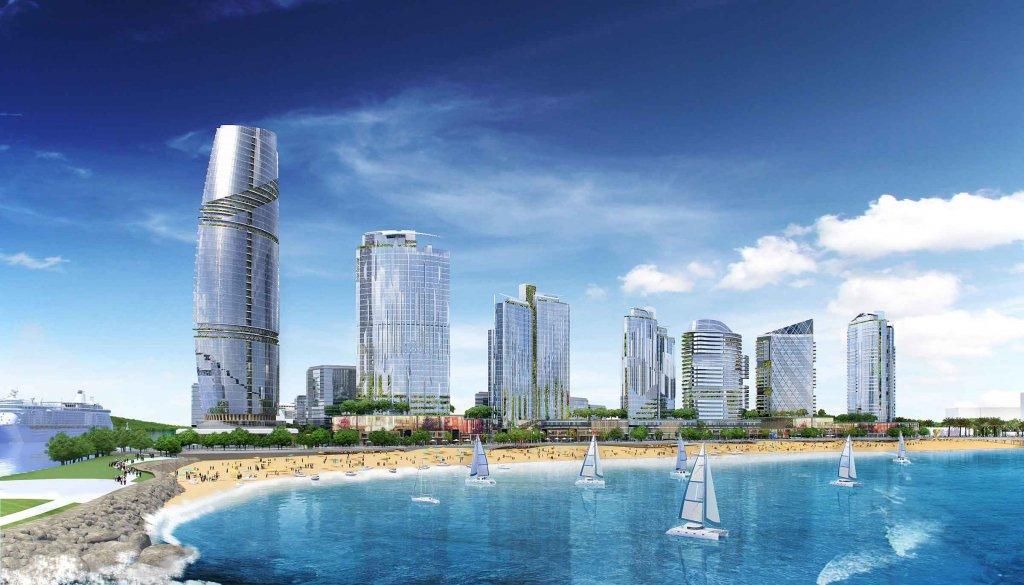
“Durban’s Point Waterfront is preparing for a proposed R30 billion to R35 billion mixed-use redevelopment that could transform the city’s waterfront into a major residential, commercial, retail and leisure destination. The project, led by Durban Point Development Company in partnership with eThekwini Municipality and UEM Sunrise, could create approximately 11,000 construction jobs and 6,750 permanent jobs if fully implemented.”
South Africa’s oldest working harbour undergoes a major property development transformation as V&A Waterfront expands
Cape Town’s historic V&A Waterfront is continuing its transformation into one of South Africa’s most significant mixed-use property development destinations. A decade of investment, redevelopment and expansion has substantially increased the value of the precinct, while new development opportunities in Granger Bay are expected to shape its next stage of growth.
According to a report published by Daily Investor on 1 November 2026, Growthpoint Properties’ 50% stake in the V&A Waterfront increased in value from R7.8 billion in the 2016 financial year to R16.2 billion in the 2026 financial year. This represents a significant expansion in the value of one of the country’s most recognisable property assets.
The development demonstrates how carefully planned property investment can transform an established urban destination into a more diversified economic and commercial environment. It also highlights the growing importance of mixed-use developments in South Africa’s property sector.
A decade of investment reshapes the V&A Waterfront
The V&A Waterfront has developed beyond its traditional identity as a harbour and tourism destination. Over the past decade, the precinct has experienced substantial construction, redevelopment and commercial expansion, bringing together residential accommodation, corporate offices, hospitality, entertainment, retail and cultural facilities.
Growthpoint’s 50% ownership interest provides an important indication of the financial scale of this transformation. Its investment valuation increased from R7.8 billion in 2016 to R9.6 billion in 2019. Although the valuation declined to R8.8 billion in 2021, it subsequently recovered and reached R10 billion in 2023.
The expansion accelerated during the following financial years. The reported valuation increased to R11.5 billion in 2024, R13.3 billion in 2025 and R16.2 billion in 2026.
This progression reflects the contribution of successive development phases, property improvements and changing commercial opportunities within the precinct.
The Silo District establishes a new development direction
One of the earliest major redevelopment initiatives between 2016 and 2018 focused on the historic grain silo area.
Rather than allowing former industrial infrastructure to lose its economic relevance, the precinct’s development strategy transformed the area into a cultural, hospitality and commercial destination.
The development included the Zeitz Museum of Contemporary Art Africa, the Silo Hotel and Radisson RED Hotel. These facilities introduced new tourism, hospitality and cultural attractions while establishing opportunities for additional commercial investment.
The same period also delivered approximately 110,000 square metres of bulk space. This included corporate office accommodation occupied by businesses such as Allan Gray and PwC, alongside the No. 3 Silo residential apartments.
The completed projects strengthened the Silo District’s position as an important part of Cape Town’s commercial and tourism landscape. They also demonstrated how historic structures can be incorporated into modern property developments without completely removing their architectural and industrial character.
Connecting the waterfront with Cape Town’s central business district
Between 2018 and 2023, development priorities increasingly focused on strengthening the connection between the waterfront and Cape Town’s central business district.
This stage included the completion of approximately 20,000 square metres of space at Waterway House, which attracted major commercial occupiers, including British American Tobacco, EY and Ferrari.
The redevelopment of Dock Road Junction also introduced modern workspace facilities through Spaces by Regus and accommodated Apple’s first flagship store in South Africa.
Another significant achievement was Battery Park, which opened in November 2018. The approximately three-acre public park was constructed above a parking facility accommodating 1,200 vehicles.
In addition, the precinct welcomed Deloitte’s approximately 9,000-square-metre corporate office building in the Portswood District.
These projects illustrate how property development can improve the relationship between commercial buildings, public spaces and established urban infrastructure.
Instead of concentrating exclusively on individual buildings, the broader development approach seeks to create a connected destination where residents, workers, tourists and businesses can access multiple services within one urban environment.
Luxury retail and hospitality drive the latest expansion
From 2023 onwards, the V&A Waterfront placed greater emphasis on expanding its luxury retail, accommodation and hospitality offering.
One of the notable developments was a 3,759-square-metre retail extension designed to increase the space available for international luxury brands. The expansion tripled the previous retail space available for this category and introduced global names such as Louis Vuitton, Gucci and Dolce & Gabbana.
The precinct also completed a major refurbishment of the Table Bay Hotel. The refurbishment, valued at approximately R995.1 million, resulted in the property reopening as the InterContinental Table Bay Hotel in December 2025.
Another important hospitality development is the Cape Town EDITION hotel, which opened in October 2026. The hotel includes 142 rooms and six branded residences, strengthening the area’s position in the premium accommodation market.
These investments demonstrate how hospitality and retail development can support the long-term competitiveness of an established property destination. They also provide opportunities for employment, tourism spending and additional commercial activity.
Importantly, the developments are not limited to luxury retail and hotels. Residential construction has also become an increasingly important component of the waterfront’s property strategy.
Residential property development creates new opportunities
The V&A Waterfront’s residential developments demonstrate the growing importance of introducing permanent residential communities into established commercial and tourism precincts.
One example is the 5 Dock Road residential development, which recorded the transfer of 97 out of its 98 residential units during the 2026 financial year.
This development highlights the demand for residential accommodation in locations offering access to employment, restaurants, shopping facilities, entertainment and transport connections.
The introduction of residential properties also changes the economic character of the waterfront. Rather than functioning primarily as a destination visited during business hours or holidays, a mixed-use precinct can attract people who live within the area throughout the year.
This creates opportunities for restaurants, supermarkets, service providers, healthcare businesses and other local enterprises.
The broader objective is to establish an environment where residential, commercial and recreational activities complement one another.
Granger Bay becomes the next major development opportunity
One of the most significant components of the V&A Waterfront’s future expansion is the Granger Bay District.
In January 2026, the City of Cape Town approved an additional 440,000 square metres of permissible development rights for the district. According to the report, this forms part of a total development runway of approximately 600,000 square metres.
The first phase of the Granger Bay Master Plan covers approximately 200,000 square metres.
Residential accommodation is expected to account for 55% of this first phase, with the remaining development incorporating commercial, healthcare, educational, retail and hospitality facilities.
This represents an important shift towards a more comprehensive mixed-use development model.
Healthcare and educational facilities, for example, can make a residential neighbourhood more practical by providing services that people need in their everyday lives. Commercial buildings can attract businesses and employment opportunities, while hospitality and retail facilities can support visitors and residents.
The residential component is particularly important because it can help create a more active neighbourhood beyond conventional shopping and tourism hours.
Nevertheless, the successful implementation of the master plan will depend on coordinated planning, infrastructure capacity, financing and effective development management.
Economic implications for Cape Town and South Africa
The V&A Waterfront’s expansion has implications extending beyond the immediate property investment.
Large developments can stimulate economic activity through construction expenditure, professional services, building materials, engineering, architecture, maintenance and property management.
Furthermore, completed commercial and residential properties can create demand for permanent employment across hospitality, retail, security, cleaning, administration and other service industries.
For Cape Town, the waterfront’s expansion also strengthens the city’s ability to attract international visitors, businesses and property investors.
The combination of accommodation, corporate offices, residential properties and entertainment facilities gives the precinct multiple sources of commercial activity.
This diversification can help reduce dependence on any single property category. For example, commercial offices, residential accommodation and hospitality facilities respond to different market demands.
However, the reported increase in Growthpoint’s investment valuation should not automatically be interpreted as equivalent growth in rental income, profits or cash returns. Property valuations are influenced by several factors, including market conditions, development improvements and investment expectations.
The long-term success of the precinct will therefore depend on its ability to maintain occupancy, attract businesses, deliver quality facilities and generate sustainable commercial performance.
Infrastructure and sustainable urban planning
As the V&A Waterfront expands, infrastructure planning will remain central to its future development.
Mixed-use developments require reliable electricity, water, sanitation, transport connections, waste management and public spaces.
These requirements become particularly important when residential, commercial, hospitality and healthcare facilities operate within the same precinct.
The integration of green spaces and accessible public areas can also improve the experience of people living, working and visiting the waterfront.
South Africa’s property industry increasingly needs developments that balance commercial returns with environmental responsibility and long-term infrastructure resilience.
The waterfront’s experience with adaptive reuse, public parks and the redevelopment of existing buildings provides examples of how established urban areas can accommodate new uses.
Nevertheless, future development phases will need to ensure that additional construction does not place excessive pressure on existing services or reduce public accessibility.
Challenges and the future outlook
Despite the reported progress, large-scale property development is not without challenges.
Construction costs, financing conditions, interest rates, regulatory approvals and demand for commercial and residential accommodation can influence project feasibility.
Developers must also consider the affordability and accessibility of housing, particularly in a city where residential demand extends across different income groups.
The expansion of premium residential and hospitality properties creates investment opportunities, but the wider city also requires housing solutions that serve ordinary working households.
Consequently, the long-term contribution of major developments should be evaluated not only through property valuations but also through employment, economic participation, infrastructure improvements and the wider benefits delivered to surrounding communities.
Granger Bay’s proposed expansion offers an opportunity to demonstrate how residential, commercial, educational and healthcare facilities can be planned together.
Its implementation will require continued cooperation between property owners, municipal authorities, investors, businesses and infrastructure providers.
Conclusion: A major milestone for South African property development
The V&A Waterfront’s transformation represents an important example of how long-term property investment can reshape an established urban destination.
Growthpoint’s reported 50% investment valuation of R16.2 billion in 2026, compared with R7.8 billion in 2016, demonstrates the financial scale of the precinct’s development over the past decade.
More importantly, the next phase at Granger Bay introduces opportunities to expand residential accommodation, commercial activities, healthcare, education, retail and hospitality facilities.
For South Africa’s real estate industry, the development highlights the importance of integrated planning, adaptive reuse, private investment and infrastructure-led urban regeneration.
As Cape Town continues to attract businesses, residents and international visitors, the V&A Waterfront is positioned to remain a significant part of the city’s property development landscape.
However, its long-term success will depend on responsible investment, effective infrastructure management and the delivery of developments that create lasting economic and social value.
The coming years will therefore be important in determining how successfully the Granger Bay Master Plan translates its development potential into completed buildings, functioning neighbourhoods and sustainable economic opportunities.
Ultimately, the V&A Waterfront illustrates how a historic working harbour can continue evolving into a modern urban destination while maintaining its importance within South Africa’s property, tourism and commercial sectors.



