




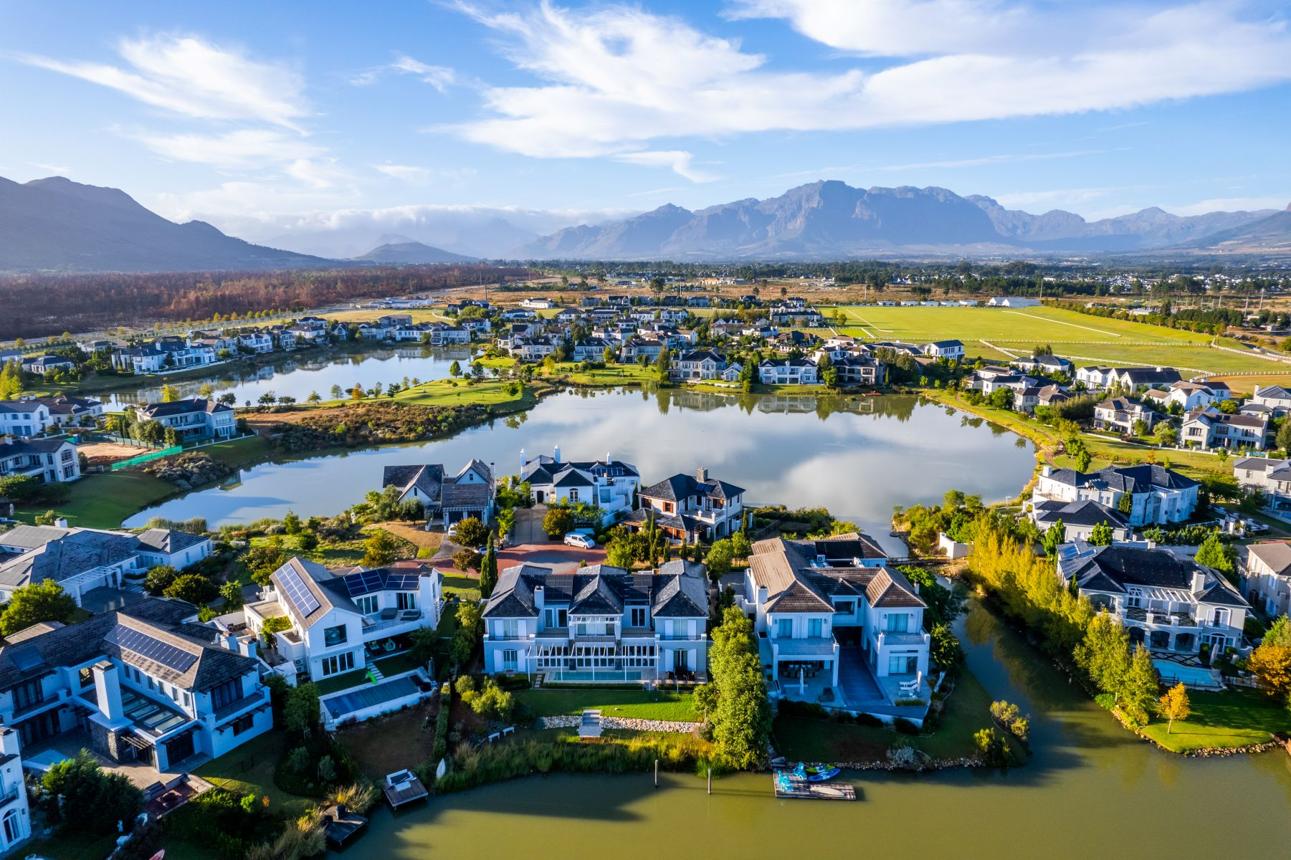
“South African entrepreneur Martin Venter has transformed a struggling Cape Winelands farm acquired for approximately R20 million into Val de Vie Estate, a luxury residential and lifestyle development valued at approximately R15 billion. The development illustrates the growing importance of premium residential property, lifestyle amenities, secure estate living and long-term investment in South Africa’s luxury real estate market.”
From a R20 Million Farm to a R15 Billion Property Empire: The Rise of Val de Vie Estate in South Africa’s Luxury Real Estate Market
A landmark transformation in South African luxury property
South Africa’s luxury real estate sector has another remarkable development story to examine following the transformation of a neglected Cape Winelands farm into one of the country’s most prominent high-end residential destinations. At the centre of this story is entrepreneur and property developer Martin Venter, whose investment in a rural property near Paarl has developed into the prestigious Val de Vie Estate.
The development demonstrates how strategic land acquisition, carefully planned infrastructure, lifestyle amenities and premium residential offerings can transform an ordinary agricultural property into a valuable real estate destination. It also highlights the growing importance of luxury lifestyle estates in South Africa, particularly in the Western Cape, where wealthy families, entrepreneurs, investors and retirees continue to seek secure and attractive residential environments.
According to a report published by Billionaires.Africa on 1 November 2026, Venter acquired the original farm in 2002 for approximately R20 million. The property subsequently became Val de Vie Estate, which the developer valued at approximately R15 billion in 2020. This represents a remarkable transformation in the property’s scale and commercial significance.
From corporate law to property development
Martin Venter’s journey into luxury real estate began with a professional background in corporate commercial law. However, his involvement in property-related legal matters gradually developed into an interest in property investment, planning and development.
Before establishing Val de Vie, Venter worked with Atterbury Property, where he gained experience in commercial property development. His exposure to the property industry helped him understand how land acquisition, development rights, infrastructure investment and changing market conditions influence real estate values.
After leaving Atterbury, Venter spent time studying successful residential lifestyle estates in international markets, including developments in the United States and Spain. He examined how premium residential communities were planned, marketed and managed.
His research eventually led him to the Cape Winelands, an area offering attractive scenery, established agricultural landscapes and access to important urban facilities.
In 2001, Venter chartered a light aircraft to search for suitable development land. During the flight, he identified a neglected wine farm near the Berg River, between Paarl and Franschhoek. The property offered an opportunity to develop a residential destination within an attractive natural environment.
He acquired the farm in 2002, setting the foundation for what would become Val de Vie Estate.
Building a luxury residential destination
Transforming agricultural land into a premium residential estate required substantial investment and careful planning.
Construction began in 2004, with approximately R450 million allocated to roads, services and infrastructure before the first houses were completed. This investment was important because luxury residential developments require more than attractive buildings. Buyers expect dependable infrastructure, well-maintained communal spaces, security and convenient access to everyday facilities.
The estate gradually introduced amenities designed to attract families seeking an integrated lifestyle.
A lifestyle centre featuring swimming facilities, a gym, tennis courts and squash courts was completed in 2006. The development also incorporated wine production, polo facilities and recreational opportunities.
The first residents moved into the estate in 2007, marking an important milestone in its transformation from a development project into an established residential community.
The estate’s name, Val de Vie, translates from French as “valley of life”. Its identity reflects the developer’s intention to combine residential living with outdoor recreation, natural surroundings and premium lifestyle experiences.
Rather than positioning the development simply as a collection of expensive homes, the business created a residential environment in which amenities and community activities formed part of the property’s overall appeal.
Why lifestyle estates attract wealthy property buyers
Luxury property buyers increasingly evaluate residential developments according to the experiences and services they provide.
Although architectural design, property size and location remain important, security, recreation, privacy and access to amenities can significantly influence purchasing decisions.
Val de Vie’s development strategy recognised these priorities early.
According to the original report, approximately 60% of residents have children under the age of 12. This influenced the decision to position the estate primarily around family living rather than developing it exclusively as a holiday destination for international buyers.
The development also made an important distinction in its recreational offering by placing greater emphasis on horses and polo rather than relying entirely on golf.
The polo fields and surrounding paddocks became defining features of the landscape. They also helped establish a recognisable identity for the estate.
This approach illustrates an important principle in luxury property development: successful estates must offer a distinctive lifestyle proposition that separates them from competing residential projects.
For affluent buyers, the opportunity to enjoy open spaces, organised recreational activities and a secure residential environment can be just as important as the physical property itself.
Security and recreational infrastructure strengthen the estate’s appeal
Security is another important consideration in South Africa’s premium residential property market.
High-value homes represent substantial financial investments, and buyers frequently seek developments that provide additional protection, controlled access and professional estate management.
Val de Vie has promoted a security offering that includes 24-hour armed response and more than 100 infrared cameras.
The development also advertises extensive outdoor recreational infrastructure, including approximately 42 kilometres of mountain-bike trails and a 50-metre Olympic swimming pool.
These facilities contribute to the estate’s wider lifestyle positioning.
Furthermore, its polo activities and sporting events have helped establish the development as a destination beyond the residential property market.
The Veuve Clicquot Masters Polo and the Absa Cape Epic have contributed to its public profile, while the estate has also hosted international sporting personalities.
For the luxury real estate industry, these activities demonstrate how events, recreation and destination branding can support the commercial attractiveness of a residential development.
Billionaires.Africa
The Pearl Valley acquisition expands the property portfolio
One of the most significant developments in Val de Vie’s growth was its expansion through the acquisition of neighbouring Pearl Valley Golf & Country Estate.
Pearl Valley had previously been acquired by Dubai World in 2007 for approximately R700 million. However, financial difficulties eventually placed the development into business rescue in 2012.
Standard Bank, which was the estate’s principal creditor, subsequently took control through a debt-for-equity arrangement.
Venter’s business had already acquired substantial undeveloped land in the surrounding area. In 2015, a consortium led by Val de Vie, together with the Mantis Collection, acquired the remaining Pearl Valley development from Standard Bank.
The transaction included the golf course, clubhouse, residential plots, hotel development opportunities and equestrian facilities.
Although the purchase price was not disclosed, the acquisition significantly expanded the group’s development opportunities.
The two estates were subsequently marketed together as a larger lifestyle destination, combining polo, golf, residential properties, hospitality and recreational facilities.
This expansion demonstrates how strategic acquisitions can strengthen a developer’s market position. Instead of concentrating exclusively on constructing new homes, property companies can acquire existing developments, improve their operations and integrate complementary amenities.
The acquisition also strengthened the estate’s appeal to buyers seeking a broader range of residential and recreational experiences.
Investment from Patrice Motsepe strengthens the business profile
Another important milestone occurred in 2016 when African Rainbow Capital, the investment group founded by South African businessman Patrice Motsepe, acquired a 20% interest in Val de Vie Investments.
This investment represented an important endorsement of the development’s commercial potential.
African Rainbow Capital’s involvement also provided a rare public insight into the company’s financial performance because its investment reports disclosed selected valuations and information relating to the holding.
The investment demonstrated that luxury residential estates can attract institutional investment when their underlying land, development opportunities and business models offer potential long-term value.
Nevertheless, Val de Vie remains a privately operated property group, and its complete financial accounts and the precise value of individual shareholders’ interests are not publicly available.
Consequently, the approximately R15 billion valuation reported for the estate should be understood as a historical valuation attributed to Venter, rather than a newly audited 2026 market valuation.
This distinction is important for investors and readers assessing the financial strength of luxury property businesses.
Strong property transactions demonstrate continued demand
The estate’s growth has also been supported by significant residential property transactions.
The original report indicates that Val de Vie recorded approximately R1.2 billion in sales during the year to September 2018. This increased to approximately R2.4 billion in the year to September 2021 and R3.1 billion in the 12 months to March 2023.
More recently, registered property sales at Val de Vie reached approximately R826.9 million during the first half of 2026.
Neighbouring Pearl Valley contributed another R467.3 million over the same period.
The most expensive home sold during that six-month period achieved approximately R58.65 million.
These figures illustrate the substantial value of transactions taking place within the combined development.
They also demonstrate why established luxury estates can remain important contributors to regional property markets, particularly when they offer a combination of desirable locations, established infrastructure and premium residential facilities.
However, transaction values should not automatically be interpreted as investment returns or guaranteed future property appreciation. Actual performance depends on purchase prices, property condition, operating costs, market demand and broader economic conditions.
Retirement living becomes an important growth opportunity
Another significant part of the group’s development strategy is its expansion into retirement residential property.
Val de Vie Evergreen introduces a retirement lifestyle offering within the wider estate.
The development combines residential accommodation with access to healthcare and lifestyle facilities, responding to demand among older buyers seeking security, convenience and a community environment.
By February 2025, the Evergreen development reportedly had more than 550 residents, over 300 homes and 60 suites sold.
Its Silver Leaf phase introduced another 127 homes, with advertised starting prices of R7.8 million.
A Mediclinic facility also operates within the retirement village.
This development highlights an important opportunity in South Africa’s luxury real estate sector.
As the population ages, premium retirement communities can attract buyers who want to maintain independence while accessing healthcare and recreational facilities.
For developers, integrating retirement accommodation into established lifestyle estates can create additional sources of demand and broaden the potential customer base.
It also illustrates how luxury real estate is evolving beyond traditional mansions and large family homes.
The Western Cape’s growing attraction for wealthy buyers
Val de Vie’s development has taken place alongside broader changes in South Africa’s residential property market.
The Western Cape has become an important destination for affluent households relocating from other parts of the country.
Factors influencing these decisions include lifestyle preferences, access to established schools, recreational facilities, attractive natural surroundings and opportunities for retirement living.
The Cape Winelands offers a particularly distinctive residential proposition because it combines agricultural landscapes with established towns, wine tourism, hospitality businesses and access to Cape Town.
Val de Vie benefits from its position between Paarl and Franschhoek, with access to the N1 highway and regional services.
This location helps balance the privacy of estate living with connectivity to surrounding economic and social centres.
However, the development’s success should not be taken as evidence that every luxury property in the Western Cape will experience similar demand.
Premium property markets are influenced by location, affordability, available inventory, interest rates and buyer confidence.
The strongest developments are generally those that can demonstrate a distinctive offering rather than relying entirely on the prestige associated with their addresses.
Environmental responsibility and community development
Environmental considerations are becoming increasingly important in the luxury property sector.
Affluent buyers are paying greater attention to natural surroundings, water management, landscaping, energy efficiency and the long-term environmental impact of residential developments.
Val de Vie’s positioning within the Cape Winelands provides opportunities to incorporate outdoor recreation and natural landscapes into its residential offering.
The development has also established a foundation that contributes to community projects. According to the original report, the Val de Vie Foundation receives 1% of the developer’s property sales and 2.5% of monthly levies.
By 2025, the foundation had invested more than R50 million in community projects.
This approach demonstrates how large residential developments can incorporate social investment into their broader business models.
Nevertheless, environmental and social commitments require continuous implementation and transparent reporting to demonstrate their long-term effectiveness.
Challenges facing luxury estate developers
Despite its impressive growth, Val de Vie’s development history also illustrates some of the challenges associated with managing large residential communities.
The expansion involving Pearl Valley resulted in disagreements between the developer and some homeowners concerning governance, voting arrangements and the proposed integration of additional residential developments.
These disagreements resulted in legal proceedings in 2022, although the urgent interdict application was dismissed by the Western Cape High Court.
The two homeowners’ associations subsequently approved a reciprocal-use agreement in July 2024, allowing residents to access facilities across both developments.
This experience highlights an important issue for South Africa’s luxury property industry: successful development is not determined by construction quality and property sales alone.
Transparent governance, fair community participation, appropriate management structures and clear communication with homeowners are essential to maintaining confidence in large residential estates.
Developers must therefore balance commercial expansion with the expectations and interests of existing residents.
Future expansion creates additional investment opportunities
Val de Vie’s development strategy extends beyond its original estate.
The group has also been involved in Paarl Valleij, a residential development covering approximately 43 hectares in northern Paarl.
The project introduced homes aimed at buyers seeking access to the broader Cape Winelands residential market.
Another development, Fijnland, is also part of the group’s expansion activities.
Within Val de Vie, the Vivante Village apartment development achieved approximately 95% sales following its launch in late 2023, according to the original report.
These projects illustrate the developer’s intention to broaden its residential portfolio and introduce different housing options.
The strategy also reflects the importance of maintaining a pipeline of development opportunities as established estates approach the limits of their available land.
However, future performance will depend on the availability of buyers, infrastructure capacity, financing conditions and the ability to deliver developments at commercially sustainable prices.
What the Val de Vie story means for South Africa’s luxury property market
The transformation of Val de Vie represents an important example of how strategic property investment can reshape a regional real estate market.
What began as a neglected agricultural property has developed into a major residential destination offering luxury homes, sporting facilities, retirement accommodation, hospitality and recreational opportunities.
For South African property developers, the project demonstrates the importance of identifying land with strong long-term potential and creating a development that offers more than conventional residential accommodation.
For property investors, it highlights the potential commercial value of established lifestyle estates, particularly those supported by infrastructure, recognisable branding and consistent buyer demand.
For prospective homeowners, it demonstrates how premium residential developments are increasingly competing through lifestyle experiences, security, community facilities and access to essential services.
Nevertheless, the estate’s reported historical valuation should not be confused with a guaranteed investment return or independently verified current market value.
South Africa’s luxury real estate sector will continue to face challenges involving affordability, economic conditions, municipal services, infrastructure and development costs.
Ultimately, Val de Vie’s story demonstrates that successful luxury property development requires a combination of strategic land acquisition, financial commitment, market understanding and effective estate management.
As the Western Cape continues attracting affluent buyers and property investors, established developments such as Val de Vie are likely to remain important examples of the changing character of South Africa’s premium residential property market.



