




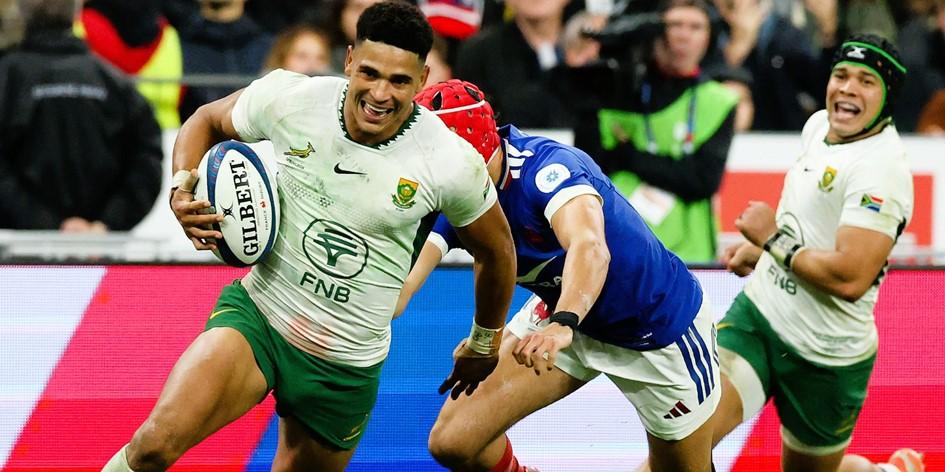
”Rassie Erasmus has defended his decision to maintain a largely unchanged Springbok lineup for Friday’s Nations Championship encounter against France, arguing that the players are sufficiently fresh despite the demanding international schedule. South Africa’s 66–7 victory over Italy has strengthened confidence in the squad, while Wilco Louw’s promotion to the starting front row and Cobus Reinach’s inclusion on the bench represent the principal selection adjustments.”
Springboks Back Continuity as Rassie Erasmus Prepares for Massive France Test
Erasmus trusts winning combination ahead of Paris showdown
South Africa’s Springboks are preparing for one of their most demanding challenges of the 2026 Nations Championship after head coach Rassie Erasmus reaffirmed his confidence in a largely unchanged matchday squad ahead of Friday’s encounter against France. The decision follows a commanding 66–7 victory over Italy in Turin, a performance that demonstrated the defending world champions’ attacking strength and growing confidence in their developing combinations.
Erasmus believes maintaining continuity is the appropriate strategy as South Africa pursue their ambitions in the international competition. Rather than making extensive changes following the Italian victory, the coach has retained most of the players responsible for delivering the impressive result.
The selection decision reflects a broader approach to squad management, balancing player development, workload considerations and the importance of establishing consistency in performance.
Wilco Louw returns to the starting front row
The most significant adjustment to South Africa’s starting lineup sees experienced tighthead prop Wilco Louw promoted into the starting XV, replacing Thomas du Toit, who moves to the replacements bench.
Louw will join loosehead prop Ox Nché and hooker Malcolm Marx in a powerful front row expected to play an important role against France.
The adjustment provides Erasmus with an opportunity to maintain continuity in the team’s forward structure while managing the workload of experienced players.
Du Toit’s inclusion among the replacements also gives South Africa additional scrum strength and physicality later in the match.
The front row remains an important area of focus because France traditionally place significant emphasis on forward power, territorial pressure and set-piece execution.
South Africa’s ability to establish dominance in the scrum could influence how effectively the team controls possession and territory during the encounter.
Cobus Reinach strengthens the replacements bench
The second major adjustment concerns the inclusion of scrumhalf Cobus Reinach, who replaces Grant Williams among the substitutes.
Reinach’s experience in French rugby is expected to provide useful familiarity with the conditions and playing environment.
The scrumhalf previously represented Montpellier, giving him considerable exposure to French rugby culture, competition intensity and tactical approaches.
His inclusion also strengthens South Africa’s options in the final stages of the match, particularly if the contest develops into a demanding tactical battle.
Experienced replacements can become especially important in international rugby, where the outcome frequently depends on the ability to maintain intensity during the closing minutes.
Reinach’s presence therefore provides Erasmus with another experienced option as South Africa prepare for a potentially physical encounter.
Springboks arrive with confidence after Italy demolition
South Africa’s preparation for France has been significantly influenced by the impressive performance against Italy.
The Springboks defeated the Italians 66–7 in Turin, scoring nine tries and establishing a commanding 45–0 halftime advantage.
Flyhalf Sacha Feinberg-Mngomezulu played a prominent role in the victory, contributing through his kicking, attacking decisions and ability to exploit defensive weaknesses.
Malcolm Marx also delivered an outstanding performance, scoring twice as South Africa established their dominance during the opening half.
Additional tries from Morne van den Berg, Siya Kolisi and Damian Willemse helped the visitors build an overwhelming advantage before halftime.
Although Italy improved after the break, South Africa continued to add points through Wilco Louw, Paul de Villiers and Ethan Hooker.
The victory reinforced the Springboks’ position as one of the leading contenders in the Nations Championship and demonstrated their capacity to generate attacking opportunities across multiple areas of the field.
Erasmus believes workload management has worked
One of the central arguments behind Erasmus’s selection strategy is his confidence that the players have been adequately managed throughout the international campaign.
The coach has explained that several experienced players have not accumulated excessive playing minutes, allowing them to remain physically prepared for demanding fixtures.
South Africa have also managed individual workloads during matches, removing certain players when appropriate to limit unnecessary exposure to physical demands.
Erasmus believes the Italian encounter was not excessively taxing for the majority of the squad, particularly considering the team’s comfortable first-half advantage.
This assessment has influenced his decision to retain most of the players rather than introduce extensive rotation before the France match.
Nevertheless, international rugby remains physically demanding, and maintaining player freshness throughout a sequence of high-intensity matches presents significant challenges.
South Africa’s management team will therefore continue monitoring fitness, recovery and performance levels as the European campaign progresses.
Eben Etzebeth’s return provides additional depth
The return of experienced lock Eben Etzebeth to the touring group has also attracted considerable attention.
Etzebeth arrived in France after recovering from an injury-related absence, providing the Springbok management team with another experienced forward option.
However, Erasmus has decided against immediately placing him in the matchday squad.
The coach explained that Etzebeth would benefit from additional time to regain his rhythm after spending time away from competitive rugby.
South Africa already possess experienced options in the second row, including Lood de Jager and Franco Mostert.
The decision demonstrates Erasmus’s willingness to prioritise preparation and fitness rather than selecting players solely because of their reputations or previous achievements.
Etzebeth’s return nevertheless represents an encouraging development for South African rugby as the team continues building depth ahead of future international competitions.
France presents a different challenge
Despite their convincing victory over Italy, the Springboks are expected to face considerably greater resistance in Paris.
France remain one of the strongest international rugby teams and possess the physical strength, attacking creativity and tactical flexibility necessary to challenge South Africa.
The French side also benefits from playing at the Stade de France, where passionate home supporters frequently create an intimidating atmosphere for visiting teams.
South Africa’s previous encounters with France have demonstrated the intensity of the rivalry.
The teams produced a memorable contest during the 2023 Rugby World Cup quarter-final, while their subsequent international meetings have continued to underline the competitive nature of the relationship.
Erasmus has acknowledged the difficulty of the upcoming fixture, describing the encounter as an intense challenge in which both teams will have significant ambitions.
France’s forward pack and dangerous attacking players will require South Africa to maintain discipline and defensive organisation throughout the match.
SA Rugby+1
Nations Championship ambitions increase the stakes
The France encounter carries important implications for South Africa’s position in the Nations Championship.
The competition’s structure places considerable importance on results across the international campaign, with the leading teams seeking opportunities to qualify for the concluding Finals Weekend.
South Africa have already established a strong position following their earlier victories and their emphatic performance against Italy.
However, France’s strength means the Springboks cannot afford to underestimate the challenge.
A successful result in Paris would provide significant momentum ahead of their subsequent encounter against Ireland.
The match also offers an opportunity for South Africa to demonstrate that their developing combinations can perform consistently against leading international opponents.
The competition therefore provides valuable preparation for the team’s broader ambitions, including maintaining their status among the leading rugby nations.
Key players expected to influence the contest
Several experienced Springboks will play important roles in determining the outcome.
Captain Siya Kolisi remains central to South Africa’s leadership and forward organisation.
Pieter-Steph du Toit provides defensive intensity, physical strength and exceptional work rate, while Jasper Wiese offers carrying power and support around the breakdown.
In the backline, Feinberg-Mngomezulu’s decision-making and kicking accuracy will be important in controlling territory.
The combination of Jesse Kriel and Damian de Allende provides experience and defensive reliability in midfield.
Meanwhile, Kurt-Lee Arendse and Ethan Hooker offer attacking opportunities through speed, movement and their ability to exploit space.
The team also benefits from Damian Willemse’s versatility, allowing South Africa to adapt their attacking structure and defensive positioning.
These combinations will need to operate effectively against a French side expected to challenge South Africa physically and tactically.
South Africa must improve despite impressive results
Although the victory against Italy was comprehensive, Erasmus has indicated that the Springboks still have areas requiring improvement.
The team will need to maintain its concentration throughout the match rather than relying exclusively on strong attacking periods.
Defensive organisation, tactical discipline and effective execution remain essential against opponents capable of exploiting small mistakes.
South Africa must also ensure that their attacking approach remains balanced, combining forward pressure with opportunities for their dangerous backline players.
The France encounter is expected to provide a more accurate assessment of the team’s current international standing.
It will also offer valuable information about the effectiveness of the squad’s combinations against a high-quality opponent under significant pressure.
Paris encounter offers another opportunity for Springbok progress
The Springboks’ decision to maintain continuity reflects confidence in the players who delivered their recent success.
Erasmus believes the squad possesses the freshness, experience and tactical understanding necessary to compete against France.
However, the outcome will ultimately depend on execution rather than selection alone.
South Africa will need to demonstrate physical resilience, tactical discipline and attacking precision throughout the encounter.
The match represents an important opportunity to strengthen their Nations Championship ambitions while continuing preparations for the next phase of international rugby.
With experienced leaders, emerging talents and additional squad depth available, the Springboks approach the Paris showdown with considerable confidence.
Their challenge will be to transform that confidence into another performance capable of confirming their position among international rugby’s strongest teams.
Friday’s contest is therefore more than another international fixture. It is an opportunity for South Africa to demonstrate that their impressive victory against Italy represents sustained progress rather than an isolated performance.
The Springboks will enter the Stade de France knowing that France will demand considerably more from them, but Erasmus’s selection strategy indicates that he believes continuity provides the strongest foundation for meeting that challenge.



