




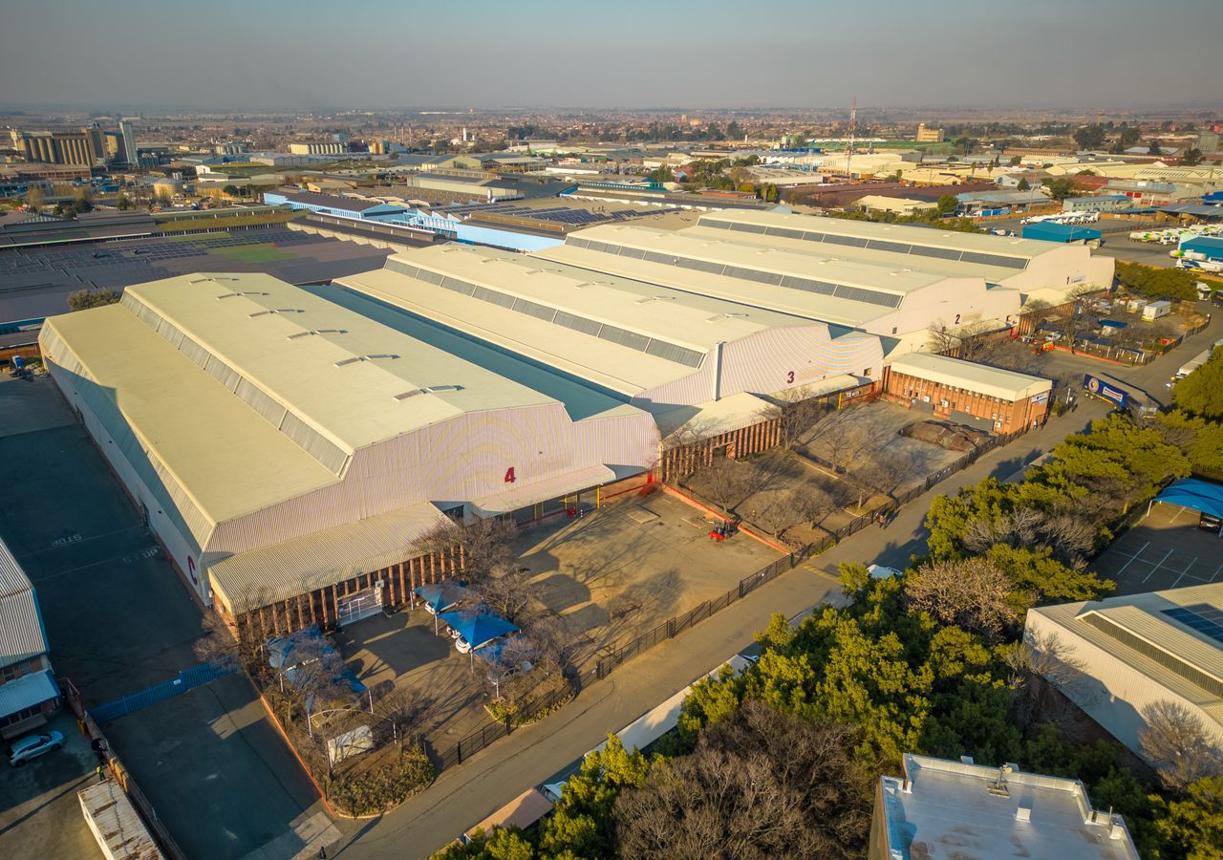
“Burstone has launched a new South African funds-management platform with Nedbank Property Partners, initially backed by 14 retail, industrial and logistics properties valued at approximately R5.4 billion, including nine industrial and logistics assets. The transaction is designed to release about R4.5 billion in capital, while Burstone retains a 50% equity interest and continues managing the properties, creating a new investment structure focused partly on South Africa’s industrial and logistics real-estate market.”
Burstone Launches R5.4 Billion South African Property Platform as Industrial and Logistics Assets Attract Investment
South Africa’s industrial real-estate market is receiving a significant new investment structure after Burstone Group entered into agreements with Nedbank Property Partners to establish the SA Core Plus platform, a South African funds-management vehicle initially seeded with a portfolio of 14 properties. The portfolio includes five retail properties and nine industrial and logistics properties, with the combined portfolio carrying a gross asset value of approximately R5.4 billion. The development places industrial and logistics property firmly within a new capital-management strategy being established by one of South Africa’s listed real-estate groups.
The announcement was made through a JSE SENS disclosure by Burstone on September 25, while PropertyWheel reported the development on September 26. The timing makes the transaction one of the latest developments relevant to South Africa’s industrial-property market. The structure is particularly notable because it combines existing industrial and logistics properties with new third-party capital rather than relying exclusively on traditional property ownership by the listed group.
Nine Industrial and Logistics Properties Form Part of the Initial Portfolio
The industrial component of the platform consists of nine properties located in Gauteng and KwaZulu-Natal. According to Burstone’s SENS announcement, the assets include 181 Barbara – WACO, 130 Gazelle, 15 Pomona, 16 Pomona, Riverhorse – Midas, Riverhorse – Adcock Ingram, Riverhorse – Discovery Health, Riverhorse – ABB, as well as another industrial property included in the portfolio. The properties are primarily warehousing and logistics assets, with Burstone describing them as well-located properties supported by strong tenant covenants and long-term lease profiles.
The listed industrial properties include several assets in Gauteng’s important logistics and industrial corridors. The Pomona properties, for example, are located in an area associated with Johannesburg’s broader logistics and distribution network, while the Riverhorse properties are situated in KwaZulu-Natal. This geographic spread gives the platform exposure to two important industrial-property regions rather than concentrating the entire industrial portfolio in one metropolitan market.
The industrial properties have a combined role beyond simply providing physical warehouse space. Modern logistics facilities increasingly form part of the infrastructure that connects manufacturers, distributors, retailers and consumers. Consequently, demand for appropriately located warehouses can be influenced by supply-chain requirements, transport networks, tenant operating needs and the availability of suitable land and buildings.
Industrial Property Remains an Important Segment
The Burstone transaction comes as industrial and warehousing property continues to attract attention within South Africa’s broader commercial-property market. Recent market analysis cited by Marder Properties, drawing on FNB data, said industrial and warehousing remained the strongest-performing segment of the commercial property market during the second quarter of 2026. The analysis attributed demand partly to logistics, warehousing and continuing supply-chain restructuring, with Johannesburg identified as a major industrial market.
This environment helps explain why institutional and property investors continue to examine industrial assets. Unlike office property, which has faced structural changes associated with hybrid working, industrial real estate is closely connected to physical economic activity. Warehouses, distribution centres and logistics facilities remain necessary for companies that need to store, move and distribute physical goods.
However, industrial property is not immune to economic pressures. Tenants remain sensitive to rental costs, electricity expenses, transport costs, infrastructure reliability and the efficiency of surrounding road and logistics networks. For property owners, this means location, building quality, tenant strength and lease duration can all influence the resilience of an industrial asset.
Burstone Will Retain 50% Equity Interest
Under the proposed structure, Burstone will retain a 50% equity interest in the SA Core Plus platform, while Nedbank Property Partners will acquire the other 50% interest. Burstone will also act as both fund manager and asset manager, allowing it to remain involved in the operation and management of the underlying properties.
The structure is important because Burstone is not simply disposing of the properties and exiting the industrial market. Instead, the company is recycling capital from its existing property portfolio while retaining economic exposure to the assets. It will also earn fund and asset-management fees, with the transaction structured to provide recurring management income.
The initial SA Core Plus platform is structured as a permanent-capital vehicle. Burstone and Nedbank Property Partners intend for the platform to accommodate additional private and institutional investors in the future. This means the initial portfolio could potentially form the foundation of a larger South African property investment platform rather than remaining a fixed portfolio of 14 assets.
R4.5 Billion Capital to Be Released
One of the most significant aspects of the transaction is the amount of capital expected to be released. Burstone said the transaction will release approximately R4.5 billion, providing additional flexibility to support local and international growth opportunities. The company also said the capital will assist with its first-loss obligations associated with its European logistics platform.
Nedbank Property Partners is expected to pay approximately R677 million for its 50% equity interest in the platform, subject to the transaction’s conditions and property transfers. The platform itself has been priced at a gross asset value of approximately R5.155 billion, compared with the properties’ March 31, 2026 book value of about R5.429 billion. Burstone stated that this represented a 5% discount to the book value, with a blended asset yield of approximately 8.4% based on rolling net operating income of about R435 million.
The initial loan-to-value ratio of the SA Core Plus platform is expected to be 70%, with the intention of reducing leverage as additional third-party capital enters the platform. The eventual target will depend on the asset strategy and investment mandate of incoming investors.
What the Deal Means for Industrial Real Estate
For South Africa’s industrial-property sector, the transaction illustrates how existing logistics assets can be packaged into investment vehicles designed to attract additional capital. Rather than treating warehouses and logistics facilities solely as individual properties, the platform creates a portfolio approach in which several assets can be managed and financed together.
That approach can provide investors with exposure to different industrial locations and tenants through one investment structure. It can also allow the property manager to pursue acquisitions, asset improvements and portfolio expansion using a dedicated platform.
The industrial assets are also positioned within a broader logistics environment where transport infrastructure remains important. Recent reporting on South Africa’s freight sector has highlighted continuing efforts to improve rail and port capacity, while logistics operators continue to deal with operational bottlenecks. These developments matter to industrial-property owners because efficient transport connections can influence the attractiveness of distribution and warehousing locations.
Johannesburg and KwaZulu-Natal Remain Important Industrial Markets
The geographic composition of Burstone’s industrial portfolio also demonstrates the importance of major logistics centres. Gauteng remains South Africa’s largest economic hub and has extensive warehousing and distribution infrastructure, while KwaZulu-Natal provides access to the country’s major port and logistics network around Durban.
Industrial property demand in these regions is therefore influenced by more than local business activity. Companies seeking distribution facilities consider access to highways, ports, customers, suppliers and labour markets when selecting warehouse locations.
The industrial properties within the Burstone platform are described as well located, with long-term leases and strong tenant covenants. Those characteristics can provide investors with greater visibility over rental income, although future performance will still depend on tenant renewals, operating conditions, property costs and wider economic circumstances.
A Potential New Phase for South African Property Investment
The SA Core Plus platform also forms part of Burstone’s wider strategy of building funds-management businesses alongside direct property ownership. The company has previously developed similar partnerships internationally, including platforms involving European logistics and light-industrial assets. The South African platform brings that model into Burstone’s domestic market.
Burstone said the transaction is expected to increase the proportion of its revenue generated through fees, with fee revenue expected to rise to 19.3%, compared with 15.5% for the year ended March 2026. Third-party assets under management are expected to increase by 10.9% to R26.8 billion, while equity under management is expected to increase by 4.5% to R11.5 billion.
The transaction remains subject to customary conditions and regulatory approvals, including Competition Commission approval. Burstone expects the effective date to be no later than December 1, 2026, assuming the required conditions are satisfied and the property transfers proceed as planned.
For South Africa’s industrial real-estate market, the development is significant because it combines institutional capital, an established property portfolio and a structure designed for future expansion. The nine industrial and logistics properties provide the initial foundation, while the platform’s permanent-capital structure could allow additional investors and properties to be introduced over time.
More broadly, the transaction highlights the continuing importance of logistics and warehousing property within South Africa’s commercial real-estate landscape. As supply chains evolve and companies continue to require strategically located distribution facilities, industrial properties remain closely connected to the country’s physical economy. The Burstone-Nedbank partnership therefore provides a current example of how capital is being structured around South Africa’s industrial and logistics real-estate assets.



