




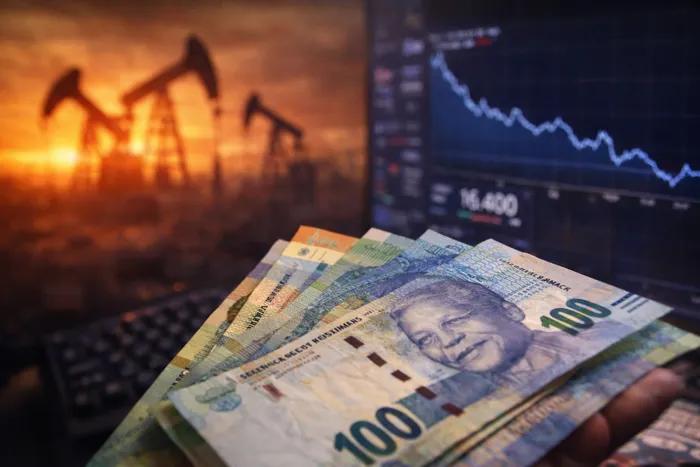
“The South African rand strengthened in early trading on Monday, 9 November 2026, as softer international oil prices eased concerns about domestic inflation and supported investor sentiment. Meanwhile, financial markets continued monitoring municipal election results and coalition negotiations, with political developments potentially influencing confidence in South Africa’s economic management and future investment environment.”
South African Rand Strengthens as Softer Oil Prices Ease Inflation Concerns Amid Coalition Uncertainty
South Africa’s rand strengthened against the United States dollar on Monday as declining international oil prices helped ease inflation concerns, providing temporary support to the country’s currency and financial markets. However, investors remained cautious as political uncertainty following the municipal elections continued to influence expectations regarding economic policy, governance and investment prospects.
According to Reuters, the rand traded approximately 0.4% stronger at R16.4875 against the dollar during early trading on Monday. The currency’s improvement reflected a combination of international market developments and domestic political considerations, highlighting the complicated economic environment facing South Africa as it approaches the final weeks of 2026.
Lower Oil Prices Provide Relief for the Rand
International oil prices have become an important determinant of South Africa’s economic outlook because the country imports a substantial proportion of its petroleum requirements. Consequently, movements in global crude prices directly influence domestic fuel costs, transportation expenses, inflation expectations and the country’s external financial position.
The latest decline in oil prices provided some relief to investors concerned about inflationary pressures. Lower petroleum prices can reduce expectations of future fuel increases, supporting the rand by improving the anticipated inflation outlook and reducing pressure on monetary policy.
South Africa remains particularly vulnerable to international energy-market disruptions because domestic fuel prices are influenced by global petroleum costs and exchange-rate movements. When oil prices increase significantly, the country faces higher import expenditure, greater transportation costs and additional pressure on households and businesses.
Conversely, declining oil prices can improve the economic outlook by reducing some of these pressures.
Reuters reported that oil prices steadied on Monday after United States President Donald Trump suggested that further attacks on Iran were unlikely. Nevertheless, concerns about energy supply disruptions persisted, particularly following reports of attacks involving vessels near the strategically important Strait of Hormuz.
The waterway remains essential to international petroleum transportation, meaning disruptions can affect global energy prices even when actual supply interruptions are limited.
For South Africa, the significance of these developments extends beyond the currency market. A sustained reduction in oil prices could help moderate fuel inflation, improve business operating conditions and reduce pressure on household budgets.
Inflation Remains a Major Economic Concern
Although the rand strengthened, South Africa’s inflation outlook remains complicated by earlier fuel-price increases and persistent international uncertainty.
Statistics released in October showed that consumer inflation increased to 4.5% year-on-year in September 2026, compared with 4.4% in August.
Transport inflation accelerated significantly, reflecting higher fuel costs and their effects on transportation-related expenses.
The South African Reserve Bank has previously warned that inflation could exceed 5% during the latter part of 2026 and early 2027 before gradually returning towards its target.
The central bank’s September Monetary Policy Committee statement indicated that headline inflation was expected to return towards 3% around the end of 2027, provided the current inflationary shocks gradually dissipated.
However, the outlook remains vulnerable to international developments, including geopolitical conflicts, petroleum-market volatility and movements in the exchange rate.
A weaker rand generally increases the cost of imported goods and energy products, potentially contributing to domestic inflation. A stronger currency, therefore, can provide some protection against imported inflation, although its benefits depend on the duration and magnitude of appreciation.
The Reserve Bank has maintained a restrictive monetary policy stance to contain inflation expectations and prevent temporary price increases from spreading throughout the economy.
Its September decision raised the repo rate by 25 basis points to 7.25%, reflecting concerns about inflationary pressures and the uncertain international environment.
The upcoming monetary policy decision will consequently attract considerable attention from businesses, consumers and financial-market participants.
Municipal Elections Introduce Political Uncertainty
Domestic political developments also played an important role in shaping investor sentiment on Monday.
South Africa’s municipal elections produced a significant setback for the African National Congress, which experienced a substantial decline in electoral support compared with previous elections.
The results have created a more fragmented political landscape, with numerous municipalities requiring coalition arrangements to establish functioning administrations.
The Democratic Alliance, uMkhonto weSizwe Party, Economic Freedom Fighters and other political organisations have become important participants in negotiations across several municipalities.
Political uncertainty can influence economic confidence because investors closely monitor the stability of government institutions, the consistency of policy implementation and the effectiveness of public administration.
Municipal governments are particularly important because they oversee essential services, infrastructure maintenance, local economic development and numerous administrative functions affecting businesses and residents.
Weak municipal administration can contribute to deteriorating infrastructure, unreliable water supplies, electricity distribution challenges and inefficient business services.
Conversely, effective municipal leadership can improve the operating environment for enterprises, support investment and encourage economic activity.
Coalition negotiations therefore represent more than a political exercise. Their outcomes may influence economic governance and the delivery of services in some of South Africa’s largest commercial centres.
Reuters reported that investors were assessing the election results and coalition talks while monitoring the rand’s performance.
Municipal Financial Problems Remain a Structural Risk
South Africa’s municipal financial challenges represent another significant concern for economic policymakers.
Municipalities are responsible for collecting revenue from households and businesses while maintaining infrastructure and paying service providers, including Eskom and water authorities.
However, weaknesses in revenue collection, financial management and service delivery have placed considerable pressure on local government finances.
Reuters previously reported that municipalities owed Eskom approximately R122.5 billion, while households and businesses owed municipalities approximately R484.5 billion.
Poor collection rates have contributed to financial difficulties across several municipalities, creating risks for electricity distribution, water provision and public infrastructure.
These problems are economically important because reliable infrastructure is essential for productivity, investment and employment creation.
Businesses require dependable electricity, functioning transport infrastructure, adequate water supplies and efficient municipal administration to operate competitively.
Consequently, improving municipal governance and financial management could strengthen South Africa’s economic performance over the medium term.
Fiscal Revisions Offer Encouraging Signals
South Africa’s macroeconomic outlook has also received attention following the recent revision of gross domestic product figures by Statistics South Africa.
The national statistical agency completed a comprehensive GDP rebasing and benchmarking exercise that increased the measured nominal size of the economy.
National Treasury subsequently updated several fiscal ratios using the revised GDP figures.
The government reported that the debt-to-GDP ratio peaked at 74.6% during the 2025/26 financial year, compared with the previous estimate of 78.4%.
The revised calculations also reduced the projected main budget deficit for 2026/27 from 3.7% to 3.5% of GDP.
Importantly, the adjustments resulted from the higher measured GDP denominator rather than changes in government borrowing, expenditure or revenue projections.
Nevertheless, the revised figures provide an updated perspective on South Africa’s fiscal position and may influence how investors assess the country’s public finances.
National Treasury has indicated that the 2027 Budget will provide further information regarding updated economic forecasts and fiscal projections.
Economic Growth Continues to Face Challenges
Despite improvements in some financial indicators, South Africa continues to face persistent economic growth challenges.
The Reserve Bank’s September assessment indicated that the economy contracted by 0.2% during the second quarter of 2026.
The central bank projected annual economic growth of approximately 1.2% for 2026, while anticipating a gradual improvement towards approximately 2% over the medium term.
However, achieving stronger economic growth will require sustained improvements in infrastructure, productivity, investment conditions and business confidence.
South Africa’s unemployment challenges also remain significant, increasing the importance of policies that support employment creation and private-sector expansion.
A stronger rand alone cannot resolve these structural problems. Sustainable economic growth depends on improvements in productive capacity, business competitiveness, infrastructure reliability and public-sector efficiency.
Implications for Businesses and Consumers
The rand’s improvement could provide temporary benefits to businesses that depend heavily on imported products, machinery, petroleum and industrial inputs.
Importers may experience reduced currency-related costs if the rand maintains its strength, although the actual benefits depend on exchange-rate movements and international commodity prices.
Consumers could also benefit indirectly if lower petroleum prices eventually translate into reduced transportation costs and more moderate increases in the prices of imported goods.
However, these benefits are not automatic.
Retail prices, transportation charges and production costs often respond gradually to changes in international markets. Furthermore, domestic taxes, distribution expenses and other operating costs can limit the extent to which lower petroleum prices reduce consumer prices.
Businesses therefore remain cautious about making long-term investment decisions based solely on short-term exchange-rate improvements.
Investors Continue Monitoring Global Developments
International financial markets remain influential in determining South Africa’s economic performance.
Movements in United States interest rates, global commodity prices, geopolitical developments and international investor appetite for emerging-market assets can significantly influence the rand.
When investors become more cautious about emerging markets, currencies such as the rand can experience increased volatility.
South Africa’s relatively liquid financial markets make the currency particularly responsive to international developments and changes in investor positioning.
Consequently, the rand’s performance during the coming weeks will depend partly on international financial conditions and the trajectory of global energy prices.
Domestic developments, including coalition negotiations and economic policy implementation, will also remain important.
Outlook: Currency Relief Depends on Sustained Stability
The rand’s appreciation on Monday represents a welcome development for South Africa’s financial markets, particularly given persistent concerns about inflation and international economic uncertainty.
Nevertheless, the improvement should not be interpreted as evidence that the country’s structural economic challenges have been resolved.
Lower oil prices could help moderate inflation, but continued geopolitical uncertainty means energy markets remain vulnerable to renewed disruptions.
Similarly, political developments following the municipal elections could either strengthen investor confidence through effective governance or create additional uncertainty if coalition administrations struggle to deliver services.
South Africa’s economic recovery will ultimately depend on a combination of responsible fiscal management, credible monetary policy, infrastructure improvements and effective public administration.
The country’s ability to attract investment, expand productive capacity and generate employment will remain central to its long-term economic prospects.
For now, the stronger rand provides a measure of relief. However, investors will continue watching petroleum prices, inflation developments, interest-rate expectations and coalition negotiations to determine whether Monday’s improvement signals a sustained recovery or simply a temporary movement in an increasingly uncertain economic environment.



