




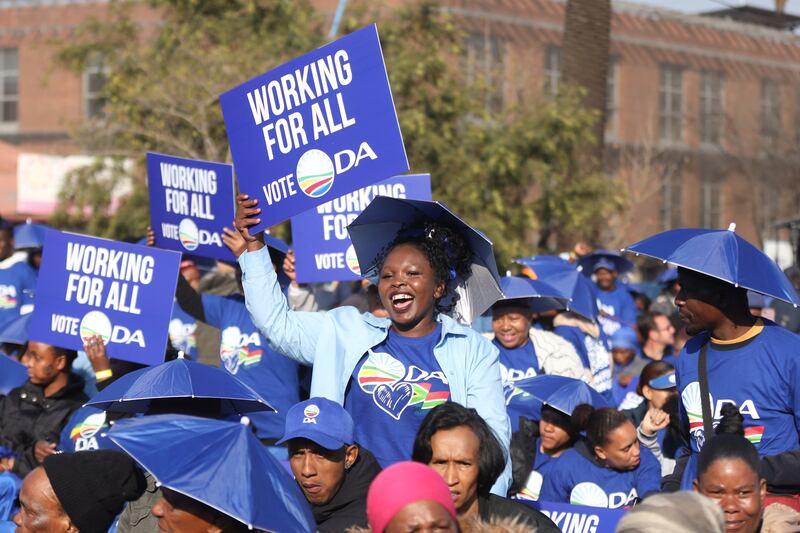
“A new News24/SABI Strategy Group poll shows that 61% of registered South African voters would be happy for a coalition to govern their municipality after the 4 November 2026 local government elections, while 32% oppose coalition government. The findings point to a major shift in public opinion as voters become more comfortable with coalition politics, even though there is no overwhelming agreement on which parties should work together.”
South Africans Show Growing Acceptance of Coalition Politics
South Africa’s political landscape is entering an important new phase ahead of the 4 November 2026 local government elections, with public opinion suggesting that voters are increasingly prepared to accept coalition governments at municipal level. A new News24/SABI Strategy Group poll indicates that 61% of registered voters would be happy to see a coalition governing their municipality, compared with 32% who would oppose such an arrangement.
The finding is significant because coalition government was once viewed by many South Africans as an unusual political arrangement. However, the fragmentation of the country’s political environment has made coalitions increasingly common, particularly in municipalities where no single political party can secure more than half of the vote.
The latest polling suggests that the public may now be adjusting to this reality. Rather than automatically regarding a hung council as a political failure, a majority of voters appear willing to accept cooperation between parties if that arrangement can produce functioning municipal government.
However, the same poll reveals an important contradiction. While voters are increasingly comfortable with coalition government in principle, they remain uncertain about which political parties should work together.
Only 20% selected an ANC-Democratic Alliance coalition as their preferred arrangement. A coalition involving all 10 parties represented in the Government of National Unity received 19%, while ANC-EFF and ANC-EFF-MK combinations each received 15%. Another 20% of respondents said they did not know which coalition they would prefer.
This suggests that South African public opinion is not simply moving towards one particular political alliance. Instead, voters appear to be accepting coalition politics as part of the country’s changing democratic system while remaining cautious about the political compromises that may follow.
A Political Landscape Becoming More Fragmented
The public opinion findings must be understood against the broader transformation taking place in South African politics.
For decades, the African National Congress dominated national and local politics. Although the ANC remains one of the country’s largest political organisations, its electoral dominance has weakened considerably. The growth of the Democratic Alliance, Economic Freedom Fighters, uMkhonto weSizwe Party, Inkatha Freedom Party, Patriotic Alliance and other parties has produced a much more fragmented political environment.
The latest News24/SABI poll puts the ANC at 31.6% nationally, followed by the DA at 25.2%, MK Party at 14.7% and EFF at 12.2%.
These numbers illustrate why coalition government is becoming increasingly important. If similar voting patterns occur at municipal level, many councils could fail to produce an outright majority.
That possibility is particularly important in major metropolitan areas.
In Tshwane, the DA is polling at 32%, compared with 24% for the ANC, while the EFF is on 14% and ActionSA on 11%. In Johannesburg, no political party appears positioned to secure an outright majority. The News24 polling project says DA mayoral candidate Helen Zille is leading Johannesburg with 36%, but that remains well below the 50% required to govern alone.
Consequently, voters are not simply choosing parties. They are also indirectly determining which political organisations may have to negotiate with one another after the election.
Public Dissatisfaction Remains a Major Political Force
The acceptance of coalitions does not mean South Africans are satisfied with municipal or national governance.
In fact, the poll shows considerable dissatisfaction with the direction of the country and local government.
According to the findings, 69% of respondents believe South Africa is moving in the wrong direction, while 66% believe their municipality is also moving in the wrong direction. At the same time, 71% believe the November elections can bring change to their municipality.
These figures reveal an important feature of current public opinion.
Many voters appear dissatisfied with the status quo, but they have not necessarily decided that one particular opposition party should replace the established governing party.
Instead, voters may be prioritising outcomes such as better service delivery, cleaner government, improved infrastructure and greater political stability.
This helps explain why coalition government can be viewed positively despite the instability associated with some previous municipal coalitions.
For many residents, the key question may not be which party controls a municipality, but whether the administration can deliver reliable services.
Service Delivery Could Determine Voter Attitudes
South Africa’s municipal elections are closely connected to everyday issues.
Residents experience government through services such as water, electricity, refuse collection, roads, sanitation, housing administration and local economic development. Consequently, public opinion about political parties is often influenced by practical experiences rather than national political rhetoric alone.
New polling from The Common Sense and the Social Research Foundation reinforces this point. It found that 56% of likely voters believe service delivery would improve if the DA governed their municipality alone, while 17% believe it would worsen. For the ANC, respondents were more evenly divided, with 33% expecting improvement and 29% expecting deterioration. For the MK Party, 32% expected improvement compared with 29% expecting deterioration.
The EFF produced a different result, with 45% expecting service delivery to worsen under an EFF majority and 29% expecting improvement.
These findings show that public opinion is becoming increasingly connected to perceptions of administrative performance.
Political parties therefore face pressure to demonstrate not only ideological differences but also credible plans for running municipalities.
Coalition Stability Is the Central Question
Although 61% of voters say they would be comfortable with coalition government, the experience of South African municipalities since the 2021 local elections provides a warning.
Several councils have experienced leadership changes, political disputes, shifting alliances and votes of no confidence.
The concern is therefore not necessarily whether coalition government can work. Rather, the question is whether political parties can cooperate long enough to provide consistent administration.
A North-West University political analyst, André Duvenhage, warned on Monday that an increasing number of hung councils and the growing influence of smaller parties could complicate the formation of stable local governments following the November election. He argued that unstable coalitions could deepen existing municipal governance problems.
This is particularly important because voters may support coalition government while simultaneously becoming frustrated if coalition negotiations lead to prolonged political disputes.
The distinction between coalition acceptance and coalition performance could therefore become one of the defining issues of the 2026 elections.
Smaller Parties Could Become Powerful
Another consequence of the fragmented political environment is the growing influence of smaller parties.
If no major party wins a majority, smaller parties may hold the balance of power. Their support could determine who becomes mayor, which party controls municipal committees and which policy priorities receive attention.
The latest polling demonstrates this possibility particularly clearly in metropolitan areas.
In eThekwini, for example, MK Party support is strong enough to make the party a major factor in determining the eventual governing arrangement. The News24 polling project describes MKP as potentially becoming eThekwini’s largest party.
This means that the 2026 local elections could produce political outcomes that are considerably more complicated than a simple contest between the ANC and DA.
The result may instead be a series of negotiations involving three, four or even more parties.
The ANC-DA Question
One of the most significant findings is that an ANC-DA coalition is the most popular specific coalition option, although only 20% selected it.
The result is politically important because the ANC and DA have historically represented substantially different political constituencies and have frequently been opponents.
Yet their cooperation at national level through South Africa’s Government of National Unity has already demonstrated that political parties with major differences can work together within a shared governing framework.
The polling indicates that some voters may now see such cooperation as a practical solution to fragmented election results.
However, the fact that only one in five respondents chose an ANC-DA coalition also demonstrates that there is no overwhelming public mandate for the arrangement.
Political parties will therefore have to interpret the results carefully.
Voters Want Change, But They Also Want Functioning Government
The most important message from the public opinion data may be that South Africans increasingly want political change without necessarily wanting political chaos.
The finding that 71% believe the November elections can bring change indicates considerable electoral optimism.
However, voters’ willingness to accept coalition government suggests that many are also recognising that political change may not produce single-party majorities.
The electorate appears to be preparing for a political system in which negotiation, compromise and cooperation become permanent features of local government.
That could represent an important development in South African democracy.
Coalitions can encourage political parties to cooperate, share responsibility and negotiate policies. They can also prevent a single party from exercising unchecked political power.
At the same time, coalition governments can become unstable when parties prioritise positions, personalities or short-term political interests over effective administration.
What the Poll Means for the November Elections
The News24/SABI findings should not be treated as a prediction of the final election results. News24 explicitly notes that its poll is a snapshot of public sentiment rather than an election forecast. The survey involved 5,001 registered voters between 25 August and 17 September 2026, with a national sample of 1,000 respondents and additional metropolitan samples. The national margin of error is 3.2% at a 95% confidence level.
Nevertheless, the findings provide a valuable indication of how voters currently view the country’s changing political environment.
The central message is clear: coalition government is becoming normalised in the minds of South African voters.
The bigger uncertainty is what voters expect those coalitions to achieve.
If parties can form stable administrations focused on service delivery, infrastructure, accountability and economic development, coalitions could strengthen local democracy.
If coalition negotiations instead result in repeated leadership battles, political instability and administrative paralysis, public confidence could decline further.
Conclusion
South Africa’s latest public opinion data provides a revealing picture of an electorate preparing for a more fragmented political future.
With 61% of registered voters saying they would be happy with coalition government at municipal level, coalition politics appears to have moved from being an exceptional arrangement to an increasingly accepted feature of South African democracy.
Yet the absence of overwhelming support for any particular coalition shows that voters remain uncertain about the political partnerships that should govern their municipalities.
The November 4 local government elections will therefore be about more than which party wins the most votes. In many municipalities, the decisive question could be which parties can cooperate after the votes are counted.
For voters, however, the ultimate test is likely to be practical: whether their municipality delivers clean water, functioning infrastructure, reliable services, safer communities and accountable leadership.
South Africa’s political future may increasingly belong to coalitions. The challenge for political parties will be proving that those coalitions can govern effectively.



