




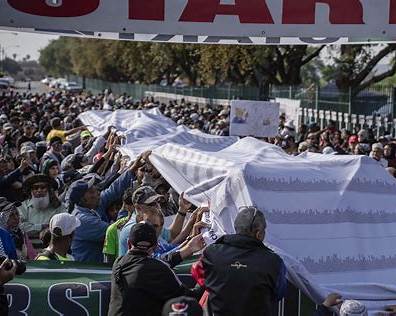
“Thousands of people gathered in Lenasia, south of Johannesburg, for the 17th annual Walk for Freedom, making it one of South Africa’s largest recent public demonstrations of solidarity with Palestine. Organised by the Palestine Solidarity Alliance, the march also broadened its message to include social justice, youth participation and civic engagement ahead of South Africa’s local government elections.”
Thousands of South Africans Join Johannesburg’s 17th Walk for Freedom
JOHANNESBURG — Thousands of people gathered in Lenasia, south of Johannesburg, for the 17th annual Walk for Freedom, turning a long-running Palestine solidarity event into one of the country’s most visible demonstrations of activism this weekend. Organised by the Palestine Solidarity Alliance (PSA), the five-kilometre march brought families, community organisations and activists into the streets on Sunday, with participants calling attention to the Palestinian cause while also linking international solidarity to social justice in South Africa.
GroundUp reported on 5 October that a 25-metre banner carrying the names of more than 20,000 children killed in Gaza was unfurled during the march. Participants also encountered a symbolic wall made from cardboard boxes, marked with “Free Palestine”, representing the barrier constructed by Israel in the occupied West Bank. The organisers used the visual displays to turn the march into both a public protest and a memorial, giving participants a physical way to confront the scale of suffering associated with the conflict.
The event is significant because activism in South Africa has historically been closely connected to questions of justice beyond the country’s borders. The anti-apartheid movement drew international solidarity, boycotts and political campaigns, and the organisers of the Walk for Freedom continue to place Palestinian solidarity within that tradition. The PSA has organised the annual event for years, making it an established part of civil-society activism in Johannesburg.
This year’s march also came after another large Palestine solidarity demonstration in Cape Town. On Saturday, thousands gathered along the Sea Point promenade to call for an end to Israel’s military campaign in Gaza and to express support for Palestinians. The Cape Town protest included British politician George Galloway and journalist Yvonne Ridley, who were visiting South Africa as part of a People Power Tour focused on Palestine and human-rights issues. The demonstration was hosted by the Palestine Solidarity Campaign.
These events show how Palestine activism continues to occupy public space in South Africa, using marches, speeches, banners, public education and community mobilization.
In Lenasia, the PSA presented the march not simply as a protest about foreign policy, but as part of a broader argument about social justice. PSA member Naazim Adam told GroundUp that the organisation wanted to build a wider social-justice movement that extends beyond Palestine to issues affecting South Africa, Africa and the world. He also raised concerns about the difference between online support and sustained participation, arguing that reposting information on social media does not necessarily amount to deeper activism.
That distinction is important as political organizing increasingly happens across both physical and digital spaces. Social media can spread images, slogans and information quickly, allowing young people to follow conflicts and political debates from anywhere. However, the Lenasia march demonstrated the continuing importance of physical mobilisation: people walked together, carried banners, listened to speakers and participated in educational activities.
The organisers also connected the march to South Africa’s approaching local government elections. According to GroundUp, educational programmes were held after the march about the elections, while Adam called for greater youth participation in local government and community organisations. The message reflects a broader idea of activism in which international solidarity is connected to demands for accountability at home.
The wider political environment has also produced activism around domestic issues. On 5 October, residents in Villa Liza in Ekurhuleni called for urgent action over recurring raw sewage flowing through their streets. SABC News reported that residents said years of sewer problems and unsuccessful repairs had created serious health and environmental concerns. One resident warned that people were considering withholding their votes until authorities provided a permanent solution.
In Limpopo, Eyewitness News reported the same day that residents of Phugwane village had gone for more than a decade without running water and were relying on a dirty puddle shared with animals. Residents linked their frustration directly to the upcoming elections, saying they would not vote without meaningful action on water access. These developments show how activism in South Africa can take many forms, from organised national campaigns to local communities using protests, public statements and electoral pressure to demand services.
The Walk for Freedom therefore sits within a much wider culture of political activism. Its immediate focus is Palestine, but its organisers are deliberately presenting solidarity as part of a broader social-justice framework. That approach is likely to remain influential because South Africa’s own history gives international human-rights campaigns a strong political and emotional resonance.
For participants, the march offered an opportunity not only to demonstrate but also to belong to a community. Families, civil-society organisations and young people shared the streets, while activists used the gathering to encourage longer-term engagement. That community-building function can be as important as the immediate political message because sustained movements depend on networks of people who remain active after a single demonstration ends.
The event also reinforces South Africa’s prominent role in international debate over the Israel-Palestine conflict. The country has pursued legal and diplomatic action concerning Israel at the International Court of Justice, while civil-society organisations have maintained pressure through demonstrations, boycotts, educational campaigns and public advocacy. The continued size of solidarity marches suggests that the issue remains significant for many South Africans.
However, the organisers’ emphasis on broader social justice may ultimately be the most important political development emerging from the march. If activism remains limited to expressing solidarity at periodic demonstrations, its influence may be temporary. If campaigners can translate public mobilisation into community organisation, youth participation, accountability campaigns and sustained civic engagement, the impact could extend well beyond the Palestine issue.
That challenge is particularly relevant to the next generation of activists. Digital platforms make it easier than ever to encounter political information, but sustained civic participation requires time, organisation and willingness to engage with institutions. The Lenasia march provided an example of how online awareness can be converted into a physical gathering, while its organisers urged participants to take the next step toward deeper involvement.
As South Africa moves closer to local government elections, activism is likely to become increasingly visible across the country. Communities are demanding water, sanitation, safety and accountable government, while civil-society organisations continue to campaign on international human-rights questions. These movements may have different priorities, but they share a common demand: that public institutions and political leaders listen and respond.
The 17th Walk for Freedom consequently stands as both a Palestine solidarity demonstration and a snapshot of South Africa’s evolving activist landscape. Thousands of people filled the streets of Lenasia, carrying flags and messages of solidarity, remembering victims and discussing wider questions of justice. The organisers’ call for deeper participation suggests that the real measure of the march will not simply be the number of people who attended, but whether those participants remain engaged in civic and political action after the banners are folded and the streets return to normal.
For South Africa’s activism movement, that is the central question. Demonstrations attract attention and create solidarity, but lasting change requires organisation and continued participation. The Lenasia march showed a strong appetite for collective action; what follows will determine whether it becomes another annual demonstration or a catalyst for sustained activism across communities and political institutions.



