




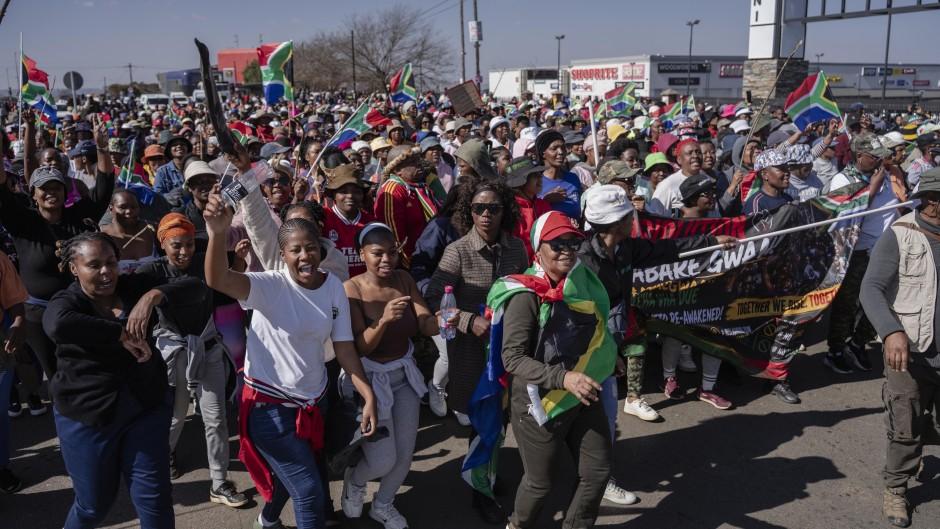
“New polling reported by The Common Sense indicates that South Africans may find common ground on cooperation between civil society organisations despite divisions across racial and political lines. The findings come as confidence in the Government of National Unity faces pressure and political parties prepare for the November 2026 local government elections.”
South Africans Find Common Ground as Poll Reveals Support for AfriForum and March and March Cooperation
South Africa’s political landscape is entering an important period of public scrutiny as voters prepare for the November 2026 local government elections. Amid disagreements over governance, service delivery, immigration, economic opportunity and political leadership, new polling suggests that South Africans may be more willing to support cooperation across political and racial divisions than public debate sometimes indicates.
A report published by The Common Sense on 21 October highlights survey findings showing majority support for cooperation between AfriForum and March and March, two civil society organisations with different constituencies and political associations. The research, conducted by the Social Research Foundation (SRF) in conjunction with The Common Sense, offers a timely perspective on public opinion and the potential for collaboration beyond traditional political boundaries.
The findings are particularly significant because they distinguish between how people view individual organisations and whether they support those organisations working together. Although the survey identifies clear differences in the public’s attitudes towards AfriForum and March and March, it reports that majorities across racial and political groups favour cooperation between them.
Public opinion challenges assumptions about political divisions
South African political discussion frequently focuses on disagreements between communities, political parties and ideological movements. These divisions are real and have deep historical roots. However, the latest polling suggests that disagreement about identity or political affiliation does not necessarily prevent people from supporting practical cooperation.
According to The Common Sense, respondents expressed different levels of favourability towards the two organisations. White voters were more likely to view AfriForum favourably than black voters, while black voters were more likely to view March and March favourably than white voters. Political affiliation also influenced attitudes, with AfriForum receiving comparatively more favourable views among Democratic Alliance voters than among African National Congress and uMkhonto weSizwe Party supporters.
These differences demonstrate why public opinion cannot be understood through a single national average. Citizens interpret organisations through their experiences, values, political affiliations and perceptions of the issues those organisations represent.
Nevertheless, the survey’s central finding is that these differences did not translate into equivalent opposition to cooperation. Instead, majorities across the racial and political groups examined supported the idea that AfriForum and March and March should work together.
This distinction matters in a democracy where political disagreements are often presented as insurmountable. Citizens may disagree about an organisation’s broader agenda while still believing that it can contribute constructively to specific community initiatives.
Why the two organisations matter
AfriForum is a civil rights organisation known for its advocacy around community interests, language, education, cultural identity and governance. March and March is a civic movement associated with campaigning on illegal immigration and related public concerns.
Their cooperation attracted attention because the organisations have different histories, constituencies and public reputations. In August 2026, the two groups established a collaborative working relationship intended to explore shared interests and practical community initiatives.
Areas identified for possible cooperation included community safety, education, community development and accountability. Their collaboration also reflects a broader question confronting South African civil society: whether organisations with different ideological positions can work together on selected issues without abandoning their distinct identities.
Such partnerships can create opportunities to combine networks, knowledge and organisational resources. However, they also require clear communication about objectives, responsibilities and the principles governing joint activities.
For the public, the important question is not simply whether two organisations have announced a partnership. It is whether their cooperation produces measurable improvements in the lives of the communities they claim to represent.
What the polling reveals
The latest report describes majority support for cooperation between AfriForum and March and March across the racial and political categories examined. It specifically reports that more than 70% of ANC and MKP voters believed the two organisations should work together.
That result challenges the assumption that people who support different political parties will automatically reject cooperation involving organisations associated with opposing constituencies.
It also illustrates an important principle in political research: attitudes towards an individual organisation are not necessarily the same as attitudes towards a particular proposal involving that organisation.
A respondent might disagree with some of AfriForum’s positions but still support joint work on local safety or education. Similarly, someone who supports March and March’s stated objectives might favour cooperation without agreeing with every position taken by AfriForum.
The distinction is important because political campaigns frequently encourage voters to make broad judgements about people and organisations. Survey findings that separate general favourability from specific policy preferences can provide a more nuanced picture of public attitudes.
However, the findings should be interpreted carefully. The publicly accessible report does not provide all the underlying numerical breakdowns, the complete wording of every question or enough methodological detail to independently assess every subgroup comparison. The results therefore indicate a reported pattern of support rather than proof that every community or individual shares the same priorities.
The influence of declining confidence in political parties
The report places the findings within a period of declining confidence in the Government of National Unity and weakening public faith in established political parties.
This context is important because civil society organisations can become more influential when voters believe conventional political institutions are not adequately addressing their concerns.
Residents dealing with unreliable municipal services, crime, unemployment or deteriorating infrastructure may look beyond party manifestos for practical assistance. Community organisations can offer an alternative route for raising concerns, organising volunteers, monitoring institutions and advocating for changes.
Nevertheless, greater interest in civil society should not automatically be interpreted as rejection of democratic institutions. It may instead reflect citizens seeking additional ways to influence decisions and obtain results.
Political parties remain central to elections and government formation, while civic organisations can play a complementary role by representing particular concerns and scrutinising public administration.
The challenge is ensuring that public frustration translates into constructive participation rather than deepening mistrust, hostility or division.
Local elections place cooperation under pressure
The November local government elections give these findings particular relevance. Municipal politics directly affects everyday life through water provision, sanitation, refuse collection, roads, electricity, local planning and other essential services.
Unlike national political debates, municipal issues often require practical cooperation between different parties, community organisations, businesses and residents.
A council may have to negotiate a coalition after no single party wins an outright majority. Even parties that compete fiercely during an election may subsequently need to agree on budgets, leadership arrangements and service delivery priorities.
A similar principle applies to civil society. Organisations do not necessarily have to agree on every ideological question to collaborate on a clearly defined local project.
The challenge is that cooperation becomes difficult when disagreements concern fundamental values, accountability or the treatment of vulnerable communities. A partnership can only retain public confidence if participants explain what they intend to achieve and demonstrate that their methods are lawful and consistent with constitutional rights.
Consequently, the reported support for AfriForum and March and March cooperation should be understood as an indication of public openness to collaboration, not an unconditional endorsement of every activity or policy associated with either organisation.
Race, identity and the search for common ground
South Africa’s history makes questions of race, identity and representation particularly sensitive. Historical inequality, apartheid-era discrimination and continuing economic disparities shape how citizens interpret political organisations and their public campaigns.
The polling’s reported differences in favourability towards AfriForum and March and March reflect the importance of those perceptions. At the same time, support for cooperation suggests that some voters distinguish between an organisation’s broader identity and the potential benefits of working together on specific issues.
That distinction offers a useful lesson for political leaders and community activists. Productive cooperation does not require pretending that historical disagreements have disappeared. Instead, it requires acknowledging those disagreements while identifying objectives that can be pursued without compromising people’s rights or dignity.
Community safety, educational opportunities and accountable local government can provide areas for discussion, provided that proposed initiatives are inclusive and do not unfairly target people because of nationality, race or cultural background.
The strength of any partnership will ultimately depend on how it treats people who disagree with it, how transparently it operates and whether its actions match its stated principles.
The importance of evidence and accountability
Public opinion polling can help political observers understand how voters respond to changing alliances, policy proposals and public campaigns. However, a survey is a snapshot of attitudes at a particular time, not a guarantee of future behaviour.
Responses can be influenced by the wording of questions, the timing of interviews, the composition of the sample and the issues dominating public discussion. These considerations become especially important before elections, when political messaging and public attention can change rapidly.
For that reason, readers should examine who conducted a poll, when the interviews took place, how respondents were selected, whether the sample represents the population being discussed and whether uncertainty around the results is disclosed.
The latest report offers evidence of support for cooperation, but it does not establish that this sentiment will translate into electoral gains for either organisation or any political party. Nor does it demonstrate that every proposed joint initiative will succeed.
The more meaningful test will be whether cooperation produces outcomes that residents can evaluate independently.
What the findings could mean for South African politics
The polling arrives as political parties face pressure to convince voters that they can govern effectively and work with others when necessary. Recent polling published by The Common Sense has also highlighted support for cooperation between the ANC and DA in municipalities where neither party wins a majority.
Taken together, these reports suggest that some voters may prioritise stability and practical results alongside party loyalty. However, the findings concern different questions and should not be treated as proof of a single nationwide political consensus.
For parties, the implication is that coalition negotiations and cross-party collaboration may increasingly influence public expectations. For civic organisations, the lesson is that partnerships can attract support when they address clearly defined concerns and remain accountable to the communities involved.
For voters, the findings reinforce the importance of looking beyond political slogans. Citizens can judge organisations on their records, proposed actions and willingness to explain their decisions.
Conclusion: Cooperation must deliver results
The latest South African public-opinion report provides a noteworthy indication that support for cooperation can extend beyond divisions in political affiliation and racial identity. Although attitudes towards AfriForum and March and March differ substantially, the survey reports majority support for the two organisations working together, including support exceeding 70% among ANC and MKP voters.
The finding does not mean that South Africa’s disagreements have disappeared. Rather, it suggests that some citizens may be willing to consider cooperation even when they do not share identical political loyalties or views of the organisations involved.
As the country approaches its local government elections, the crucial question is whether this openness can translate into responsible action. Partnerships must be judged by their transparency, respect for constitutional rights, inclusiveness and measurable contribution to community wellbeing.
Ultimately, public confidence cannot be secured through announcements or favourable polling alone. It must be earned through consistent conduct and practical results. If civic organisations and political parties can demonstrate that cooperation improves local services, strengthens accountability and respects South Africa’s diversity, they may help create a more constructive political environment.
The central message of the reported findings is therefore cautiously encouraging: disagreement does not always prevent collaboration. Whether that potential becomes lasting progress will depend on what organisations and leaders do next.



