




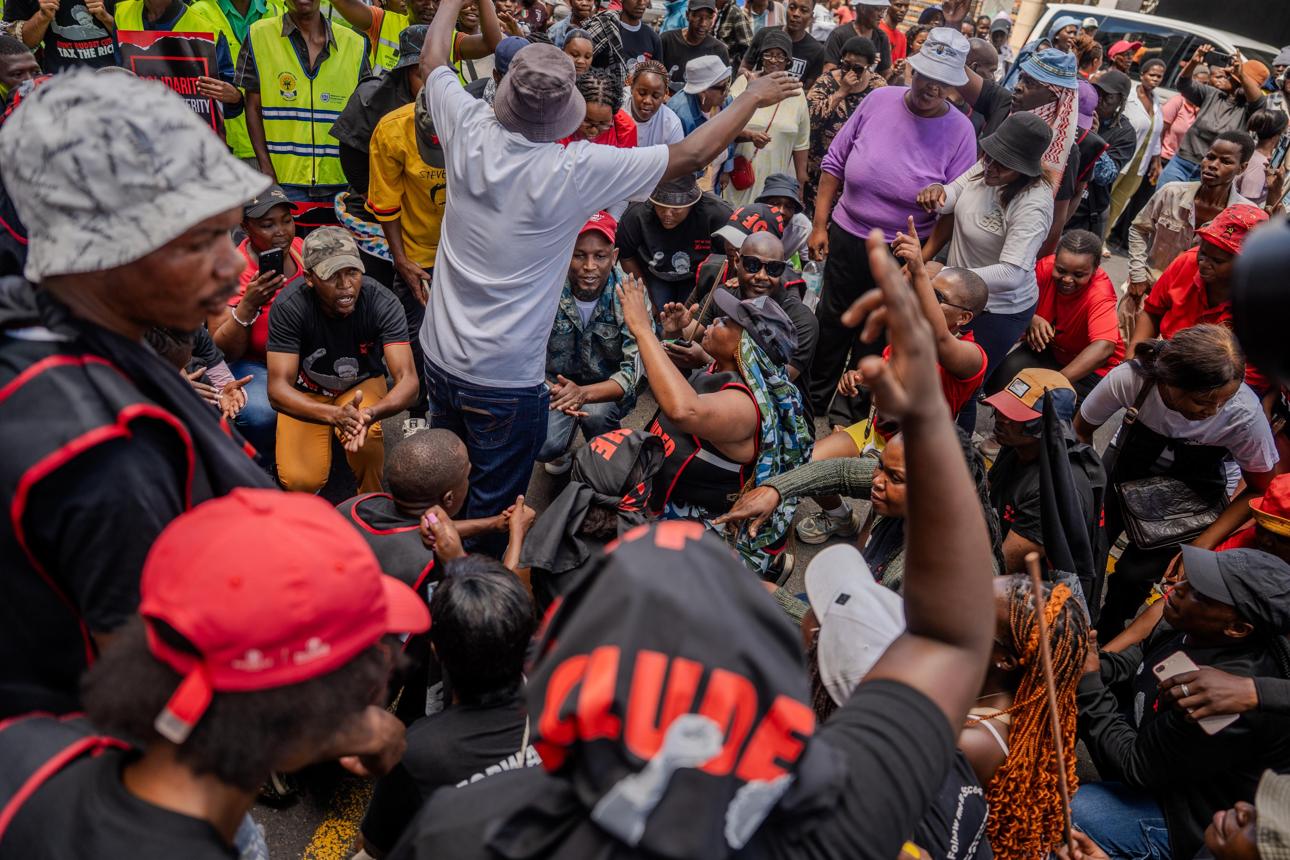
“The South African Federation of Trade Unions (SAFTU), the Association of Mineworkers and Construction Union (AMCU), and the Assembly of the Unemployed are mobilising under the Cry of the Xcluded banner to challenge austerity measures as the government presents its Medium-Term Budget Policy Statement. The campaign calls for greater public investment in healthcare, education, housing and basic services, arguing that budget decisions must address poverty, unemployment and inequality rather than deepen the hardship experienced by vulnerable communities.”
The South African Federation of Trade Unions (SAFTU), the Association of Mineworkers and Construction Union (AMCU), and the Assembly of the Unemployed are mobilising under the Cry of the Xcluded banner to challenge austerity measures as the government presents its Medium-Term Budget Policy Statement. The campaign calls for greater public investment in healthcare, education, housing and basic services, arguing that budget decisions must address poverty, unemployment and inequality rather than deepen the hardship experienced by vulnerable communities.
South Africa’s anti-austerity activism puts public spending and economic justice in the spotlight
Workers and unemployed people challenge government spending priorities
South Africa’s debate over economic policy is moving beyond Parliament and into the streets, as trade unions, unemployed people’s organisations and civil society groups mobilise against government austerity measures. On Wednesday, 21 October 2026, the Cry of the Xcluded campaign is drawing attention to the relationship between public spending, unemployment, poverty and access to essential services. The demonstration coincides with Finance Minister Enoch Godongwana’s presentation of the Medium-Term Budget Policy Statement, a key moment for examining the government’s fiscal priorities.
The protest brings together organisations that believe budget decisions should be judged not only by their effect on government finances, but also by their consequences for ordinary South Africans. Healthcare, education, housing and municipal services are central to their demands. For these campaigners, the question is whether fiscal decisions will improve living conditions for struggling communities or leave existing inequalities largely untouched.
The mobilisation reflects a wider political argument about the responsibilities of government in a country facing persistent unemployment and substantial economic inequality. Although the authorities must manage public finances carefully, activists argue that spending restraint should not come at the expense of people who depend on public services.
Cry of the Xcluded gives unemployed people a political platform
The Cry of the Xcluded banner provides a shared platform for labour organisations and people experiencing economic exclusion. According to eNCA, the South African Federation of Trade Unions (SAFTU), the Association of Mineworkers and Construction Union (AMCU), and the Assembly of the Unemployed planned to mobilise thousands of workers towards the National Treasury.
Their participation highlights the connections between workplace concerns and the experiences of people without jobs. Workers may be concerned about wages, employment security and the affordability of transport, while unemployed people face the immediate challenge of securing income and meeting basic needs. Both groups are affected by the availability of public services and the broader direction of economic policy.
The campaign therefore seeks to make economic hardship a central issue in the national budget debate. Its message is that people experiencing poverty should have a meaningful voice in decisions that shape employment opportunities, social protection and access to public resources.
However, bringing different groups together does not automatically resolve their individual concerns. Trade unions, unemployed communities and civil society organisations may have different priorities. Their ability to maintain a common platform and translate their demands into practical proposals will be important in determining the campaign’s longer-term influence.
Why the Medium-Term Budget Policy Statement matters
The Medium-Term Budget Policy Statement is an important stage in South Africa’s fiscal planning process. It provides an opportunity for the government to communicate its economic outlook and spending priorities before the next national budget.
For activists, this makes the statement a significant moment for political engagement. Decisions about expenditure, borrowing, revenue and the allocation of available funds can affect the resources provided to schools, clinics, housing programmes and municipalities.
The campaign’s timing is intended to draw attention to these consequences while national fiscal priorities are being discussed. Eyewitness News reported that demonstrators regard budget decisions as determining who gains access to essential services and who risks being left behind.
The dispute is not simply about whether government spending should increase or decrease. It also concerns how resources are distributed, which services receive priority and whether public investment can support sustainable employment and economic development.
Government officials must weigh competing demands, including debt-servicing costs, revenue constraints and the need to maintain financial stability. Activists, meanwhile, argue that these pressures should not obscure the immediate needs of people living with poverty and inadequate services.
The political challenge is to reconcile responsible fiscal management with measurable improvements in living standards.
Healthcare, education and housing at the centre of the protest
The campaign is calling for increased spending on healthcare, education, housing and service delivery.
These priorities connect national budget decisions with the everyday experiences of households.
In healthcare, access to properly staffed facilities, essential medicines and reliable infrastructure can influence whether communities receive timely treatment. Underfunded or poorly managed services can impose additional costs on families who already face financial pressure.
Education is similarly important because schools influence future employment opportunities and social mobility. Funding decisions affect infrastructure, learning resources, staffing and the ability of institutions to provide appropriate support to learners.
Housing remains another significant concern. Affordable and adequate accommodation is essential for household security, while shortages and high costs can leave low-income residents struggling to find suitable places to live.
Municipal service delivery also matters. Reliable water, sanitation, electricity infrastructure, refuse removal and road maintenance contribute to public health and economic activity. Where services fail, households and businesses may face additional expenses.
Activists argue that these issues cannot be considered separately from national economic policy. In their view, public spending should be assessed according to whether it improves access to essential services and expands opportunities for communities experiencing economic exclusion.
Austerity and the struggle against inequality
Austerity generally refers to measures designed to restrain public expenditure, reduce deficits or improve government finances. Such policies can involve spending limits, reduced allocations or efforts to contain public-sector costs.
Supporters of fiscal restraint may argue that controlling expenditure is necessary to protect financial stability and preserve the government’s capacity to meet its obligations. However, critics warn that spending reductions can have damaging consequences when they weaken essential services or reduce support for vulnerable households.
The Cry of the Xcluded mobilisation reflects this disagreement. Organisers are challenging what they see as an unfair distribution of the costs associated with economic adjustment. They argue that lower-income communities often have fewer resources to compensate for declining public provision.
This concern is particularly important where households depend heavily on public healthcare, public education and municipal services. When these systems are insufficient, people with greater financial means may be better able to purchase alternatives, while poorer households have fewer options.
Nevertheless, the effects of fiscal policy depend on the specific measures adopted, how they are implemented and whether savings are accompanied by reforms that improve efficiency. Not every spending reduction produces the same outcome, and additional expenditure does not automatically guarantee better services.
A meaningful assessment therefore requires evidence about budget allocations, service quality, implementation and the distribution of benefits.
Trade unions expand the debate beyond workplace conditions
The involvement of SAFTU and AMCU demonstrates how organised labour can participate in broader political debates beyond collective bargaining and workplace disputes.
Trade unions represent workers whose living standards are influenced by wages, inflation, transport expenses, housing costs and the availability of public services. These factors help explain why labour organisations may mobilise around the national budget.
The participation of unemployed people adds another dimension. People outside formal employment may have limited access to the bargaining structures available to unionised workers, making community organisations and public demonstrations important channels for expressing their concerns.
Eyewitness News reported that social movements, faith-based organisations and non-governmental organisations had joined the wider demonstration against austerity.
Their involvement indicates that the protest extends beyond a single workplace issue.
Coalitions of this kind can broaden public discussion by connecting economic policy with social justice, dignity and equality. However, their influence depends on the clarity of their demands, the strength of their public support and their ability to sustain engagement after a demonstration ends.
Civil society activism and democratic accountability
Public demonstrations are one way citizens seek to influence decisions made by elected representatives and government departments. In South Africa, activism has historically provided a platform for communities to raise concerns about working conditions, housing, education, public services and political accountability.
The current anti-austerity mobilisation continues this tradition by directing attention towards the consequences of national fiscal choices. Rather than treating the budget as a technical document intended only for economists and policymakers, campaigners are presenting it as a matter of public interest.
This approach can encourage citizens to ask questions about the allocation of public money, the performance of institutions and the results achieved through government expenditure.
For activism to produce lasting change, however, public pressure generally needs to be accompanied by continued engagement. Organisers can submit memoranda, participate in public consultations, approach parliamentary committees and monitor whether government departments fulfil their commitments.
Clear and measurable proposals can also strengthen a campaign. Demands linked to service delivery targets, transparent spending information and publicly reported outcomes provide a basis for assessing whether policymakers have responded.
The government, in turn, can strengthen accountability by explaining its decisions, publishing accessible information and engaging constructively with affected communities.
What the demonstration means for South Africa’s political debate
The protest places economic fairness firmly within the discussion surrounding the Medium-Term Budget Policy Statement. It highlights the competing pressures facing policymakers as they attempt to manage public finances while responding to social needs.
The campaign’s significance will depend partly on the response from government and the extent to which its concerns receive attention in subsequent budget decisions. A demonstration can raise awareness and signal public dissatisfaction, but its long-term impact must be assessed through concrete policy developments.
Relevant indicators include whether essential services receive adequate resources, whether expenditure is implemented effectively and whether improvements reach communities most in need. Employment opportunities, access to housing and the quality of public services will also remain important measures of progress.
It is equally important to distinguish between the campaigners’ demands and government decisions. The groups are calling for greater investment in essential services, but their demands should not be interpreted as proof that specific policy changes have already been adopted.
The budget debate also presents an opportunity for activists to explain how their proposals could be funded, implemented and evaluated. Transparent costing and practical recommendations could help move discussions beyond opposing austerity towards identifying sustainable alternatives.
Conclusion: activism keeps economic justice on the national agenda
South Africa’s anti-austerity mobilisation on 21 October 2026 demonstrates how trade unions, unemployed people and civil society organisations are seeking to influence national economic priorities. By protesting during the presentation of the Medium-Term Budget Policy Statement, the Cry of the Xcluded campaign is directing public attention towards healthcare, education, housing, service delivery and the unequal effects of economic hardship.
The demonstration highlights a fundamental question: how can the government maintain responsible public finances while ensuring that vulnerable communities are not excluded from essential services and economic opportunities?
The answer will require more than public statements or demonstrations. It will depend on transparent policymaking, effective public spending, accountable institutions and measurable improvements in people’s lives.
For activists, the immediate objective is to ensure that economic decisions reflect the experiences of workers and unemployed communities. For government, the challenge is to respond to these concerns while addressing the country’s fiscal constraints.
Ultimately, the importance of this mobilisation will be determined not simply by the number of people taking to the streets, but by whether the issues they raise contribute to meaningful public debate, stronger accountability and tangible improvements in living standards.



