




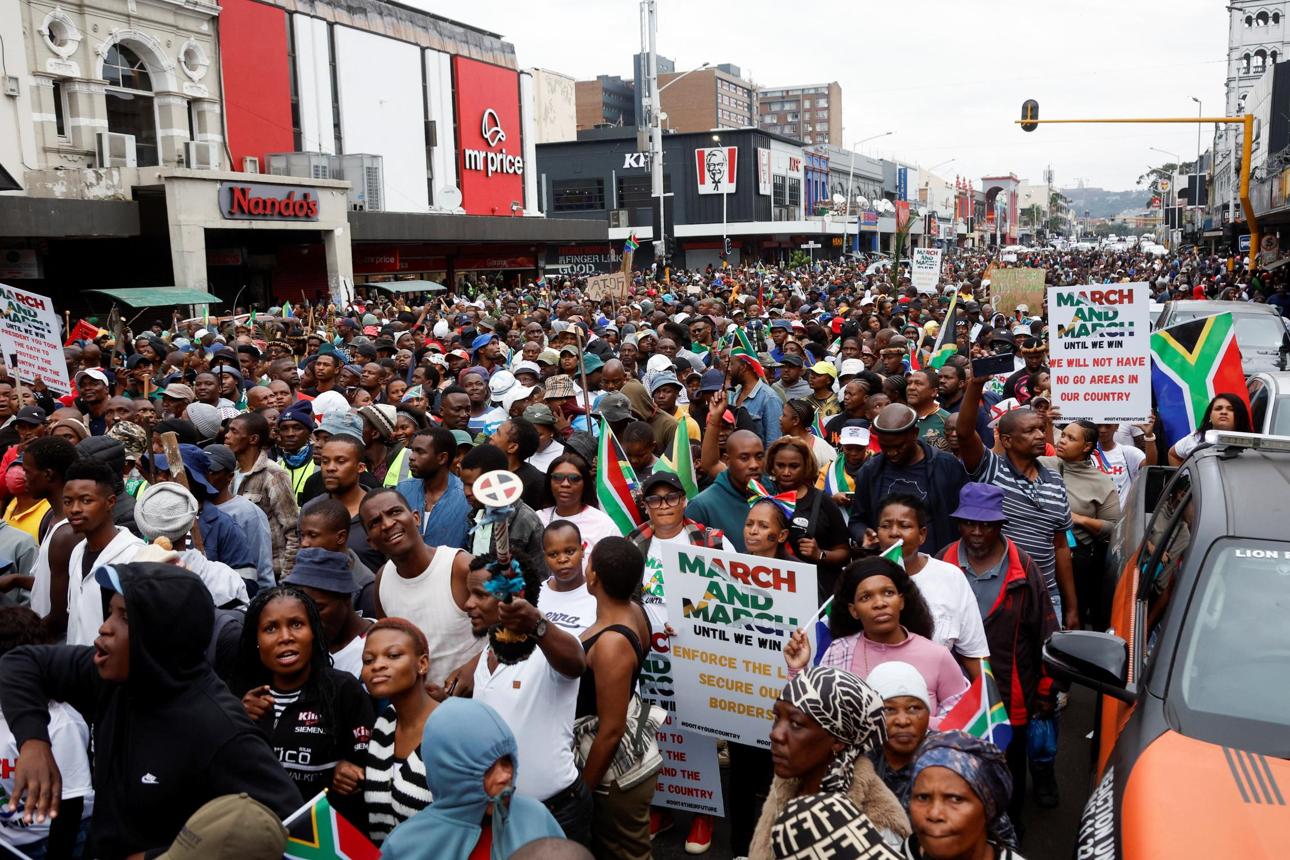
“South Africa’s anti-immigration protest movement March and March has intensified its confrontation with government institutions over immigration enforcement, public demonstrations and the treatment of foreign nationals, creating a major political debate about citizenship, public accountability and constitutional freedoms. The government’s response, including legal action against planned demonstrations and the deployment of security personnel in KwaZulu-Natal, has placed freedom of assembly, public safety and protection against xenophobic violence at the centre of national political discussion.”
South Africa’s Anti-Immigration Activism Faces Government Challenge as March and March Protests Intensify
South Africa | Politics | Activism | 7 November 2026
South Africa’s anti-immigration activism has entered a significant new phase as the March and March movement confronts government authorities over immigration enforcement, public demonstrations and the constitutional right to protest. The growing dispute has placed political accountability, public safety, asylum administration and the protection of foreign nationals at the centre of national debate, particularly in KwaZulu-Natal.
The movement’s campaign against undocumented immigration has increasingly attracted political attention, while its demonstrations have triggered serious questions about the boundaries between legitimate activism, intimidation and unlawful conduct. At the same time, government authorities face pressure to respond to public concerns about immigration without undermining constitutional protections or permitting violence against vulnerable communities.
March and March becomes a prominent political force
March and March has emerged as a prominent grassroots movement campaigning for stronger immigration enforcement and improved opportunities for South African citizens.
Its activities have included demonstrations, protest convoys, public meetings and memoranda directed at government institutions. The movement has particularly focused on the Department of Home Affairs and refugee reception centres, where asylum seekers seek access to South Africa’s protection system.
The organisation’s political messaging frequently connects immigration with unemployment, economic insecurity, crime, business competition and dissatisfaction with government service delivery.
These issues have become increasingly prominent in public discussions, particularly among communities experiencing economic hardship and frustration with public institutions.
However, the movement’s approach has also generated substantial criticism. Civil society organisations and migrant-rights advocates have warned that anti-immigration activism can encourage xenophobic attitudes, particularly when foreign nationals are collectively blamed for social and economic problems.
The distinction between lawful political campaigning and discriminatory mobilisation has consequently become central to the debate.
Durban protests intensify immigration controversy
Durban has emerged as one of the principal locations of the confrontation.
In October 2026, March and March demonstrations around the Home Affairs Refugee Reception Centre disrupted access to immigration services. Protesters demanded stronger enforcement against undocumented migration and objected to administrative arrangements affecting asylum applications.
The protests escalated during a period of heightened uncertainty following a Constitutional Court judgment concerning asylum procedures.
According to reporting by Daily Maverick and other news organisations, demonstrations in Durban were accompanied by attacks on businesses, property damage, looting and disruptions to public services. These incidents intensified concerns among residents, business owners, migrant communities and law-enforcement authorities.
The violence also complicated the movement’s efforts to present itself as a political organisation pursuing legitimate public grievances.
Police subsequently increased their response, while authorities sought judicial intervention to prevent further unrest.
Government takes legal action against demonstrations
The confrontation reached a significant point when Acting Police Minister Firoz Cachalia and KwaZulu-Natal Police Commissioner Lieutenant-General Nhlanhla Mkhwanazi sought court restrictions against March and March.
Authorities argued that intervention was necessary to protect residents, businesses, public infrastructure and foreign nationals from violence and intimidation.
Police raised concerns about alleged threats involving the Home Affairs Refugee Reception Centre and the possibility of further unrest.
On 28 October 2026, an interim interdict restricting demonstrations was granted. Subsequent court proceedings resulted in additional restrictions governing protests during the local government election period.
The restrictions addressed several issues, including the carrying of weapons, concealment of identities, violent conduct and the disruption of businesses or roads.
The legal proceedings represented a significant development in the relationship between organised activism and state institutions.
March and March, however, criticised the government’s intervention, arguing that it threatened the democratic right to protest.
The movement’s leadership characterised the legal action as an attempt to silence citizens demanding stronger immigration enforcement.
Its supporters maintained that public demonstrations remained necessary to pressure government officials to respond to immigration concerns.
The dispute therefore extended beyond immigration policy into a broader constitutional debate about the limits of political activism.
Constitutional rights and the freedom to protest
South Africa’s Constitution protects freedom of expression, peaceful assembly, demonstration and petition.
These rights form an important foundation of democratic participation, enabling citizens to challenge government decisions, demand accountability and mobilise around public concerns.
Nevertheless, constitutional protection does not extend to violence, intimidation, unlawful obstruction or attacks on individuals and property.
The government’s responsibility is consequently twofold: protect the right to peaceful protest while preventing demonstrations from becoming vehicles for violence.
This balance is particularly difficult when politically charged demonstrations involve vulnerable communities, competing public interests and heightened tensions.
The March and March controversy illustrates the challenges facing democratic institutions when organised activism becomes confrontational.
Courts play an important role in determining whether restrictions are legally justified, proportionate and consistent with constitutional protections.
At the same time, law-enforcement authorities must ensure that restrictions do not become a blanket prohibition on peaceful political expression.
Asylum policy becomes a central political issue
The controversy surrounding immigration activism has also been shaped by developments in South Africa’s asylum system.
In July 2026, the Constitutional Court delivered a judgment concerning the treatment of asylum seekers who entered the country without the required transit documentation.
The ruling challenged aspects of the existing asylum administration framework and required government authorities to reconsider how asylum applications are received and processed.
Subsequent administrative developments contributed to increased pressure on refugee reception offices.
Government authorities acknowledged difficulties arising from the implementation of the judgment, including administrative capacity and the need for structured registration arrangements.
The Inter-Ministerial Committee on Migration subsequently announced plans for an intention-registration and appointment system intended to improve the management of asylum applications.
According to official government information, the proposed system includes online registration, appointment scheduling and assisted registration for people requiring support.
Government also reaffirmed that immigration enforcement and deportation procedures would continue in accordance with applicable law.
These developments have become a major focus of political activism, with March and March arguing that immigration administration requires stronger enforcement and greater accountability.
However, refugee-rights advocates maintain that asylum seekers must retain access to lawful protection procedures and that administrative difficulties should not become grounds for discrimination or violence.
Civil society challenges xenophobic mobilisation
South African civil society organisations have increasingly criticised activism that targets foreign nationals or associates migration with criminality without sufficient evidence.
Human Rights Watch warned in May 2026 that vigilante-style actions and xenophobic violence were placing foreign nationals at risk.
The organisation called on authorities to protect affected communities and ensure accountability for those responsible for violence.
Activists working on migrant protection have similarly warned that political campaigns can exploit legitimate public concerns about unemployment, gender-based violence and crime.
GroundUp reporting on March and March demonstrations has documented concerns about the treatment of migrant women, businesses and people mistakenly identified as foreign nationals.
These criticisms highlight the importance of distinguishing immigration policy debates from discrimination against individuals based on nationality or perceived identity.
South Africa’s history of xenophobic violence makes the issue particularly sensitive.
The country has experienced repeated episodes of attacks against foreign nationals, including major outbreaks in 2008, 2015 and 2019.
The current political environment has therefore renewed concerns that immigration-related activism could contribute to further instability if public grievances are mobilised through hostility or intimidation.
Immigration and economic frustration intersect
The growing influence of anti-immigration activism cannot be understood without considering South Africa’s economic challenges.
High unemployment, inequality, limited economic opportunities and pressure on public services continue to affect millions of households.
These conditions contribute to dissatisfaction with government performance and increase public demand for visible policy action.
March and March has sought to connect its campaign with these frustrations, including demands for employment opportunities, improved border management and support for local businesses.
The movement has also raised concerns about the regulation of e-hailing and delivery industries.
Its campaign therefore encompasses issues beyond immigration administration, extending into economic policy, policing and governance.
Nevertheless, analysts and civil society organisations have cautioned against treating foreign nationals as the principal explanation for South Africa’s economic difficulties.
Structural unemployment, unequal access to opportunities, weak economic growth and deficiencies in public administration require broader policy responses.
Political activism can contribute to public debate, but solutions depend on evidence-based policymaking and effective institutional implementation.
Political parties and electoral competition
Immigration has also become an increasingly important issue in South African political competition.
Political parties and movements have sought to demonstrate their positions on immigration enforcement, employment, public safety and national identity.
The controversy surrounding March and March has attracted attention from political organisations and elected representatives, particularly in KwaZulu-Natal.
The movement’s demonstrations and public messaging have created opportunities for political actors to engage with communities dissatisfied with government performance.
At the same time, political involvement raises questions about the relationship between grassroots activism and party competition.
The risk is that immigration debates may become increasingly polarised, particularly when political organisations compete to demonstrate stronger enforcement commitments.
A constructive political response would require parties to address public concerns while rejecting xenophobia, violence and unlawful discrimination.
The debate also underscores the importance of transparent immigration administration, accountable policing and effective communication from government institutions.
The implications for democratic governance
The confrontation between March and March and government authorities carries wider implications for South Africa’s democratic institutions.
First, it demonstrates the continuing importance of organised public mobilisation in demanding government accountability.
Second, it highlights the responsibility of state institutions to respond to public grievances through transparent and effective policies.
Third, it raises concerns about the relationship between political activism, public safety and constitutional rights.
Government authorities must ensure that immigration enforcement remains lawful, asylum procedures remain accessible and public institutions operate effectively.
Law-enforcement agencies must protect communities without unlawfully restricting peaceful political participation.
Civil society organisations must continue monitoring the treatment of vulnerable communities and challenging discriminatory practices.
Political movements, meanwhile, have a responsibility to ensure that their campaigns do not encourage violence or collective punishment.
The effectiveness of democratic governance ultimately depends on the ability of institutions and citizens to resolve disagreements through lawful processes.
What happens next?
The future of March and March’s activism will depend partly on the movement’s response to court restrictions and its ability to organise demonstrations within the applicable legal framework.
The government must also address the administrative challenges surrounding immigration and asylum processing.
The introduction of structured registration arrangements could help reduce confusion and pressure on refugee reception offices, provided implementation is accessible and consistent with constitutional obligations.
The broader political debate is likely to continue as communities demand stronger immigration enforcement and improved economic opportunities.
However, the challenge facing South Africa is not simply whether immigration laws should be enforced more effectively.
It is whether the country can address immigration concerns while protecting constitutional rights, maintaining social stability and preventing xenophobic violence.
Conclusion
South Africa’s anti-immigration activism has become one of the country’s most contentious political developments in 2026.
The confrontation involving March and March, government authorities and civil society organisations illustrates the complex relationship between grassroots mobilisation, immigration policy and constitutional democracy.
The movement has brought immigration enforcement and government accountability into national political discussions, while its activities have generated serious concerns about violence, intimidation and the treatment of foreign nationals.
The government’s response through legal proceedings, policing and administrative reform demonstrates the pressure on institutions to maintain public order while respecting democratic freedoms.
Ultimately, South Africa’s ability to manage this controversy will depend on evidence-based immigration policy, effective public administration, responsible political leadership and respect for constitutional rights.
The country’s democratic institutions face the challenge of ensuring that legitimate public grievances are addressed without allowing political activism to undermine the dignity, safety and rights of any community.
The central question remains whether South Africa can transform immigration-related political confrontation into constructive democratic engagement, effective governance and peaceful coexistence



