




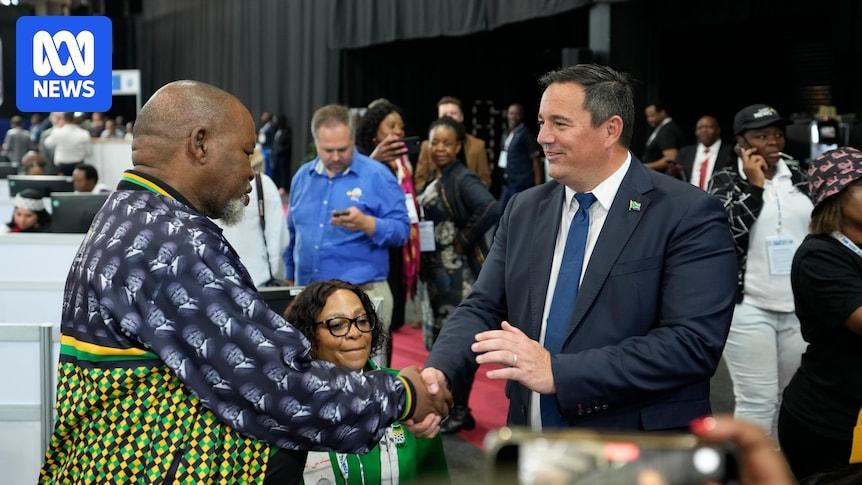
“South Africa’s political parties are preparing for intense coalition negotiations following the 2026 Local Government Elections, with the African National Congress (ANC), Democratic Alliance (DA), uMkhonto weSizwe Party (MK Party), Economic Freedom Fighters (EFF) and ActionSA competing to influence the leadership of municipalities where no party secured an outright majority. The negotiations are expected to reshape municipal governance, particularly in Johannesburg, Tshwane, Ekurhuleni and eThekwini, while raising important questions about political alliances, accountability, service delivery and the future direction of South African politics.”
South Africa’s Political Parties Prepare for High-Stakes Coalition Negotiations Following 2026 Local Government Elections
JOHANNESBURG, 8 November 2026 — South Africa’s political landscape is entering a decisive period following the 2026 Local Government Elections, with political parties preparing for extensive coalition negotiations that could fundamentally reshape municipal governance across the country. The election results have weakened the African National Congress (ANC), strengthened the Democratic Alliance (DA) in several municipalities, and established the uMkhonto weSizwe Party (MK Party) as an increasingly influential political force, particularly in KwaZulu-Natal.
With numerous municipalities facing hung councils, political parties are now confronted with the challenge of transforming electoral mandates into workable governing arrangements. The negotiations are expected to determine who controls mayoral offices, municipal councils and executive committees, while potentially influencing the country’s political relationships ahead of future national elections.
Coalition negotiations become the central political priority
The immediate consequence of the election results is the emergence of coalition negotiations as the central priority for political parties. Across South Africa, voters have delivered fragmented electoral outcomes, preventing numerous parties from governing municipalities independently.
According to reporting published by The Citizen on November 8, preliminary coalition discussions have already begun between several political formations. These discussions are expected to become more formal as parties establish negotiating teams, identify potential partners and determine the conditions under which they would participate in municipal administrations.
The situation represents a significant development in South African politics, where coalition government has increasingly become a feature of municipal administration since the 2016 local elections.
The 2026 elections have reinforced this trend, creating additional opportunities for smaller political parties to influence municipal leadership despite receiving comparatively limited electoral support.
The National reported on November 8 that seven of South Africa’s eight metropolitan municipalities were heading towards coalition arrangements, highlighting the extent of political fragmentation following the election.
Cape Town remained an exception, with the DA retaining its position as the dominant governing party.
ANC faces a difficult political recovery
The African National Congress enters coalition negotiations following another substantial electoral setback.
The party received approximately 30.7% of the national vote in the 2026 local government elections, significantly below its 45.59% performance in 2021.
The decline represents a continuation of the ANC’s electoral challenges following its loss of an outright parliamentary majority in the 2024 national elections.
The party’s weakening support has reduced its ability to govern municipalities independently and increased its dependence on political partnerships.
ANC leaders have acknowledged that the election results require serious reflection and organisational renewal.
Deputy secretary-general Nomvula Mokonyane indicated that the party remained open to negotiations with political formations willing to cooperate around its policy priorities.
However, secretary-general Fikile Mbalula has emphasised that the ANC would not approach coalition discussions from a position of desperation.
The party is expected to evaluate its options municipality by municipality, with the National Executive Committee providing guidance on potential partnerships.
The ANC’s negotiating strategy will therefore involve balancing political survival, organisational identity and the practical requirements of municipal governance.
The party may seek alliances with ActionSA, the EFF, the MK Party or other smaller political formations, depending on the electoral arithmetic in individual councils.
However, any agreement with the DA would carry significant political implications because the two parties currently cooperate within the national government of unity.
DA seeks to expand municipal influence
The Democratic Alliance has entered coalition negotiations following a comparatively strong electoral performance.
The party’s leadership has instructed its negotiating teams to engage political formations that support clean governance, accountability, service delivery, the rule of law and non-racialism.
DA leader Geordin Hill-Lewis has indicated that the party intends to approach negotiations with humility while respecting the electoral mandates received by competing parties.
The DA is particularly interested in municipalities where it emerged as the largest political formation but failed to secure an outright majority.
Johannesburg, Tshwane and Ekurhuleni are among the most important battlegrounds.
The party’s coalition strategy could determine whether it expands its municipal governing influence beyond traditionally strong areas.
DA federal chairperson Solly Msimanga has indicated that negotiations should begin with agreement on governance principles before parties determine which political representatives will occupy particular positions.
The approach suggests that the DA intends to establish formal coalition agreements capable of providing greater stability and accountability.
However, disagreements over political ideology, leadership positions and relationships with other parties could complicate negotiations.
MK Party positions itself as a major coalition player
The uMkhonto weSizwe Party has emerged as an important political force following its participation in the 2026 local government elections.
The party’s electoral strength in eThekwini has positioned it as a central participant in negotiations over municipal leadership in KwaZulu-Natal.
MK Party representatives have indicated that the organisation intends to prioritise partnerships with political formations sharing its ideological positions.
According to reporting published by IOL on November 7, the party has ruled out coalition arrangements with the DA while identifying the ANC, EFF, IFP, ActionSA and other political organisations as potential negotiating partners.
Advocate Dali Mpofu said party president Jacob Zuma had instructed the leadership to begin discussions with other formations without delay.
The party has also emphasised that coalition negotiations should respect the political mandates delivered by voters.
Its approach reflects a broader effort to consolidate electoral support and translate political influence into municipal governing responsibilities.
However, the MK Party will need to demonstrate that its coalition strategy can produce stable administrations capable of addressing municipal challenges.
EFF calls for political reconciliation
The Economic Freedom Fighters has also positioned itself as an important participant in the coalition negotiations.
Although the party experienced electoral setbacks, its representation in several municipalities could provide opportunities to influence governing arrangements.
EFF leader Julius Malema has called on the ANC to reconsider its relationship with the DA and instead pursue political reconciliation with formations including the EFF, MK Party and South African Communist Party.
The EFF argues that parties sharing progressive political objectives should cooperate to prevent the expansion of political forces it considers ideologically opposed to its priorities.
The party has also indicated that coalition participation must be based on policy commitments rather than political convenience.
According to EWN reporting published on November 8, Malema urged the ANC to reconsider its relationship with the DA and explore opportunities for cooperation with its former political allies.
However, the ANC has not formally committed itself to the proposal.
The EFF’s negotiating position is expected to focus on policy influence, municipal responsibilities and commitments concerning service delivery.
ActionSA emerges as an influential negotiating partner
ActionSA could play a significant role in determining coalition outcomes, particularly in Gauteng.
The party has maintained that it will negotiate with political formations willing to support improved governance, accountability and service delivery.
Its leadership has rejected attempts by other parties to dictate which political partners it should engage.
ActionSA’s municipal experience could strengthen its negotiating position, especially where its councillors are necessary to establish governing majorities.
However, the party must also consider the political consequences of working with formations whose policy positions differ significantly from its own.
The negotiations could therefore provide ActionSA with opportunities to expand its municipal influence while testing its commitment to maintaining a distinct political identity.
Municipal service delivery remains the central challenge
Despite the political competition surrounding coalition negotiations, municipal service delivery remains the principal concern for residents.
South African municipalities continue to face challenges involving water infrastructure, electricity distribution, sanitation, road maintenance, waste management and financial accountability.
The election results suggest that voters increasingly expect political parties to demonstrate practical improvements rather than relying exclusively on historical political loyalties.
The 2026 elections have consequently increased pressure on parties to establish administrations capable of delivering measurable improvements in local government performance.
Coalition agreements that concentrate exclusively on political appointments without addressing municipal priorities could face significant public criticism.
Parties will therefore need to establish clear mechanisms for monitoring performance, resolving disagreements and ensuring accountability.
The stability of municipal administrations will depend partly on whether coalition partners can maintain cooperation when confronted with difficult budgetary and governance decisions.
Political negotiations could reshape future elections
The coalition negotiations may also influence South Africa’s broader political future.
The ANC’s declining electoral support, the DA’s expanding municipal influence and the MK Party’s emergence as a significant political force could contribute to further changes in party competition.
Smaller formations may become increasingly important in determining governing arrangements, particularly where electoral outcomes remain fragmented.
The negotiations could also reveal whether political parties are capable of maintaining ideological differences while cooperating around practical governance objectives.
Successful coalition administrations could strengthen public confidence in multiparty government.
Conversely, unstable arrangements, leadership disputes and unsuccessful municipal administrations could reinforce public dissatisfaction.
Political parties therefore face an important opportunity to demonstrate that coalition government can provide effective administration rather than merely political compromise.
Conclusion
South Africa’s 2026 Local Government Elections have created a new political environment in which coalition negotiations are becoming essential to municipal governance.
The ANC is seeking to recover from electoral losses, the DA is attempting to expand its governing influence, the MK Party is consolidating its political position, and the EFF is pursuing opportunities for ideological cooperation.
ActionSA and other smaller political formations could also play decisive roles in determining municipal leadership.
Ultimately, the success of these negotiations will depend on whether political parties can translate electoral mandates into stable administrations that prioritise accountability, effective governance and service delivery.
For South African residents, the most important outcome will not simply be which party occupies a mayoral office, but whether the resulting municipal governments can improve everyday living conditions and restore confidence in local democracy.
The coalition negotiations beginning on November 8, 2026, therefore represent more than a contest for political positions. They constitute a critical test of South Africa’s multiparty democratic system and its ability to respond to changing voter expectations.



