




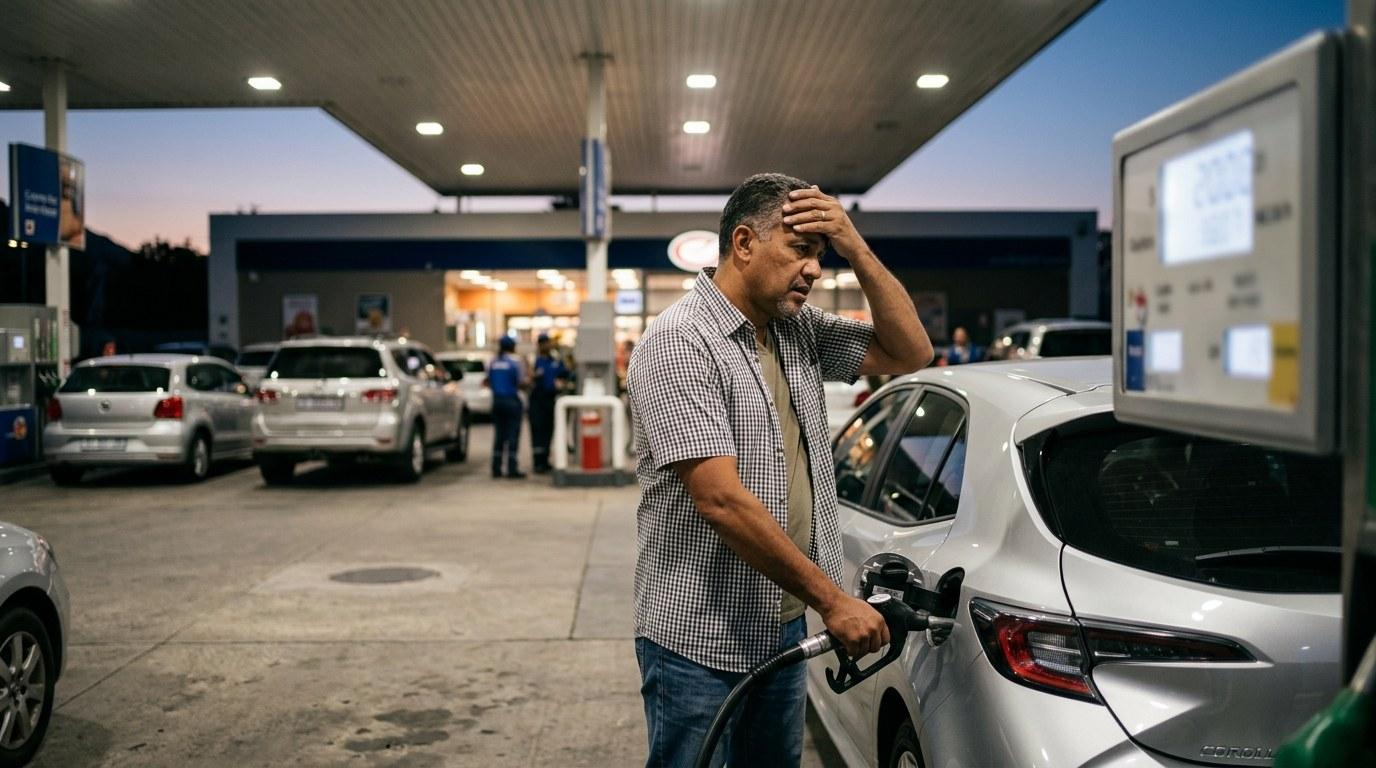
“South Africa’s regulated fuel prices will rise sharply from 7 October 2026, with 95-grade petrol increasing by R3.33 per litre inland to a record R30.25, while wholesale diesel rises by up to R3.24 per litre. The increase, driven mainly by higher international oil prices and supply disruptions linked to the Middle East conflict, is expected to raise transport and operating costs, intensify inflationary pressure and renew calls for government intervention to protect households and businesses.”
South Africa’s Record Fuel-Price Increase Deepens Pressure on Businesses and Consumers
South African households and businesses are entering a difficult new phase after the government announced another sharp increase in regulated fuel prices, with the new prices taking effect from Wednesday, 7 October 2026. The adjustment is one of the most significant fuel-price shocks of the year and places renewed attention on government policy, energy security, inflation management and the cost of doing business in the country.
The Department of Mineral and Petroleum Resources announced that petrol 93 would increase by R3.12 per litre, while petrol 95 would rise by R3.33 per litre. Wholesale diesel prices will increase by R2.84 per litre for 0.05% sulphur diesel and R3.24 per litre for 0.005% sulphur diesel. Illuminating paraffin will rise by R3.58 per litre.
For motorists in Gauteng and other inland areas, the increase means 95-grade petrol will reach R30.25 per litre. Coastal motorists will pay R29.38 per litre. Inland 93-grade petrol will rise to R29.88 per litre, while the corresponding coastal price will be R29.09. Wholesale 0.005% sulphur diesel will reach R33.29 per litre inland and R32.03 on the coast.
The announcement is particularly important from a business-policy perspective because fuel prices influence almost every part of the South African economy. Transport companies, retailers, manufacturers, farmers, construction firms, logistics operators and small businesses all depend on fuel either directly or indirectly. Consequently, a major increase at the pump can quickly spread through supply chains and ultimately reach consumers through higher prices.
International Oil Shock Drives Domestic Prices
The government attributed the latest adjustment primarily to international market conditions. According to the Department of Mineral and Petroleum Resources, the average Brent crude oil price increased from about $87.89 per barrel to $101 during the review period. The department linked the increase to continuing US-Iran tensions, uncertainty surrounding oil flows through the Strait of Hormuz, higher shipping costs and declining inventories.
International petroleum-product prices also increased because of shortages associated with lower global inventories. These developments substantially increased the contribution of international product prices to South Africa’s Basic Fuel Prices.
South Africa is particularly exposed to these international movements because it imports both crude oil and finished petroleum products. The domestic fuel-pricing system therefore incorporates international prices and associated import costs. As a result, local consumers can experience significant price increases even though the underlying disruption is taking place thousands of kilometres away.
Reuters reported that the new increase reflects the impact of the continuing Iran conflict on global energy markets, while South Africa’s dependence on imported fuel leaves the economy vulnerable to international oil-price volatility.
The Policy Mechanism Behind the Increase
South Africa does not simply allow petrol prices to change according to individual service-station decisions. Instead, the government administers a monthly adjustment mechanism that takes international petroleum prices, exchange-rate movements and other components into account.
One element contributing to the latest adjustment is the country’s slate levy mechanism. The Department of Mineral and Petroleum Resources said the cumulative petrol and diesel slate balance had reached a negative R10.45 billion at the end of August. Consequently, a slate levy of 87.66 cents per litre is being incorporated into the petrol and diesel price structures from 7 October.
The rand provided only minimal relief during the review period. The average exchange rate was almost unchanged, moving from approximately R16.213 to R16.212 per US dollar. This generated only a very small reduction in the fuel-price contribution from the currency component.
Therefore, the currency could not offset the much larger impact coming from crude oil and refined-product prices.
Businesses Face a New Cost Shock
The biggest concern for companies is that fuel is not an isolated expense. Higher diesel prices, for example, affect trucking, agriculture, mining, construction, manufacturing and distribution.
A logistics company paying more for diesel faces higher costs for every delivery. A supermarket must then decide whether to absorb those additional expenses or pass some of them to customers. Suppliers face similar choices, and the cumulative effect can push prices higher across the economy.
Small businesses may be particularly vulnerable because they generally have less financial capacity to absorb unexpected operating-cost increases. A taxi operator, delivery company, independent contractor or small retailer cannot necessarily negotiate large discounts from fuel suppliers or immediately replace fuel-intensive operations with alternative technologies.
Moneyweb reported that fuel retailers are also facing financial pressures because higher fuel prices increase the amount of working capital required to maintain inventory.
This creates a policy challenge for government. Although fuel prices are influenced heavily by global markets, domestic policy determines how much of the shock is transferred directly to consumers and businesses.
Pressure on the Cost of Living
The fuel increase comes at a particularly sensitive time for consumers. Transport costs are closely connected to food prices, commuting expenses and household budgets.
Business Day reported that the new increase is likely to intensify the cost-of-living crisis because petrol and diesel feed into transport and other costs throughout the economy. The publication also noted that 95-grade petrol is now almost 50% more expensive than it was in March, before the latest series of oil-price shocks.
For workers who drive long distances to work, the effect is immediate. A driver using 50 litres of petrol would pay roughly R166.50 more for that quantity of 95-grade petrol after the latest R3.33 increase, assuming the same consumption and excluding any other changes.
For businesses operating vehicle fleets, the impact is considerably larger. A company running dozens or hundreds of vehicles can face thousands of rand in additional fuel expenditure every week.
The consequences could also extend to public transport. Higher operating costs can create pressure for transport operators to seek fare increases, while households may have to reduce spending on non-essential goods and services to accommodate higher commuting expenses.
Inflation and Interest-Rate Risks
Another important policy consequence is the potential effect on inflation.
South Africa’s Reserve Bank has a mandate to maintain price stability, and fuel-price shocks can complicate that task. Moneyweb reported that higher fuel prices could increase pressure on the Reserve Bank to consider further interest-rate action because of their potential effect on consumer-price growth.
The risk is not limited to the initial petrol-price increase. Economists worry about so-called second-round effects, where higher fuel costs become embedded in other prices.
For example, a manufacturer may pay more for transporting raw materials. The manufacturer could then raise the price of finished goods. A wholesaler pays more to transport those products, while retailers face higher distribution costs. Eventually, consumers can experience price increases across several categories.
This creates a difficult policy balance. Raising interest rates can help contain inflation expectations, but higher borrowing costs can simultaneously discourage investment and consumer spending. Leaving inflation unchecked, however, can weaken household purchasing power and undermine economic stability.
Calls for Government Relief
The scale of the latest increase is likely to renew political and economic debate about whether government should provide temporary relief.
Earlier fuel-price interventions included temporary reductions in the fuel levy designed to cushion consumers from international oil-price shocks. Business Day reported that the government had previously introduced such relief measures but subsequently suspended them, with the earlier intervention costing the fiscus an estimated R17.2 billion in forgone revenue.
The policy dilemma is straightforward but difficult: reducing fuel taxes can protect households and businesses in the short term, but it also reduces government revenue at a time when public finances remain under pressure.
Alternatively, government could maintain the existing pricing framework and allow international price movements to flow through to consumers. This protects fiscal revenue but transfers more of the economic shock to households and companies.
Neither option is painless.
Energy Security Becomes a Strategic Issue
The latest crisis also highlights a broader policy question: South Africa’s vulnerability to international petroleum markets.
The immediate trigger is the global oil shock, but the scale of the domestic impact raises questions about refining capacity, strategic fuel reserves, infrastructure and supply-chain resilience.
Moneyweb reported criticism from organised labour that the country’s fuel crisis reflected longer-term policy weaknesses, including concerns around refinery capacity and strategic fuel reserves.
Strengthening domestic energy resilience could therefore become an increasingly important part of South Africa’s economic policy agenda.
Government’s challenge is not simply to reduce petrol prices. It must also consider whether the country has enough resilient infrastructure and diversified energy sources to withstand future international disruptions.
What the Increase Means for South Africa
The October fuel adjustment illustrates how closely South Africa’s domestic economy is connected to global geopolitical developments.
A conflict outside the country’s borders can raise crude oil prices. Higher oil prices can increase domestic fuel costs. Higher fuel costs can raise transport expenses. Those expenses can then contribute to higher food and consumer prices, weaker household spending and increased pressure on monetary policy.
That chain of events makes energy policy a central part of economic policy.
For businesses, the immediate priority will be controlling fuel consumption, reviewing logistics arrangements and reassessing operating budgets. For consumers, higher transport costs could require difficult adjustments to household spending.
For government, the challenge is even broader. Policymakers must balance consumer protection, fiscal sustainability, inflation control, energy security and economic growth.
The Reserve Bank’s Monetary Policy Review is scheduled for release on 6 October, adding another important policy development to an already challenging economic environment.
Ultimately, South Africa’s latest fuel-price shock demonstrates why energy security and business policy cannot be considered separately. The country’s exposure to global oil markets means that international instability can quickly become a domestic economic problem.
As the new prices take effect, businesses and consumers will absorb the immediate financial impact. However, the more important policy question is how South Africa can build an economy that is less vulnerable to the next international energy shock.
For now, the record fuel prices represent another significant challenge for households, companies and policymakers alike, with the effects likely to extend well beyond the petrol station forecourt.



