




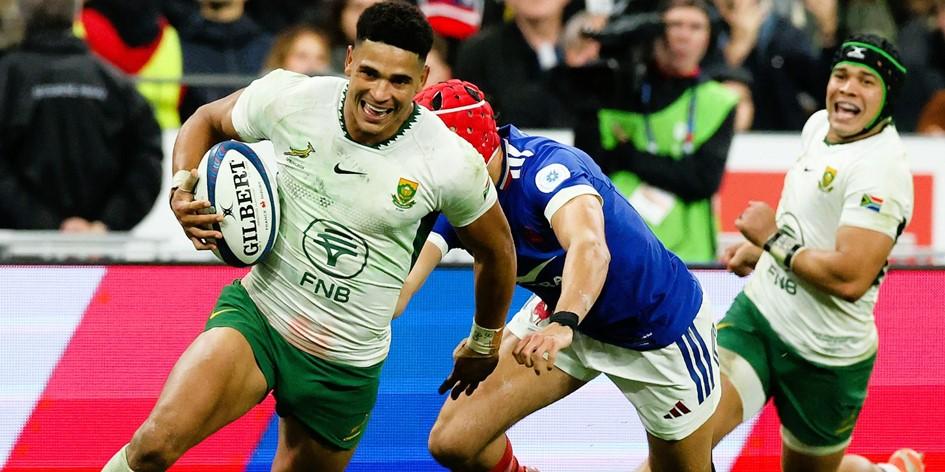
“South Africa’s Springboks are preparing for a major Nations Championship encounter against France in Paris on Friday, 13 November 2026, with the hosts making the surprise decision to deploy Antoine Dupont at fly-half amid injuries to several established playmakers. The Springboks enter the contest with strong momentum following their 66–7 victory over Italy, but face a potentially dangerous French side determined to challenge the world champions on home soil.”
Springboks Prepare for France Showdown as Antoine Dupont’s Fly-Half Selection Raises Stakes
South Africa’s Springboks are heading into one of their most anticipated international rugby encounters of November, with France preparing to host the reigning world champions in a crucial Nations Championship clash on Friday, 13 November 2026. The contest in Paris promises a demanding examination of South Africa’s physical strength, tactical discipline and championship ambitions, particularly following France’s unexpected decision to deploy captain Antoine Dupont at fly-half.
The match has attracted considerable attention across South African rugby circles, with supporters, analysts and former international players examining the implications of France’s selection decisions and the Springboks’ preparations. South Africa arrives with confidence after an impressive 66–7 victory over Italy in Turin, although the French challenge is expected to be considerably more difficult.
Springboks Carry Momentum Into Paris
South Africa’s performance against Italy provided an important demonstration of the team’s attacking potential. The Springboks produced an outstanding first-half display, establishing a commanding advantage before completing a comprehensive victory.
Fly-half Sacha Feinberg-Mngomezulu played a central role in the performance, contributing significantly through his kicking accuracy, attacking organisation and ability to capitalise on opportunities. His contribution reinforced his growing importance within the Springboks’ attacking structure.
Hooker Malcolm Marx also delivered an influential performance, scoring twice and continuing his remarkable record as one of South Africa’s most productive forwards. His ability to contribute directly to the scoreboard illustrates the importance of modern front-row players in South Africa’s attacking approach.
However, the Springboks understand that the result against Italy cannot automatically translate into success against France. The European side possesses greater attacking variety, individual creativity and the ability to generate pressure through sustained possession.
Coach Rassie Erasmus has therefore maintained an emphasis on preparation, discipline and consistency as South Africa approaches the Paris encounter.
Antoine Dupont’s Fly-Half Selection Changes the French Approach
France’s decision to select Antoine Dupont at fly-half has become one of the defining talking points ahead of the match.
Dupont is widely recognised for his exceptional running ability, decision-making, distribution and influence around the breakdown. His usual position at scrum-half allows him to control attacking sequences while remaining closely involved in the contest for possession.
Moving him to fly-half introduces a different tactical dimension.
From the number 10 position, Dupont can potentially influence the French attack earlier in possession, creating opportunities for outside runners and challenging South Africa’s defensive organisation. His ability to identify weaknesses and accelerate through defensive gaps makes him a particularly dangerous opponent.
Nevertheless, the change also presents challenges. Fly-half responsibilities include managing territorial kicking, controlling the rhythm of the match and directing attacking structures under pressure.
South Africa will seek to test France’s decision through defensive pressure, physical contact and disciplined positioning.
The Springboks’ defensive organisation will be particularly important because Dupont possesses the ability to exploit small defensive errors. Allowing him unnecessary time and space could create opportunities for France to establish attacking momentum.
France’s Injury Problems Complicate Preparations
France’s preparations have been complicated by injuries affecting several established playmakers.
The absence of experienced fly-half options has placed additional responsibility on Dupont and the wider French backline. Although France possesses considerable depth, replacing established international combinations during a major Test match can create tactical uncertainty.
The French coaching staff must therefore balance the need for attacking creativity with the importance of maintaining defensive stability.
South Africa’s coaching team will closely examine these circumstances when preparing its tactical approach.
However, the Springboks are unlikely to underestimate France simply because the hosts have experienced selection difficulties. French rugby has repeatedly demonstrated its ability to produce outstanding performances in difficult circumstances.
Playing in Paris also provides France with an important advantage, particularly through the support of its home crowd.
Springbok Forward Power Remains a Major Weapon
South Africa’s forward pack continues to represent one of the team’s strongest competitive advantages.
The Springboks have built their international reputation around physicality, scrum dominance, lineout efficiency and disciplined forward play. Their ability to establish territorial pressure through set pieces remains central to their approach.
The front row, including Malcolm Marx, Ox Nché and Wilco Louw, will be expected to contribute significantly to the contest.
Scrum pressure can influence more than possession. It can force defensive penalties, create attacking opportunities and place opponents under considerable physical strain.
South Africa’s second-row and loose-forward combinations also provide important support in the breakdown, defensive organisation and ball carrying.
The challenge against France will require sustained concentration because the hosts possess forwards capable of competing physically while contributing to expansive attacking play.
South Africa must therefore avoid unnecessary penalties and maintain its discipline throughout the contest.
Sacha Feinberg-Mngomezulu’s Growing Influence
Feinberg-Mngomezulu’s recent performances have strengthened his position as an important component of the Springboks’ attacking structure.
His contribution against Italy demonstrated the value of combining accurate goal-kicking with attacking awareness and composure.
The French encounter represents another opportunity to demonstrate those qualities against a high-quality opponent.
South Africa will need effective communication between its fly-half and scrum-half, particularly when transitioning from defensive situations into attacking opportunities.
The ability to control possession, identify space and make accurate decisions under pressure could determine whether the Springboks establish meaningful attacking momentum.
Feinberg-Mngomezulu will also face the challenge of managing territorial kicking against a French side capable of launching dangerous counterattacks.
Malcolm Marx Emphasises the Importance of the Challenge
Marx has become an influential figure within the Springbok forward pack, contributing through leadership, physical strength and exceptional try-scoring ability.
His recent performances have reinforced his reputation as one of the most effective attacking hookers in international rugby.
However, the experienced forward has also emphasised that historical results cannot guarantee future victories.
South Africa’s previous success against France provides valuable confidence, but every international encounter presents different circumstances.
The Springboks must therefore approach the contest with the same preparation and determination that have contributed to their recent achievements.
France’s motivation will be equally significant, particularly when playing in front of its home supporters.
Historical Rivalry Adds Another Dimension
South Africa and France share a long and competitive rugby history.
Their encounters have frequently featured physical battles, tactical experimentation and dramatic moments that have influenced international rugby.
The Springboks have enjoyed considerable success against France in recent years, strengthening their confidence ahead of the Paris encounter.
Nevertheless, France remains capable of producing exceptional performances against South Africa.
The rivalry also carries emotional significance following previous World Cup encounters, particularly the closely contested 2023 quarter-final.
Those experiences continue to influence discussions surrounding the two teams, although the Nations Championship provides a different competitive environment.
Both sides will be determined to establish superiority through their current performances rather than relying exclusively on historical achievements.
Nations Championship Implications
The Nations Championship provides additional significance to the encounter because performances during the competition contribute towards the teams’ broader international objectives.
South Africa’s victory over Italy strengthened its position following previous successful matches.
The French fixture represents a more demanding opportunity to demonstrate consistency against one of Europe’s strongest rugby nations.
A positive result would reinforce the Springboks’ momentum and provide valuable confidence ahead of their remaining international commitments.
However, the importance of the competition extends beyond individual results.
The Springboks are also using these matches to assess player combinations, develop depth and strengthen tactical understanding.
The experience gained against France could prove valuable in future international tournaments.
Defensive Discipline Could Determine the Outcome
One of the most important factors ahead of the match is South Africa’s defensive discipline.
France possesses dangerous attacking players capable of exploiting defensive weaknesses through quick passing, supporting runs and effective communication.
Dupont’s selection at fly-half introduces additional uncertainty because his attacking decisions may differ from those of a conventional number 10.
The Springboks must therefore remain organised while adapting to France’s attacking movements.
Effective tackling, communication between defenders and control of the breakdown will be essential.
South Africa must also avoid conceding penalties in dangerous positions because France possesses the ability to convert territorial advantages into points.
Maintaining defensive concentration throughout the match could significantly influence the final outcome.
South African Supporters Anticipate a Major Test
The upcoming encounter has generated considerable excitement among South African rugby supporters.
The Springboks’ recent success has strengthened expectations, although supporters recognise that France presents a considerably different challenge.
The match also provides an opportunity for South Africa to demonstrate its ability to compete successfully in difficult away environments.
International rugby supporters will closely monitor the contest because it brings together two teams with significant championship ambitions.
The selection decisions, tactical adjustments and individual performances are expected to generate extensive discussion before and after the match.
Conclusion: Springboks Face an Important Paris Examination
South Africa’s upcoming encounter against France represents an important examination of the Springboks’ consistency, tactical adaptability and championship ambitions.
The impressive victory over Italy has established a positive foundation, but France’s selection of Antoine Dupont at fly-half introduces a significant tactical challenge.
South Africa’s forward strength, defensive discipline and attacking organisation will remain central to its preparations.
Ultimately, the Springboks must demonstrate that their recent success can be maintained against an opponent possessing exceptional individual talent and strong home support.
The match scheduled for 13 November promises to provide an important assessment of South Africa’s progress during the Nations Championship and its ability to compete against Europe’s leading rugby nations.
For South African supporters, the encounter represents another opportunity to watch the Springboks pursue international success while continuing to strengthen their reputation as one of rugby’s most formidable teams.
The result remains uncertain ahead of kick-off, but the significance of the contest is already clear: France and South Africa are preparing for a demanding battle that could provide valuable momentum for the remainder of their international campaigns.



