




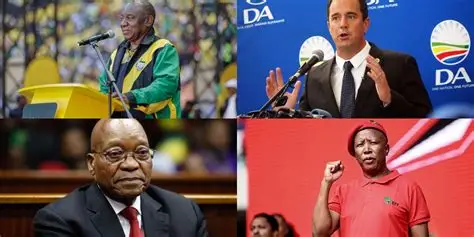
“In a landmark move, Build One South Africa, the GOOD Party, and RISE Mzansi have merged to form Unite for Change, a new opposition party aiming to challenge South Africa’s traditional political establishment. The coalition promises ethical leadership, grassroots-driven policy, and a five-point agenda focused on service delivery and governance reform.”
South Africa’s political landscape has undergone a seismic shift with the announcement that three prominent opposition parties—Build One South Africa (BOSA), the GOOD Party, and RISE Mzansi—have officially merged to form a new political entity named Unite for Change. This development, less than 18 months before the scheduled November 2026 local government elections, signals one of the most significant realignments in South African politics since the African National Congress (ANC) lost its outright majority in 2024.
Background: A Fragmented Opposition
South Africa’s opposition has long been criticized for fragmentation, with dozens of small parties competing for limited voter attention. While the Democratic Alliance (DA) and Economic Freedom Fighters (EFF) remain the largest opposition forces, smaller parties like BOSA, GOOD, and RISE Mzansi have struggled to break through nationally despite strong regional bases. Their merger into Unite for Change represents a strategic consolidation designed to maximize electoral impact.
Leadership Collective
The new party’s leadership council brings together influential figures across political institutions:
- Dr Mmusi Maimane (BOSA) – Former DA leader, now a key voice for centrist reform.
- Patricia de Lille (GOOD Party) – Minister and veteran politician known for pragmatic governance.
- Songezo Zibi (RISE Mzansi) – Former journalist and reform advocate.
- Nobuntu Hlazo-Webster, Vuyiswa Ramokgopa, Brett Herron – Leaders spanning Parliament, provincial legislatures, and municipal councils.
This diverse leadership signals a coordinated effort to reposition South Africa’s political center, appealing to voters disillusioned with both the ANC and radical opposition movements.
Five-Point Agenda
Unite for Change has outlined five core priorities:
- Capable and ethical leadership – Restoring trust in governance.
- Local economic recovery – Job creation and small business support.
- Dignity through basic services – Reliable water, electricity, and sanitation.
- Safety and justice – Tackling crime and strengthening rule of law.
- Digitisation for smart governance – Using technology to combat corruption and improve efficiency.
This agenda directly addresses voter frustrations with service delivery failures, corruption scandals, and declining municipal performance.
Grassroots Engagement
Unlike traditional top-down party structures, Unite for Change plans a nationwide tour of town hall meetings and community dialogues. This consultative process aims to shape policy through grassroots engagement, ensuring that local voices drive the party’s platform.
Political Implications
The merger could recalibrate the political landscape in several ways:
- Urban centers: With declining voter turnout and service delivery frustrations, Unite for Change may attract disillusioned urban voters.
- Coalition politics: The ANC’s reliance on coalition partners since 2024 means new players like Unite for Change could wield significant influence in municipal councils.
- Opposition dynamics: The DA and EFF now face a stronger competitor for centrist and reform-minded voters.
Challenges Ahead
Despite its promise, Unite for Change faces hurdles:
- Brand recognition: Merging three parties requires building a unified identity.
- Resource constraints: Competing against established parties with larger budgets will be difficult.
- Internal cohesion: Ensuring unity among diverse leaders and supporters is critical.
Conclusion
The formation of Unite for Change marks a pivotal moment in South African politics. By consolidating opposition forces and presenting a coherent reform agenda, the new party could reshape the balance of power in the upcoming 2026 local government elections. Whether it succeeds will depend on its ability to translate grassroots engagement into electoral momentum and to convince voters that it offers a credible alternative to the ANC-led coalition.



