




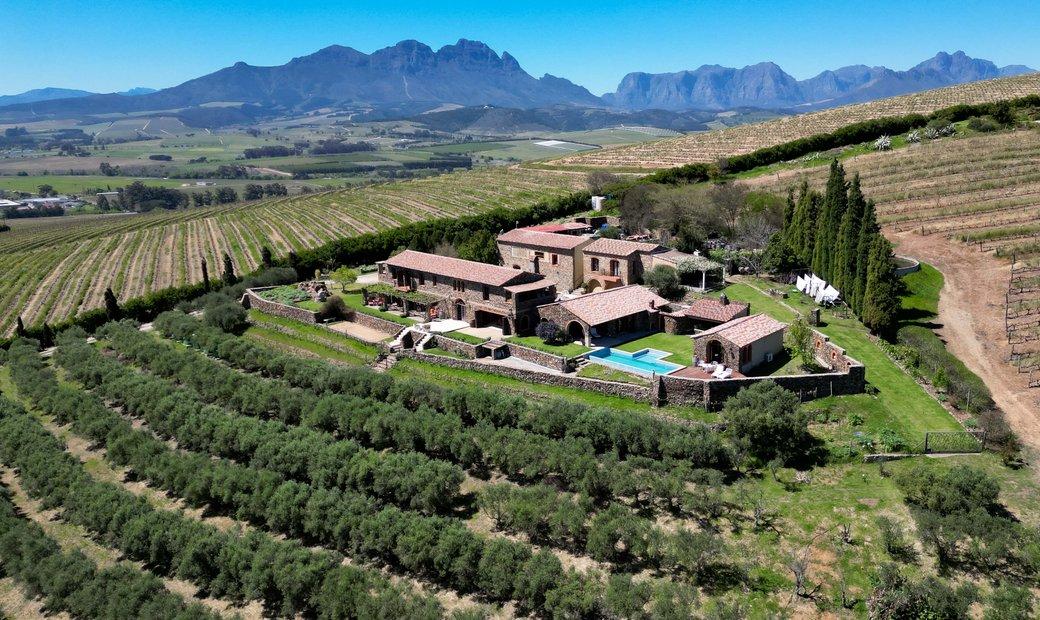
“South Africa’s Cape Winelands is attracting increasing numbers of wealthy foreign buyers and retirees seeking luxury property, security and an exclusive lifestyle in Stellenbosch, Paarl and Franschhoek. The growing demand is being supported by international wealth migration, favourable exchange rates, established lifestyle estates and access to healthcare, schools, golf, wine estates and Cape Town.”
Wealthy Foreign Buyers Drive Demand for Luxury Property in South Africa’s Cape Winelands
South Africa’s luxury property market is gaining fresh momentum in the Cape Winelands as wealthy foreign buyers and retirees increasingly target Stellenbosch, Paarl and Franschhoek. The latest market reporting points to a combination of lifestyle appeal, security, established estates, private healthcare, schools and the relative affordability of high-end South African property for buyers earning in stronger foreign currencies.
The Cape Winelands is emerging as one of South Africa’s most compelling luxury real estate destinations, with wealthy international buyers increasingly looking beyond the traditional attractions of Cape Town’s Atlantic Seaboard. According to BusinessTech, the so-called “Golden Triangle” formed by Stellenbosch, Paarl and Franschhoek is attracting affluent buyers and retirees, particularly from Europe, who are seeking secure, high-quality homes surrounded by vineyards, mountains, golf courses and outdoor amenities.
The development is significant because it highlights a wider shift in the geography of South Africa’s premium residential market. Luxury property demand is no longer defined only by oceanfront mansions or central urban addresses. Instead, affluent buyers are increasingly placing a premium on lifestyle, space, privacy, security and access to nature. The Cape Winelands brings these characteristics together while remaining within practical reach of Cape Town.
BusinessTech reported that the Africa Wealth Report 2026 identified the Cape Winelands as one of Africa’s fastest-growing dollar-millionaire hotspots. The region recorded wealth growth of 55% over the past decade, while the report expects further millionaire growth in lifestyle destinations such as the Cape Winelands. The region was also described as Africa’s second-largest billionaire hub after Cairo.
For the property industry, these figures matter because wealth creation can translate into demand for premium housing, particularly where affluent households are attracted by established infrastructure and lifestyle amenities. In the Winelands, the appeal is reinforced by developments including Val de Vie, De Zalze, Winelands Estate and Domaine des Anges.
Property prices illustrate the strength of the upper market. BusinessTech reported that retirement estates in the Drakenstein municipality, which includes Paarl and Franschhoek, have an average property value of approximately R4.9 million, while Stellenbosch has an average of about R4.55 million. The strongest demand is currently concentrated in the R4 million to R8 million range, although premium developments extend considerably beyond those levels.
At Val de Vie, three-bedroom homes start at just below R7 million, while polo-pad apartments start at approximately R4.5 million. Franschhoek has become more expensive, with properties in the R4 million to R8 million bracket increasingly difficult to find. Stellenbosch is also adding new housing supply, including Newinbosch, where reported prices range from approximately R3.75 million to R6.5 million.
The growing appeal of the region is not based on price alone. For wealthy foreign buyers, the exchange rate can make South African luxury property comparatively affordable when prices are converted into euros, dollars or pounds. This gives the country’s premium property market an important competitive advantage.
However, affordability is only one part of the equation. Security is another major factor. Gated estates with private security, recreational facilities, restaurants and other amenities offer affluent buyers an integrated environment that can be difficult to replicate in ordinary residential neighbourhoods. For international retirees in particular, the ability to combine privacy and security with healthcare, shopping and leisure is a powerful consideration.
The Cape Winelands also benefits from its proximity to Cape Town. Buyers can enjoy a quieter rural setting without completely disconnecting from a major international city. Cape Town provides an international airport, specialist healthcare, business services, cultural attractions, restaurants and established tourism infrastructure. This combination strengthens the Winelands’ appeal as both a permanent residential destination and a second-home market.
The demographic profile of buyers is also broadening. Pam Golding Properties’ Annien Borg, quoted by BusinessTech, said demand includes young professionals, families with children, returning expatriates and foreign buyers, particularly from the United States. This suggests that luxury property in the Winelands is not solely a retirement market. Instead, it is becoming a broader lifestyle investment category.
For developers, this changing buyer profile creates opportunities to design homes and estates around modern luxury rather than traditional notions of size alone. Affluent buyers increasingly want properties that provide wellness, convenience, security and social amenities. Large houses remain important, but buyers may also value restaurants, sporting facilities, landscaped spaces, energy efficiency and access to outdoor recreation.
The development pipeline is therefore an important part of the story. Strong demand encourages developers to introduce new projects, while established estates benefit from their existing reputation and amenities. This can create a cycle in which successful developments attract more affluent residents, strengthening the wider area’s prestige and supporting future property values.
The trend also reflects the broader transformation of South Africa’s luxury residential market. Cape Town has become a major destination for global wealth, while areas such as Hermanus, Plettenberg Bay and the Garden Route continue to attract affluent buyers seeking lifestyle properties. The Cape Winelands fits naturally into this national pattern because it offers a different version of luxury: less focused on beachfront living and more focused on land, vineyards, scenery, security, food, wine and wellness.
Recent research reinforces the strength of the high-end residential segment. Absa’s Homeowners Sentiment Index, reported by BusinessTech in August, found that homes valued above R4.5 million accounted for 5.2% of transactions in the second quarter of 2026, up from 4.0% a year earlier. In the Western Cape, luxury properties represented 9.9% of transactions. The figures indicate that the province has become a particularly important centre of high-value residential activity.
At the same time, the broader property market is not without challenges. Overall property confidence declined slightly in the second quarter, while affordability, interest rates, economic uncertainty and property costs remained important concerns. This means luxury buyers are also becoming more strategic. Even affluent purchasers increasingly assess location, long-term demand, security, infrastructure and the potential resilience of an investment.
This is especially relevant for foreign buyers. Exchange-rate advantages can improve purchasing power, but international purchasers still need to consider taxes, legal structures, transaction costs, maintenance, insurance and the practical requirements of owning property in another country. High-net-worth investors may also use companies, trusts or other legal entities as part of broader wealth-planning strategies.
For sellers, the changing market creates a need for sophisticated positioning. A luxury home in Stellenbosch or Franschhoek cannot be marketed only through floor area and bedroom counts. International buyers are often purchasing an experience as much as a building. Views, architecture, privacy, security, wine-country access, proximity to Cape Town and the quality of surrounding amenities can all influence the final decision.
For South Africa, the growing interest in luxury Winelands property also has wider economic implications. Affluent residents contribute to demand for professional services, construction, hospitality, restaurants, healthcare, schools and leisure businesses. New developments can create construction activity and, over time, support employment and local economic growth.
Nevertheless, the growth of the luxury segment must be balanced against broader housing needs. Rising values can benefit existing owners but may also make desirable areas less accessible to middle-income households. Developers and municipalities therefore face the challenge of supporting investment and infrastructure while maintaining communities that remain diverse and economically sustainable.
The outlook for the Cape Winelands luxury market remains positive. Wealth creation, international interest, lifestyle migration and the relative value of South African property provide strong foundations for continued demand. Established estates are likely to remain attractive, while new developments can expand the range of homes available to buyers seeking modern amenities and secure living.
The most important message from the latest market evidence is that luxury real estate in South Africa is increasingly about lifestyle rather than simply price. The Golden Triangle demonstrates how affluent buyers can be attracted to places that combine natural beauty, security, connectivity and quality services. Stellenbosch, Paarl and Franschhoek are benefiting from exactly that combination.
As international and domestic wealth continues to seek high-quality residential environments, the Cape Winelands is positioned to remain one of South Africa’s most important luxury property markets. For buyers, the region offers an opportunity to combine premium real estate with a distinctive lifestyle. For developers, it represents a market where carefully planned communities and high-quality homes can command strong interest. For the wider property sector, the trend provides another indication that South Africa’s luxury market is evolving beyond traditional coastal addresses toward a broader collection of lifestyle destinations.



