




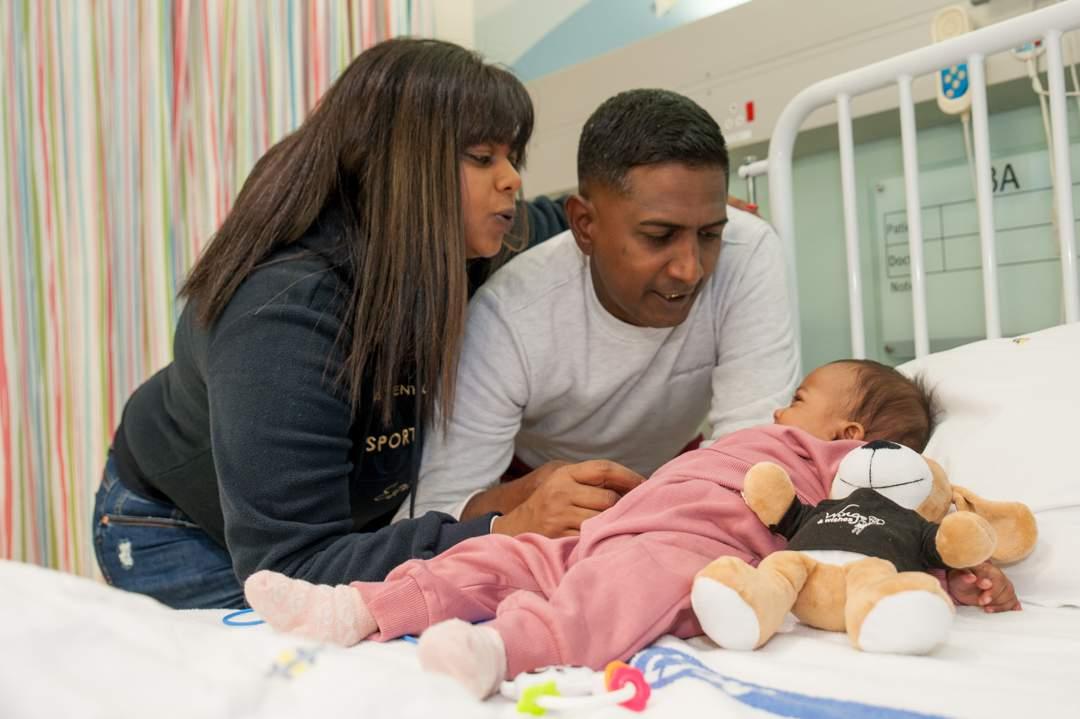
“Parents in South Africa are being encouraged to pay closer attention to subtle symptoms that may indicate congenital heart disease, including unusual tiredness, difficulty feeding, excessive sweating, poor weight gain and difficulty keeping up with other children. A paediatric cardiology expert told Eyewitness News that early recognition and medical assessment can improve the chances of children receiving appropriate treatment and living healthier lives.”
Congenital heart disease can hide behind ordinary childhood symptoms
A new health warning in South Africa is drawing attention to a disease that can sometimes remain unnoticed during the early years of a child’s life: congenital heart disease.
The condition has become the focus of renewed public awareness after Eyewitness News spoke to Professor Hopewell Ntsinjana, Academic Divisional Head of Paediatric Cardiology at the University of the Witwatersrand and Head of the Heart Centre at Nelson Mandela Children’s Hospital. His message was that heart health should not be viewed exclusively as an adult concern because some heart conditions are present from birth and may initially produce symptoms that parents could mistake for normal childhood behaviour.
The warning is particularly important because congenital heart disease can vary considerably in severity. Some children may require urgent treatment soon after birth, while others may grow for years before the condition becomes obvious. In some cases, children can participate in normal activities and appear healthy while an underlying heart problem remains undiagnosed.
According to the South African report, congenital heart disease affects approximately one in every 100 live births, making it one of the most significant congenital conditions affecting children.
The National Department of Health’s wider disease-surveillance work also demonstrates why continued awareness, surveillance and early healthcare intervention remain important in South Africa. The department maintains surveillance information on a range of communicable diseases, including cholera, influenza, malaria, measles, mpox, rabies and other conditions.
However, congenital heart disease is different from many infectious diseases because it generally develops before birth rather than being acquired through exposure to an infectious organism.
What is congenital heart disease?
Congenital heart disease refers to structural problems affecting the heart or major blood vessels that are present from birth. These abnormalities can involve the walls of the heart, valves, chambers, arteries or veins.
There are many different types of congenital heart defects. Some are relatively mild, while others can interfere significantly with the circulation of blood and oxygen around the body.
For parents, the challenge is that the severity of the condition is not always obvious from a child’s appearance.
A baby with a serious heart defect may become exhausted while feeding because feeding requires considerable energy. The child may sweat excessively during feeds, struggle to gain weight or become breathless.
Older children may show different warning signs. They may tire more quickly than their classmates, avoid physical activities they previously enjoyed, struggle during sport or repeatedly complain of being exhausted.
These symptoms do not automatically mean that a child has heart disease. Children can become tired for many reasons, including infections, nutritional problems, sleep difficulties and other medical conditions. Nevertheless, persistent or unusual symptoms deserve medical attention.
Professor Ntsinjana emphasised that parents should understand what is normal for their own child and pay attention to significant changes in behaviour or physical ability.
Why some warning signs are easily missed
One of the biggest difficulties in detecting congenital heart disease is that children do not always look seriously ill.
A child might continue playing, attending school and interacting normally with friends even when an underlying cardiac condition exists. Some heart defects can produce relatively subtle symptoms, while others become apparent only when the child’s physical demands increase.
For example, a young child may appear comfortable during everyday activities but become unusually breathless while running. Parents may initially assume the child is simply less athletic than their peers.
Similarly, a child who frequently rests during games might be described as lazy or tired. In reality, persistent exercise intolerance can sometimes warrant further investigation.
Babies can present differently. Difficulty feeding, poor weight gain and excessive sweating while feeding are among the symptoms highlighted by the South African paediatric cardiology specialist.
Other potentially concerning signs can include fainting, a racing or pounding heartbeat, swelling and a bluish colour around the lips, tongue or fingers.
Again, these symptoms are not proof of congenital heart disease. They should instead be viewed as reasons to seek professional medical assessment, particularly when they are persistent, severe or associated with other concerning symptoms.
Early detection can change a child’s future
The importance of early detection extends beyond simply identifying a disease.
When a congenital heart condition is diagnosed, healthcare professionals can determine its type and severity and decide whether the child requires monitoring, medication, an intervention or surgery.
Some defects may require immediate treatment, while others can be monitored over time.
The World Health Organization has also emphasised the importance of expanding newborn screening and improving early diagnosis of congenital conditions. WHO said in 2026 that identifying conditions early can create opportunities for treatment that may save lives and reduce lifelong disability.
The Partnership for Maternal, Newborn and Child Health, hosted by WHO, has similarly highlighted congenital heart disease as a major global child-health concern. Its 2026 publication states that congenital heart disease is the most common birth defect and affects approximately 1.35 million newborns each year worldwide. It also warns that many children in low- and middle-income countries lack timely diagnosis, treatment and lifelong care.
This has particular relevance for African healthcare systems, where specialist services may not be equally accessible in every area.
The South African healthcare challenge
South Africa has specialised paediatric cardiology services, but access to specialised healthcare can vary according to location, resources and the complexity of the condition.
Early recognition at primary healthcare level can therefore play an important role.
Parents do not necessarily need to identify the exact heart condition themselves. Instead, they need to recognise when something does not seem right and communicate their concerns to a healthcare professional.
A clinician can assess the child, listen to the heart and lungs, check oxygen levels and growth, and determine whether further investigation is necessary.
Depending on the circumstances, additional tests may include an electrocardiogram or echocardiogram, which can provide more detailed information about how the heart is structured and functioning.
The objective is not to frighten families but to prevent potentially serious symptoms from being ignored.
Congenital heart disease is not always preventable
Another important issue is understanding that parents should not automatically blame themselves when a child is diagnosed with congenital heart disease.
The causes of many congenital conditions are not fully understood.
WHO explains that congenital conditions can result from genetic, infectious, nutritional or environmental factors, although the precise cause is often difficult to identify.
This means a diagnosis should be approached as a medical condition requiring appropriate care rather than as evidence that a parent necessarily did something wrong.
The focus should instead be on diagnosis, treatment, monitoring and supporting the child’s development.
Why parents should know their child’s normal behaviour
The latest South African warning places particular emphasis on something simple but powerful: parents know their children.
A parent may notice that a child who previously enjoyed running suddenly stops participating. Another may recognise that a baby regularly becomes exhausted during feeding. Someone else may notice that a child is consistently smaller than expected or struggles to gain weight.
Individually, these signs may not appear dramatic.
Together, however, they can provide important information for a healthcare professional.
Professor Ntsinjana’s message is therefore not that every tired child has heart disease. Rather, parents should not automatically dismiss persistent changes in their child’s health and physical abilities.
This distinction is important because unnecessary fear can be harmful, but ignoring genuine warning signs can also delay diagnosis.
Awareness remains essential
South Africa’s health system faces a broad range of disease challenges, from infectious diseases to chronic conditions and congenital disorders. Official surveillance by the National Institute for Communicable Diseases continues to monitor diseases such as measles, diphtheria, respiratory infections and mpox.
Congenital heart disease belongs to another important part of the health conversation: conditions that may begin before birth but have consequences throughout childhood and, in some cases, adulthood.
Greater awareness can help families seek care earlier.
It can also encourage healthcare providers and policymakers to continue strengthening newborn screening, paediatric cardiology, referral systems and access to specialist treatment.
For families, the central message is straightforward. A child does not have to look seriously ill for a medical problem to exist. Difficulty feeding, excessive sweating, poor weight gain, unusual tiredness, breathlessness, fainting, a racing heartbeat or difficulty keeping up with peers should not automatically be dismissed when these problems persist.
Early assessment can provide reassurance when there is no serious problem, while also creating an opportunity for treatment when a heart condition is present.
As South Africa continues to strengthen its response to childhood diseases and health conditions, congenital heart disease deserves attention not only from specialists but also from parents, caregivers, teachers and primary healthcare workers.
Recognising the signs may be the first step toward giving an affected child the care needed to grow, learn, play and reach adulthood with the best possible health prospects.



