




“The African National Congress (ANC) has maintained its support for President Cyril Ramaphosa following its historic electoral setback, with its National Executive Committee concentrating on municipal coalition negotiations rather than leadership resignations. The party’s weakened electoral position, emerging opposition alliances and negotiations with the Democratic Alliance (DA), Economic Freedom Fighters (EFF), uMkhonto weSizwe (MK) Party and smaller political parties are reshaping South Africa’s political landscape.”
ANC stands by Ramaphosa as historic electoral defeat triggers political realignment and coalition negotiations
Introduction: A defining moment for South African politics
The African National Congress is confronting one of the most consequential political moments in its democratic history after suffering a devastating setback in South Africa’s 2026 local government elections. Despite growing criticism over declining electoral support, municipal service delivery failures and internal political divisions, the party’s National Executive Committee has maintained its support for President Cyril Ramaphosa while concentrating on coalition negotiations that could determine its political future.
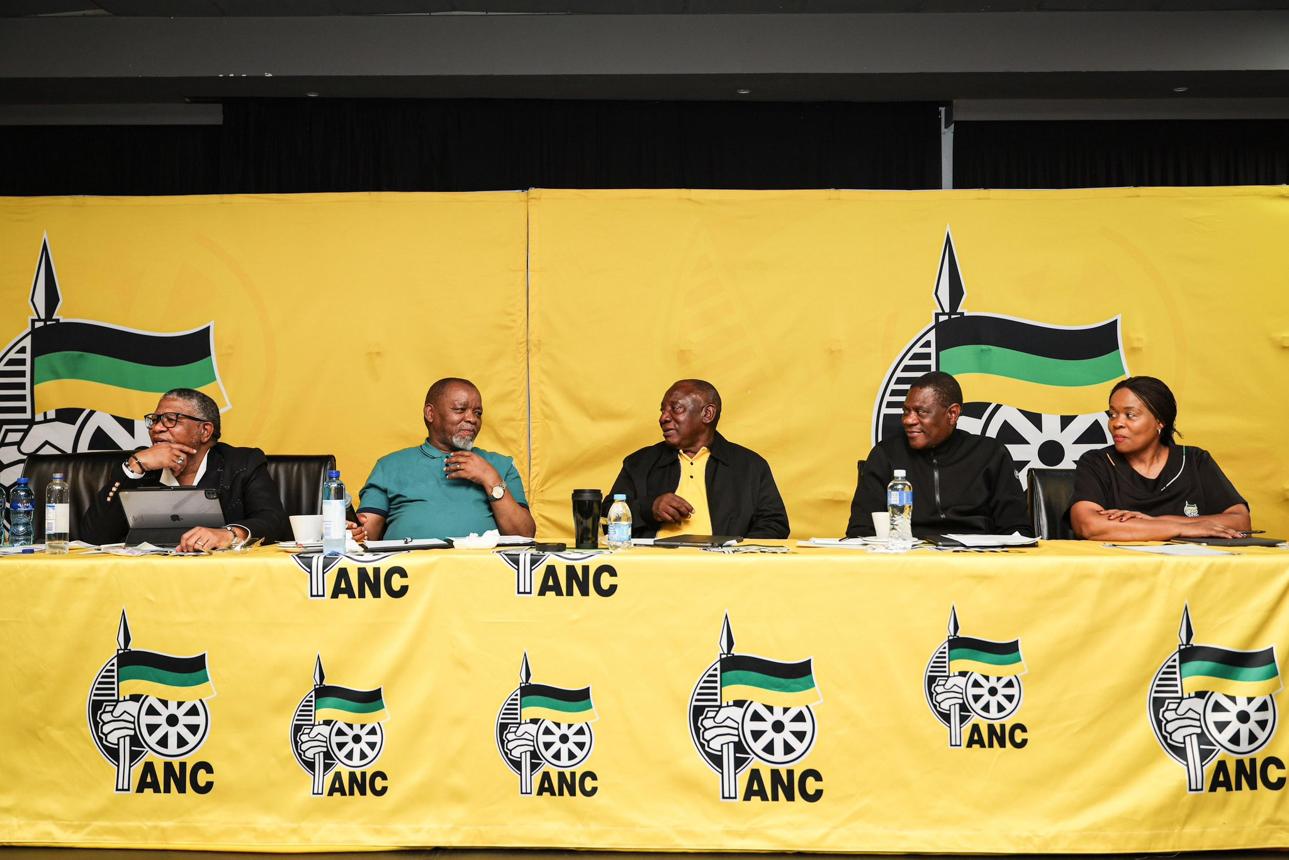
The ANC’s special National Executive Committee meeting, held at the Birchwood Hotel in Boksburg on 12 November, focused on developing a strategy to establish municipal governments following the elections. According to reporting by Business Day, discussions had not produced calls for Ramaphosa’s resignation or the dissolution of the national executive committee by the time the meeting was underway.
The developments demonstrate that the ANC leadership is prioritising political survival, coalition arrangements and institutional stability as it confronts a rapidly changing electoral environment.
Electoral defeat exposes ANC’s declining political dominance
The November 4 local government elections delivered a substantial setback to the ANC, reducing its national vote share from approximately 45.59% in 2021 to 30.76% in 2026.
Although the ANC remained South Africa’s largest political party nationally, the results significantly weakened its ability to govern municipalities independently.
The Democratic Alliance secured approximately 24.64% of the national vote, while the MK Party received 9.76%. The EFF and ActionSA also maintained important electoral positions, strengthening their influence in municipal coalition negotiations.
The election results reflected growing voter dissatisfaction with municipal governance, corruption allegations, unemployment, deteriorating infrastructure and inconsistent delivery of essential services.
In major urban centres, the ANC’s losses were particularly significant. Johannesburg, Tshwane and Ekurhuleni became increasingly competitive political battlegrounds, with the DA emerging as a leading party in all three metropolitan municipalities.
The ANC’s declining support illustrates a broader transformation in South African politics. Voters increasingly have opportunities to support alternative parties, while opposition organisations are becoming more influential in determining how municipalities are governed.
The results also reinforce the importance of coalition politics, which has become increasingly central to South Africa’s democratic system since the ANC lost its national parliamentary majority in 2024.
Ramaphosa remains supported despite internal criticism
The ANC leadership has faced growing pressure to acknowledge responsibility for its electoral performance.
Former president Thabo Mbeki reportedly urged the party’s national leadership to take accountability for its losses and consider entering opposition in municipalities while rebuilding its structures and political credibility.
However, ANC spokesperson Mahlengi Bengu rejected suggestions that Ramaphosa was facing immediate removal.
She maintained that the president remained supported by the party leadership and that the electoral campaign had been conducted effectively.
Reuters also reported on 12 November that the ANC spokesperson had stated Ramaphosa was not under pressure to resign.
The position indicates that the party’s leadership is seeking to prevent an immediate leadership crisis from complicating municipal coalition negotiations.
Nevertheless, the electoral outcome could intensify discussions about the ANC’s future leadership, especially as the party approaches its next leadership transition.
Ramaphosa’s continued position does not eliminate the political consequences of the election. Rather, it suggests that the ANC leadership is attempting to manage its crisis through institutional processes, strategic consultations and coalition negotiations.
Coalition negotiations become the ANC’s immediate priority
The ANC’s most pressing political challenge is establishing workable municipal governments in councils where no party secured an outright majority.
According to IOL, South Africa has 137 hung municipal councils following the elections, creating extensive opportunities for coalition negotiations.
The ANC has rejected a uniform national coalition strategy, arguing that negotiations must reflect the political circumstances of individual municipalities.
This approach recognises that the electoral balance differs significantly between cities and smaller municipalities.
Johannesburg, Tshwane, Ekurhuleni, Nelson Mandela Bay, Buffalo City, Mangaung and eThekwini face distinct political calculations.
ANC spokesperson Mahlengi Bengu indicated that municipal negotiations would consider local demographics, political representation, electoral outcomes and service delivery priorities.
The party is also centralising its negotiations through a national leadership team led by secretary-general Fikile Mbalula.
This arrangement is intended to prevent municipal coalitions from becoming unstable through inconsistent agreements and competing political interests.
The ANC’s strategy therefore reflects an effort to maintain organisational control over coalition arrangements while preventing internal disagreements from undermining negotiations.
DA and ANC face difficult negotiations
One of the most important developments is the possibility of renewed cooperation between the ANC and DA.
The two parties already participate in the national government of national unity established following the 2024 elections.
However, municipal coalition negotiations have created new tensions over political leadership and the distribution of governing responsibilities.
Business Day reported that the DA was pushing for a grand coalition with the ANC, while some ANC leaders resisted proposals that could allow the DA to control several major metropolitan municipalities.
The DA’s electoral performance in Gauteng has strengthened its negotiating position.
Its leadership could potentially secure mayoral positions in Johannesburg, Tshwane and Ekurhuleni through coalition agreements.
Such arrangements would represent a substantial political transformation in metropolitan governance.
For the ANC, working with the DA could provide access to stable municipal majorities, but it could also create difficulties among party members who oppose cooperation with their national government partner.
The possibility of a DA-ANC municipal coalition consequently highlights the tension between ideological commitments and practical governing requirements.
Both parties must determine whether cooperation can deliver municipal stability without undermining their respective electoral identities.
Council of the Left creates another political challenge
The emergence of the Council of the Left introduces another important dimension to South African coalition politics.
The bloc brings together organisations including the MK Party, EFF, South African Communist Party, African Congress for Transformation and other left-leaning political organisations.
The coalition initiative seeks to coordinate municipal political strategies while promoting a shared programme addressing inequality, unemployment, housing, land reform and public services.
The Council of the Left has indicated that it would consider working with the ANC under particular political conditions.
Among its demands is that the ANC distance itself from the DA and Freedom Front Plus within the government of national unity.
This position creates additional pressure on the ANC, which must balance its existing national coalition arrangements against potential municipal partnerships with left-wing political organisations.
The bloc’s influence will depend on whether its participating parties can translate their combined electoral support into coordinated municipal voting and governing agreements.
Although the organisations continue negotiating individually, their cooperation could strengthen their bargaining position in councils where the ANC or DA requires additional votes to establish a majority.
Opposition parties expand their negotiating influence
The DA, MK Party, EFF and ActionSA are all seeking to influence the composition of municipal governments.
The DA has reportedly approached the MK Party and EFF for coalition discussions despite years of political hostility.
These negotiations represent a significant change in the country’s coalition environment.
The MK Party, led politically by former president Jacob Zuma, has become an important electoral force, particularly in KwaZulu-Natal.
The EFF also remains influential in municipalities where its councillors can determine whether competing coalition arrangements succeed.
ActionSA has similarly positioned itself as an important negotiating partner in several metropolitan councils.
Its leadership has called for greater transparency in coalition negotiations, arguing that voters should understand how political parties reach agreements after elections.
ActionSA spokesperson Michael Beaumont has warned against behind-the-scenes arrangements that could undermine voters’ expectations.
The demand for transparency reflects wider concerns about coalition instability, political bargaining and the accountability of elected representatives.
Service delivery remains the central political test
Despite the intense political negotiations, municipal service delivery remains the most important issue for residents.
South Africa’s municipalities face persistent challenges involving water infrastructure, electricity distribution, sanitation, waste collection, roads and financial management.
The ANC has indicated that municipal coalitions should prioritise these responsibilities rather than focusing exclusively on political positions.
The government has allocated resources to improve metropolitan infrastructure, but the effectiveness of municipal administrations will depend on implementation, financial accountability and administrative capacity.
Coalition agreements will therefore need to establish clear governing priorities and mechanisms for resolving disagreements.
The interim coalition guidelines introduced by Cooperative Governance and Traditional Affairs Minister Velenkosini Hlabisa encourage written agreements, dispute-resolution procedures and restrictions against political interference in administrative appointments and procurement.
These measures seek to reduce the instability that has affected municipalities under previous coalition arrangements.
For political parties, the ability to improve municipal services could become a decisive factor in future elections.
Conclusion: ANC faces a long political rebuilding process
The ANC’s decision to maintain support for Cyril Ramaphosa while pursuing municipal coalition negotiations represents an attempt to manage an unprecedented political setback without immediately destabilising its leadership.
However, the party’s declining electoral support demonstrates that its traditional political dominance can no longer be assumed.
Coalition negotiations will determine whether the ANC retains influence across major municipalities or increasingly becomes a participant in governments led by opposition parties.
The emergence of the Council of the Left, stronger DA electoral performance and the negotiating influence of smaller parties are creating a more competitive political environment.
Ultimately, the ANC’s long-term political recovery will depend on more than coalition agreements.
The party must address voter dissatisfaction, strengthen accountability, improve municipal governance and rebuild confidence among communities that increasingly expect measurable results.
The November elections have therefore become more than a municipal political contest. They represent a warning about the changing relationship between South African voters and political parties.
As negotiations continue, the future of municipal governance, coalition politics and the ANC’s political leadership will remain closely connected.
The coming weeks could determine whether South Africa’s political parties establish stable governing arrangements or enter another period of coalition instability.
For the ANC, the immediate challenge is survival in government. Its longer-term challenge is restoring public confidence in a political movement whose electoral dominance has steadily weakened.



