




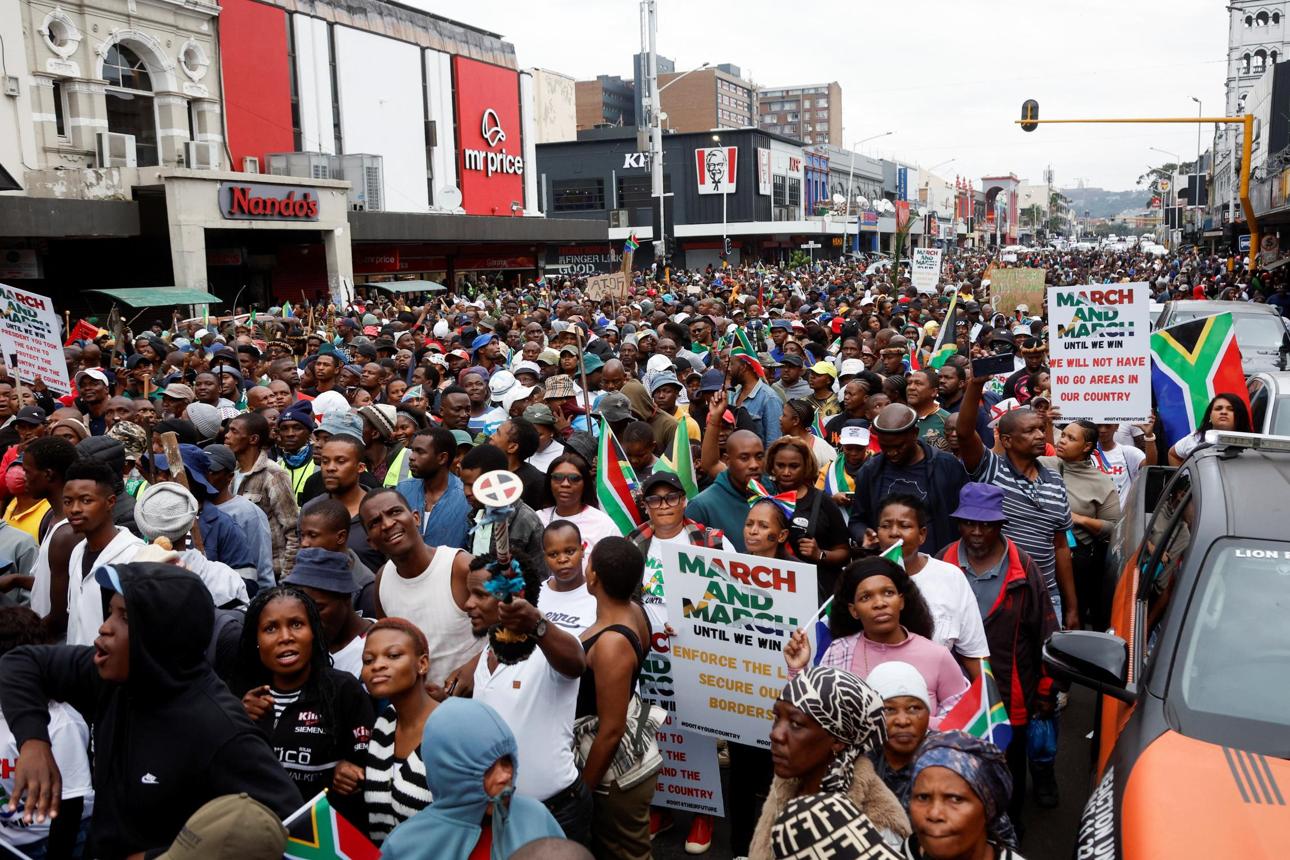
“Anti-immigrant demonstrations in South Africa have intensified tensions over immigration enforcement, asylum procedures and government accountability, with violence in Durban and Soweto in early October leaving vehicles burned, businesses damaged and migrant communities fearful. Subsequent reporting has highlighted the dangers of misinformation about a Constitutional Court ruling, the responsibilities of law-enforcement authorities and the challenge of protecting peaceful protest while preventing intimidation and attacks on vulnerable people.”
South Africa’s protest movement faces scrutiny as anti-immigrant tensions expose the limits of political activism
South Africa’s continuing debate over immigration has developed into a major test of political activism, constitutional democracy and public safety. Demonstrations demanding stronger action against undocumented migration have drawn attention to legitimate public concerns about border management, employment, crime and access to public services. However, reports of intimidation, assaults, property destruction and threats against migrant communities have also raised serious questions about the limits of protest and the responsibility of political leaders to prevent violence.
Developments reported during October 2026 illustrate the growing difficulty of separating peaceful political mobilisation from actions that threaten the rights and safety of others. In particular, protests in Durban and Soweto exposed the consequences of misinformation surrounding asylum law and the challenges facing authorities responsible for maintaining order while respecting constitutional freedoms.
Protests over asylum procedures escalate
On 8 October, demonstrations in Johannesburg’s Soweto township and Durban turned violent amid opposition to the processing of asylum applications. Reuters reported that at least 10 vehicles were burned in Soweto and at least 14 in Durban. Foreign-owned shops were also looted or damaged, while police were deployed to contain the unrest.
The demonstrations followed renewed efforts by the Department of Home Affairs to implement a Constitutional Court ruling concerning access to the asylum system. Protesters opposed the prospect of people entering the country irregularly being permitted to submit asylum applications, arguing that immigration controls needed to be strengthened.
The government, however, said the court decision had been misrepresented. The ruling removed certain procedural barriers that prevented some asylum seekers from having their claims considered. It did not automatically grant refugee status, permanent residence or unrestricted rights to remain in South Africa.
The distinction is important because the ability to apply for asylum is not the same as approval of an application. A functioning asylum system must assess individual claims according to applicable law, rather than excluding applicants solely because of certain procedural circumstances.
Government spokespersons blamed misinformation for helping to fuel anger around the ruling. The unrest demonstrated how inaccurate descriptions of legal decisions can influence public opinion, heighten tensions and contribute to confrontations between demonstrators and communities perceived to be affected by government policy.
Constitutional rights and the boundaries of activism
Political activism is a central feature of South Africa’s constitutional democracy. Citizens and civil society organisations have the right to organise, express their concerns, demonstrate peacefully and demand that elected officials address public problems.
These freedoms allow communities to challenge government decisions, highlight administrative failures and insist on greater accountability. Demonstrations can also bring attention to issues that receive insufficient attention through ordinary political channels.
Nevertheless, the right to protest does not provide permission to assault people, destroy property, threaten shopkeepers or prevent others from accessing lawful public services. Peaceful assembly and criminal conduct must be treated as distinct matters.
The October unrest illustrates why this distinction matters. Where demonstrations remain peaceful, authorities should protect participants’ ability to express their views. Where individuals commit offences, law-enforcement agencies must investigate credible evidence and take proportionate action under the law.
The South African Police Service warned that violence, arson and destruction of property would not be tolerated. Such warnings reflect the state’s responsibility to maintain public order without treating every protester as a criminal.
The challenge for authorities is to apply these principles consistently. Excessive force against peaceful demonstrators can undermine public trust, while failure to intervene against attacks can leave vulnerable residents exposed to intimidation. Credible investigations, transparent communication and equal protection under the law are therefore essential.
Migrant communities face intimidation and economic disruption
The effects of the unrest have extended beyond the immediate scenes of protest. GroundUp reported on 9 October that anti-immigrant demonstrators in Pretoria threatened migrant shopkeepers, including women and children, outside the Marabastad Refugee Reception Office.
According to the report, protesters carried sticks and other objects, harassed people seeking assistance and pressured businesses to close. Some migrant-owned businesses in Durban had also been vandalised or looted during the preceding unrest.
These incidents demonstrate how political mobilisation can affect people who have little control over the policies being debated. Shopkeepers, employees, families and asylum seekers can become targets because of their perceived nationality or immigration status, rather than because of any proven individual wrongdoing.
The economic consequences can be significant. When businesses are forced to close, owners lose income, workers may lose wages and customers lose access to local goods and services. Damage to commercial property can also weaken neighbourhood economies and discourage investment.
Importantly, not every foreign national has the same legal status. Some are citizens or permanent residents; others hold valid visas, work permits or refugee documentation, while some may be awaiting decisions on their applications. Treating all migrants as though they occupy the same legal position risks encouraging arbitrary discrimination.
South Africa’s immigration system must enforce its laws, but enforcement should be carried out by authorised institutions rather than vigilante groups.
A fatal incident underscores the risks
Concern deepened after the Associated Press reported on 22 October that a foreign citizen had been beaten to death during a march in Durban. Police said a group of approximately 50 people attacked the man, who was standing beside a road. At the time of the report, his nationality had not been confirmed publicly, and police were searching for suspects.
The incident occurred against a backdrop of months of anti-immigrant tensions and earlier episodes of violence. It underlined the potential human cost of demonstrations that turn into attacks on individuals.
The available reporting does not establish that every participant in anti-immigrant protests supported violence, nor does it establish the precise responsibility of every organisation or individual involved in the fatal incident. Those questions require evidence and a proper investigation.
However, the death reinforces the importance of preventing political disputes from becoming opportunities for collective punishment or mob violence. A person’s nationality or perceived immigration status cannot justify an assault, and responsibility for a crime must be established through lawful procedures.
The incident also increases pressure on public authorities to protect people at risk, investigate violent offences and communicate clearly about what is known and what remains under investigation.
The government faces a difficult policy challenge
The protests have exposed shortcomings in the relationship between immigration administration, public communication and community confidence.
When asylum offices are unable to process applications efficiently, queues and uncertainty can increase frustration among applicants and nearby residents. If officials then communicate policy changes poorly, confusion can spread quickly, particularly through social media.
The government withdrew its directive on asylum processing on 9 October after the violence and operational difficulties. Reuters reported that officials said reception offices had been overwhelmed and that the department would need to reconsider how to implement the court ruling.
Withdrawing an administrative directive may provide temporary breathing room, but it does not resolve the underlying legal or operational questions. Authorities still need a workable system that allows eligible people to submit claims, ensures applications are assessed fairly and maintains effective immigration administration.
A more sustainable response would involve adequate staffing, transparent procedures, reliable public information and clear explanations of the distinction between applying for asylum and receiving protection. Authorities should also communicate the status of policy changes promptly to reduce opportunities for false claims to circulate.
At the same time, legitimate concerns about immigration management should be addressed through evidence-based policymaking. This includes accurate data, fair enforcement, accessible complaint mechanisms and cooperation between national government, municipalities and affected communities.
Economic hardship and public frustration
Immigration activism also takes place within a broader context of unemployment, inequality and pressure on public services. Many South Africans are concerned about access to work, affordable housing, healthcare and reliable municipal services.
These are important political issues, and governments have a responsibility to respond to them. However, complex economic problems cannot be explained by attributing responsibility to migrants as a single group.
Employment opportunities are influenced by economic growth, investment, education, skills, labour-market conditions and public policy. Pressure on public services can reflect inadequate funding, poor administration, uneven infrastructure and growing demand. The relative contribution of different factors should be assessed using credible evidence.
Claims that migrants are responsible for particular crimes or that they receive automatic legal privileges also require careful verification. Generalisations can unfairly stigmatise entire communities and divert attention from the institutions responsible for enforcing the law.
Political leaders and activists can help reduce tensions by distinguishing verifiable problems from unsubstantiated accusations. Campaigns that identify specific administrative failures and propose realistic reforms are more likely to contribute to effective policy than those that encourage hostility toward people based on nationality.
Civil society and the responsibility to protect rights
South Africa’s civil society sector has an important role in responding to the current tensions. Legal organisations, community groups, human-rights advocates, journalists and local leaders can explain court decisions, document abuses and help affected people access assistance.
They can also hold government accountable for failures in immigration administration, policing and public communication. Effective advocacy should not require communities to choose between lawful immigration enforcement and the protection of human dignity.
The reporting on migrant shopkeepers and asylum seekers demonstrates why independent journalism matters. First-hand accounts can help establish what occurred, identify the people affected and distinguish confirmed events from competing claims.
At the same time, responsible reporting must avoid presenting allegations as proven facts. Information about arrests, injuries, fatalities and alleged offences should be attributed to the relevant authorities or reporting organisations, and updated as investigations progress.
Community leaders can also discourage retaliation and encourage peaceful ways of raising grievances. Public meetings, formal complaints, court proceedings and organised demonstrations offer alternatives to threats or attacks.
What happens next?
The central question for South Africa is whether public frustration can be channelled into effective democratic action without further violence.
Authorities need to ensure that asylum procedures comply with constitutional requirements while improving administrative capacity and communicating decisions clearly. Police must protect peaceful demonstrators, intervene when necessary to prevent attacks and investigate suspected offences impartially.
Political organisations and campaign leaders should make their demands specific and verifiable, reject violence and avoid language that encourages collective blame. Civil society organisations can continue monitoring rights violations and helping the public understand the legal issues involved.
There must also be sustained attention to the economic and governance concerns underlying public frustration. Improving employment opportunities, strengthening local services and making immigration procedures more effective will require long-term policy measures rather than slogans alone.
The reported fatality in Durban makes the stakes especially clear. Political disagreement is a normal part of democratic life, but violence against individuals undermines the freedoms that allow disagreement to be expressed.
As of 27 October 2026, the available reporting establishes that South Africa has experienced serious incidents linked to anti-immigrant mobilisation during October. It does not establish that every demonstration has been violent or that every activist shares the same aims. The wider significance lies in the challenge facing the country’s democratic institutions: protecting the right to protest while ensuring that the rights, safety and dignity of other people are not sacrificed in the process.
The lasting measure of successful activism will not simply be the size of a crowd or the intensity of its slogans. It will be whether public pressure leads to accountable government, fair enforcement of the law, better administration and solutions that respect the constitutional rights of everyone living in South Africa.



