




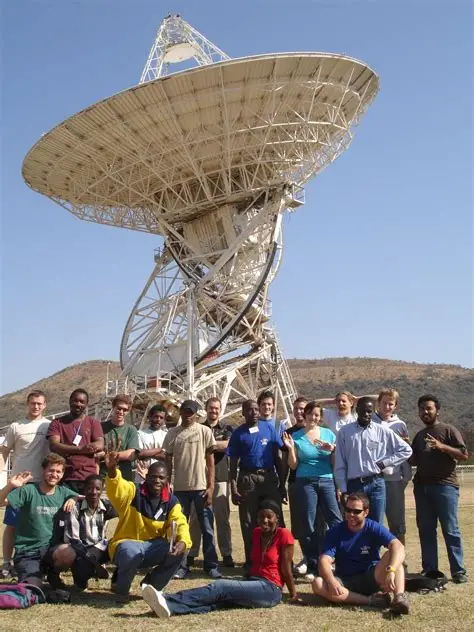
“South African scientists have announced Africa2Moon, a pioneering mission to deploy a radio telescope array on the Moon’s far side, opening up the lowest-frequency radio sky previously inaccessible from Earth. The mission, scheduled for launch in 2029 aboard China’s Chang’e‑8, marks Africa’s first independent step into deep-space science and global collaboration.”
South Africa has once again demonstrated its leadership in astronomy and space science with the announcement of Africa2Moon, the continent’s first lunar radio telescope mission. This ambitious project, spearheaded by Rhodes University and supported by a coalition of African scientists and engineers, will deploy a cutting-edge radio telescope array on the far side of the Moon. Scheduled to launch aboard China’s Chang’e‑8 mission in 2029, Africa2Moon represents a historic milestone: Africa’s first independent contribution to deep-space exploration.
Scientific Significance
Radio astronomy has transformed our understanding of the universe, revealing pulsars, quasars, and the cosmic microwave background. Yet, the lowest-frequency radio sky—below 20 MHz—remains hidden due to Earth’s atmospheric interference. By situating antennas on the Moon’s far side, Africa2Moon will access this unexplored spectrum, potentially unlocking signals from the “cosmic dark ages,” the period before the first stars and galaxies formed. This could provide unprecedented insights into the origins of the universe.
Mission Concept
The Africa2Moon project will deploy an array of antennas known as Bounced African Low Lunar Spheres (BALLS). These instruments will be strategically placed on the lunar south pole, shielded from Earth’s radio noise and solar interference. The far side of the Moon offers a pristine environment for radio astronomy, making it the ideal location for such a groundbreaking experiment.
South Africa’s Role
South Africa has already established itself as a global leader in radio astronomy through projects like MeerKAT and its participation in the Square Kilometre Array (SKA). The expertise gained from these initiatives directly feeds into Africa2Moon. Professor Oleg Smirnov, Rhodes University’s Research Chair in Radio Astronomy Techniques, emphasized that this mission is “Africa stepping off the planet.” It signals that African scientists are not merely participants but leaders in frontier science.
International Collaboration
Africa2Moon will launch aboard China’s Chang’e‑8 mission, highlighting Africa’s ability to integrate into international space partnerships. This collaboration ensures that African expertise is recognized globally while contributing unique scientific capabilities. The partnership also underscores the growing importance of South-South cooperation in space exploration.
Broader Impact
Beyond science, Africa2Moon is a statement of ambition. It demonstrates that African nations can collaborate to achieve audacious goals. Dr. Adriana Marais, Director of the Foundation for Space Development Africa, noted that the mission is “proof that African scientists and engineers can imagine something audacious and then build it, together.” The project inspires confidence in Africa’s ability to contribute meaningfully to the global space economy.
Educational and Economic Benefits
The mission is expected to inspire a new generation of African scientists and engineers. Universities across South Africa and the continent will integrate Africa2Moon into their curricula, fostering STEM education and research. Economically, the project positions Africa as a player in the global space industry, opening opportunities for innovation, investment, and technological development.
Challenges and Opportunities
While Africa2Moon is groundbreaking, it faces challenges. Funding, technical expertise, and long-term sustainability are critical issues. However, the mission also presents opportunities: building capacity in space science, fostering international partnerships, and positioning Africa as a hub for frontier research.
Conclusion
Africa2Moon is more than a scientific mission; it is a symbol of Africa’s rising ambition in space exploration. By stepping off the planet and onto the Moon, South Africa and its partners are charting a new course for the continent’s role in global science. Scheduled for launch in 2029, Africa2Moon promises to open a new window into the universe and inspire generations to come.



