




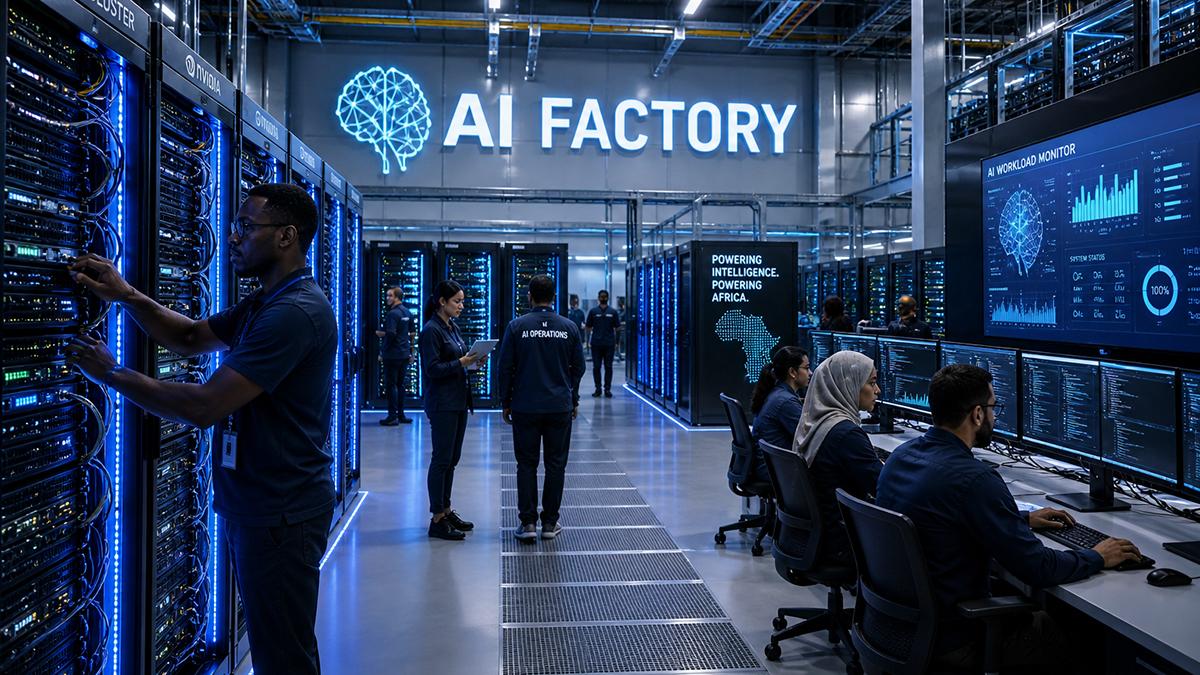
”Africa’s artificial intelligence ambitions are gaining momentum as new attention focuses on GPU cloud infrastructure, including UduTech, founded by Alexander Tsado, and Cassava Technologies’ NVIDIA-powered AI infrastructure programme. South Africa is an important part of this development because locally hosted computing facilities could give African businesses, researchers and technology developers greater access to the computing resources needed to develop and operate advanced AI applications.”
Africa’s AI Computing Race Gathers Momentum as South Africa Strengthens Its Position in Artificial Intelligence Infrastructure
Introduction: South Africa’s growing role in Africa’s AI revolution
Artificial intelligence is becoming one of the most important forces shaping the global economy. Across industries, businesses and governments are increasingly using AI to improve productivity, analyse information, automate operations and develop new products. However, the ability to participate in this technological transformation depends on more than access to AI applications. It also requires powerful computing infrastructure, reliable electricity, secure data centres, skilled professionals and affordable access to advanced processing technology.
South Africa is increasingly relevant to this infrastructure discussion. Recent developments involving Cassava Technologies, NVIDIA and emerging African GPU-cloud businesses highlight the growing ambition to establish computing capacity within the continent rather than depending entirely on infrastructure located overseas.
A report published on 8 November 2026 by Tech Insider focuses on Alexander Tsado, founder of UduTech, and the development of Africa-focused GPU-cloud services. The report also discusses the wider infrastructure investment taking place around Cassava Technologies and its NVIDIA-powered AI factory programme.
The significance of this development extends beyond individual companies. It raises important questions about who will provide the computing resources powering Africa’s AI economy, how local businesses will access those resources and whether South Africa can establish itself as a major regional centre for artificial intelligence infrastructure.
The importance of GPU computing in artificial intelligence
Graphics processing units, commonly known as GPUs, are essential components of modern artificial intelligence infrastructure.
Although GPUs were originally developed to accelerate graphics processing, their ability to perform large numbers of calculations simultaneously makes them particularly useful for AI applications.
Training advanced AI models requires processing enormous quantities of information. This includes text, images, videos, numerical information and other forms of digital data. GPUs help perform the mathematical operations needed to train, fine-tune and operate these models.
Businesses developing AI-powered applications also require computing capacity after their models have been trained. This process, known as inference, allows AI systems to generate responses, analyse information, recognise patterns and perform automated tasks.
Consequently, access to GPUs has become an important competitive advantage in the global technology industry.
For African businesses, purchasing and maintaining specialised computing equipment can be expensive. GPU cloud services offer another option by allowing organisations to rent computing capacity through cloud platforms.
This model can reduce the need for individual companies to establish expensive data centres and purchase specialised hardware.
UduTech’s Africa-focused GPU-cloud ambitions are relevant in this context. Its founder, Alexander Tsado, is described in the November 8 report as having built NVIDIA’s GPU-cloud business and founded a company focused on African computing infrastructure. However, the available reporting does not establish UduTech’s precise hardware capacity, customer base, funding or commercial launch timetable.
Cassava Technologies and the development of AI factories
One of the most significant developments in African AI infrastructure involves Cassava Technologies.
The company, founded by Strive Masiyiwa, has pursued an ambitious strategy to expand access to advanced computing resources across African markets.
Its partnership with NVIDIA supports the development of AI factories designed to provide the computing power required to train, customise and deploy artificial intelligence systems.
According to Cassava’s published infrastructure plans, South Africa is the starting point for a wider programme that also targets Nigeria, Kenya, Egypt and Morocco.
The company has described its ambition as building an African AI ecosystem in which local organisations can develop applications using computing infrastructure and data resources closer to their markets.
An AI factory differs from a conventional data centre because it is specifically designed to support the complete AI development process.
It brings together specialised processors, networking equipment, software, storage and computing systems. These components allow organisations to prepare data, train models, fine-tune existing systems and operate AI applications.
This infrastructure could become increasingly important as demand for generative AI, machine learning and automated business applications grows.
Why South Africa matters
South Africa has several advantages that make it an important location for AI infrastructure investment.
The country has an established telecommunications sector, data centre industry, financial services market and network of universities and research institutions.
Johannesburg and Cape Town are particularly important technology and business centres. Their connectivity and commercial ecosystems provide opportunities for companies building cloud computing, cybersecurity and AI services.
Cassava has also discussed expanding its South African AI factory footprint. In reporting published by ITWeb in May 2026, the company outlined plans for a second AI factory in Johannesburg, building on its Cape Town infrastructure programme.
Such investment could improve access to advanced computing resources for South African businesses and technology developers.
It could also support organisations elsewhere in Africa that need access to reliable computing services without building their own specialised facilities.
However, infrastructure investment alone will not automatically make South Africa a global AI leader. The country will also need competitive electricity costs, dependable power supplies, high-capacity connectivity, skilled engineers and strong cybersecurity protections.
The emergence of UduTech and new African technology businesses
The growing AI infrastructure market creates opportunities for new companies.
UduTech is one example highlighted in the November 8 Tech Insider report. Founded by Alexander Tsado, the company is positioned around Africa-focused GPU cloud services.
Its proposed relevance lies in helping organisations obtain computing resources without having to purchase and operate their own GPU infrastructure.
This could be valuable for startups, universities, software developers and established companies experimenting with machine learning.
Nevertheless, the company should be assessed on its actual commercial performance rather than its founder’s professional background alone.
Important questions remain about available computing capacity, data centre locations, customer agreements, service pricing, funding and the company’s relationship with existing African infrastructure providers.
The distinction matters because GPU cloud businesses operate in a highly competitive industry. They must secure expensive hardware, maintain reliable facilities and attract enough customers to keep their infrastructure commercially viable.
UduTech’s development therefore represents an emerging business opportunity rather than proof that Africa’s computing capacity challenges have already been solved.
Artificial intelligence and South Africa’s economic opportunities
The expansion of AI computing infrastructure could influence several important sectors of the South African economy.
Financial services
Banks, insurers and financial technology companies can use AI to detect suspicious transactions, identify fraud patterns, automate customer support and assess financial risks.
Locally available computing resources could also support the development of applications that understand South African business conditions and customer requirements.
Healthcare
AI systems can assist medical professionals with analysing medical images, organising patient information and identifying patterns in health data.
South African universities and research institutions could benefit from improved computing access when developing medical research applications.
Agriculture
Agricultural businesses can use AI to analyse weather information, monitor crops, identify potential pest problems and improve production planning.
These applications could be particularly valuable in a country where agriculture contributes to employment, exports and food security.
Education
Universities and schools could use AI tools to support learning, research and administrative processes.
South African developers could also create educational applications that support local languages and different learning requirements.
Manufacturing and mining
Industrial companies could use machine learning to monitor equipment, anticipate maintenance requirements and improve operational efficiency.
Mining operations could apply AI to geological analysis, workplace monitoring and equipment management.
These opportunities depend on effective implementation, accurate information and appropriate human supervision.
Local languages and African data sovereignty
One of the most important considerations in African AI development is the ability to create systems that understand local languages and social conditions.
Many widely available AI applications are primarily developed using datasets dominated by major international languages.
Although these systems can provide useful services, their performance may be less reliable when handling underrepresented languages, local expressions and region-specific information.
Cassava has highlighted its ambition to support African-language AI applications, including Swahili, Zulu and Afrikaans.
For South Africa, this could create opportunities to develop AI applications that better understand the country’s multilingual population.
Local infrastructure may also strengthen data sovereignty.
Data sovereignty concerns the ability of organisations and governments to maintain appropriate control over information, including where it is stored, processed and governed.
Keeping certain data within South Africa could help organisations meet applicable regulatory and contractual requirements.
Nevertheless, local hosting does not automatically guarantee security or legal compliance. Companies must still implement strong data protection measures, access controls, encryption and appropriate governance policies.
Government policy and responsible AI development
South Africa’s AI infrastructure ambitions must be supported by effective national policy.
Government officials have recognised the importance of developing computing infrastructure, improving research cooperation and ensuring responsible AI adoption.
At the South Africa-Finland dialogue reported by the Department of Science, Technology and Innovation on 3 November 2026, officials discussed international partnerships, research capacity, infrastructure investment and responsible AI governance.
The discussions also highlighted the role of South Africa’s National Integrated Cyberinfrastructure System and its Centre for High-Performance Computing.
These institutions provide important foundations for scientific computing, research infrastructure and advanced technology development.
The national AI policy process is another important consideration.
The Department of Communications and Digital Technologies has been revising its AI policy following the withdrawal of an earlier draft in April 2026 after concerns about fictitious references.
A revised framework will need to balance innovation with accountability, human oversight, privacy, cybersecurity and public trust.
Challenges facing South Africa’s AI infrastructure ambitions
Despite the opportunities, developing large-scale AI infrastructure presents considerable challenges.
1. Electricity availability and operating costs
AI data centres require substantial electricity to operate computing equipment and cooling systems. Reliable power is essential because interruptions can affect business operations, computing workloads and service availability.
South Africa’s electricity environment makes energy efficiency, backup systems and long-term power procurement important considerations for infrastructure operators.
2. High investment requirements
GPU infrastructure requires substantial capital investment. Specialised processors, networking equipment, cooling systems and data centre facilities can be expensive.
Companies must also consider the costs of replacing older hardware as AI technology develops.
3. Skills shortages
South Africa needs more professionals with expertise in machine learning, data science, cloud computing, cybersecurity and AI engineering.
Universities, technical institutions and private technology companies will need to strengthen training programmes to prepare workers for emerging opportunities.
4. Cybersecurity and privacy
AI infrastructure may process commercially sensitive information, financial records and personal data.
Operators must establish strong security measures to protect information from unauthorised access, cyberattacks and misuse.
5. Affordable access
Another challenge is ensuring that smaller organisations can benefit from the infrastructure.
If advanced computing services remain affordable only to large corporations, smaller South African businesses and startups could struggle to compete.
Cloud providers will therefore need transparent pricing, flexible services and accessible technical support.
Competition in the African AI infrastructure market
The development of AI infrastructure is attracting international technology companies and African businesses.
Global cloud providers have substantial resources and established platforms. However, African infrastructure operators may have advantages in local connectivity, regional knowledge and proximity to customers.
Cassava’s approach combines data centres, connectivity and AI computing services. UduTech’s proposed GPU-cloud business represents another approach to addressing the continent’s computing requirements.
South African technology companies are also exploring enterprise AI infrastructure.
ITWeb has reported on Altron’s AI factory initiative, which provides businesses with access to enterprise computing infrastructure, AI tools and specialist support. This demonstrates that the market is developing beyond one company or one infrastructure partnership.
Competition could benefit customers by encouraging better services, more innovation and potentially more affordable computing access.
However, the long-term market will depend on customer demand, investment sustainability and the ability of providers to deliver reliable services.
What the development means for South African startups
For startups, improved access to computing infrastructure could reduce some of the financial barriers associated with developing AI products.
A young technology company could potentially rent GPU capacity instead of purchasing expensive equipment.
This could make it easier to experiment with language models, develop industry-specific applications and test new software products.
South African startups could also explore solutions designed for African markets rather than relying exclusively on international products.
Potential opportunities include agricultural technology, financial services, logistics, education, healthcare administration and customer service automation.
However, startups will still need access to investment, experienced technical teams, high-quality datasets and customers willing to adopt their products.
The availability of computing power is an important foundation, not a substitute for strong business models and useful technology.
The outlook for artificial intelligence in South Africa
South Africa’s AI infrastructure market is entering an important development period.
The investments and plans associated with Cassava Technologies, NVIDIA and other technology businesses indicate growing interest in establishing advanced computing capacity within the continent.
At the same time, emerging companies such as UduTech illustrate the commercial opportunities surrounding specialised GPU cloud services.
Government research infrastructure and international partnerships could also help strengthen the country’s AI capabilities.
The central challenge will be converting infrastructure investment into measurable economic and social benefits.
South Africa will need to ensure that AI development supports local businesses, improves public services, creates employment opportunities and expands access to technology.
It will also need to ensure that innovation does not deepen existing inequalities between large companies and smaller businesses or between urban and rural communities.
Ultimately, the success of the country’s AI ambitions should not be measured simply by the number of GPUs installed or the size of data centre investments.
More meaningful indicators will include the number of businesses using AI productively, the development of locally relevant applications, improvements in public services, the creation of skilled employment and the affordability of computing services.
Conclusion
The latest attention surrounding UduTech and the wider African GPU-cloud market reinforces the growing importance of computing infrastructure in the continent’s artificial intelligence ambitions.
South Africa has an opportunity to strengthen its position through data centre investment, research partnerships, enterprise AI development and responsible technology governance.
Cassava Technologies’ NVIDIA-powered AI factory programme represents an important part of this infrastructure strategy, while emerging businesses could contribute additional services and competition.
Nevertheless, the country must address electricity costs, technical skills, cybersecurity, affordability and regulatory challenges if these developments are to produce lasting benefits.
The next phase of South Africa’s AI journey will depend on how effectively businesses, government institutions, universities and technology investors work together.
If the country succeeds, it could become an increasingly important centre for African AI innovation, supporting businesses and researchers across the continent while creating new opportunities within its own economy.
The opportunity is significant, but its success will ultimately depend on practical implementation, responsible investment and ensuring that the benefits of artificial intelligence reach more than a small group of technology companies.



