




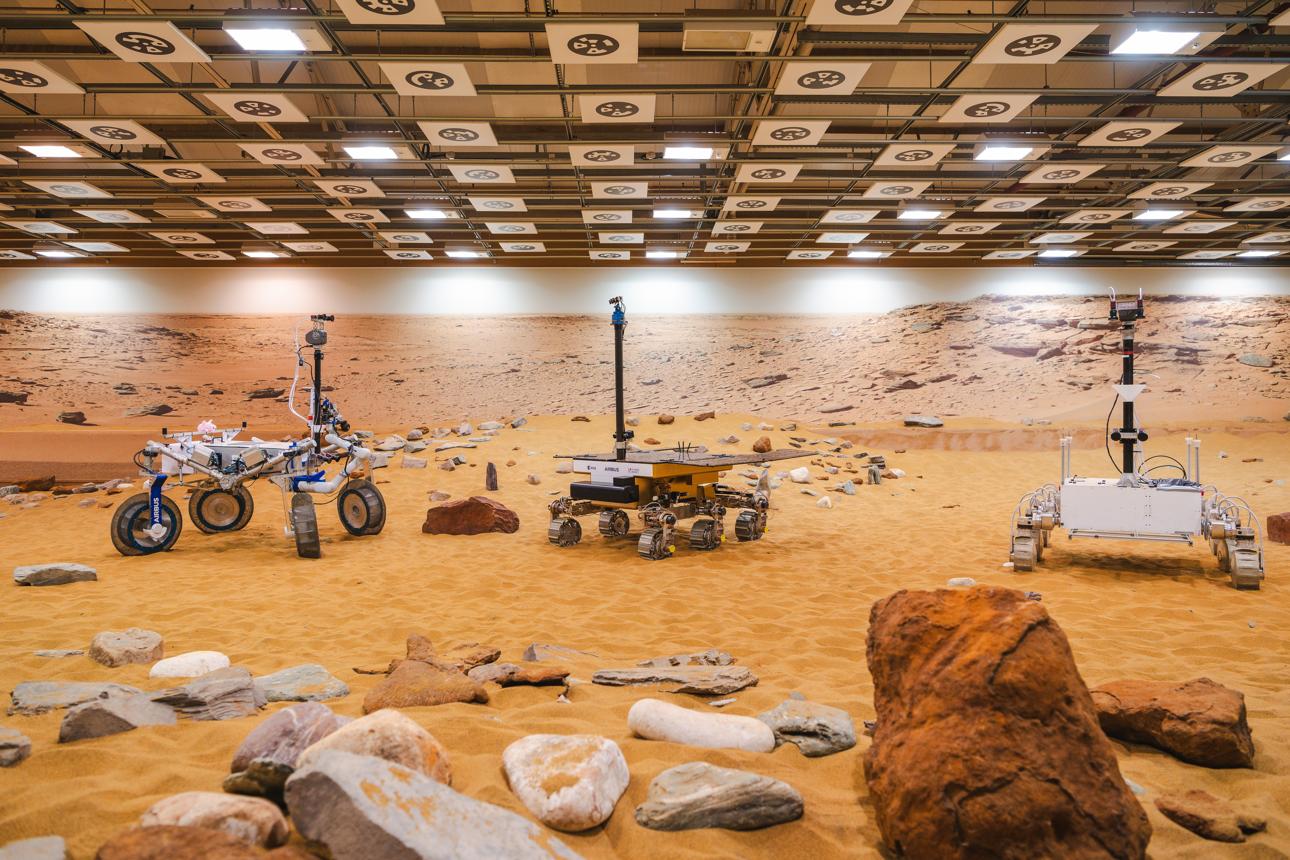
“Around 120 young innovators from South Africa, Kenya and Zimbabwe gathered at the South African National Space Agency’s Hartebeesthoek facility for the 2026 Cars4Mars African Rover Challenge, where teams tested self-built robotic rovers through terrain navigation and AI missions. The competition combined robotics, electronics, software engineering, artificial intelligence, and space technology, with South African university and school teams among those receiving the leading awards.”
Young African Innovators Take Robotics Closer to Mars at South African Space Facility
South Africa has provided a high-profile testing ground for the next generation of African robotics and space-technology innovators, as young engineers and students gathered at the South African National Space Agency’s (SANSA) Hartebeesthoek facility for the 2026 Cars4Mars African Rover Challenge.
The event, reported by SANSA on September 25, brought together approximately 120 participants representing 18 finalist teams from South Africa, Kenya and Zimbabwe. The teams had progressed through an earlier online stage involving approximately 100 teams from 11 African countries.
The competition is significant because it moves robotics education beyond classroom theory. Participants were required to design, construct, programme, test and refine functioning rover prototypes before putting them through practical missions on a specially constructed Mars-like course.
For the finalists, the Hartebeesthoek event was therefore not simply a robotics demonstration. It was an opportunity to apply engineering concepts under competition conditions while working with technologies associated with autonomous vehicles, artificial intelligence and planetary exploration.
A Mars-like testing environment in Gauteng
SANSA’s Mars Yard was designed to provide teams with an environment in which their robotic systems could be tested against uneven and challenging terrain. According to SANSA, more than 40 tonnes of red sand were used to create the Mars-like environment, with AFRIMAT supporting the construction of the facility.
The physical environment was important because a rover that operates successfully on a smooth laboratory floor faces very different challenges when it has to move across irregular ground.
Robotic mobility requires a combination of mechanical engineering, electronic control systems, sensors and software. The teams therefore had to consider how their vehicles would respond to obstacles, how they would be controlled and how information from onboard cameras could be interpreted.
These requirements made the Cars4Mars competition a multidisciplinary exercise. Rather than focusing on one narrow aspect of robotics, participants had to bring together mechanical design, electronics, programming and artificial intelligence.
Testing autonomous robotics
One of the central components of the competition was the AI Autonomous Mission.
During this challenge, teams had to demonstrate the ability of their rovers to recognise objects using cameras and artificial intelligence or computer-vision techniques. Objects used in the mission included a hammer, tennis ball, traffic cone and balloons in different colours. Additional points were available for systems capable of identifying where an object appeared within the rover’s camera image.
The task illustrates an important development in modern robotics.
A conventional remotely controlled machine depends heavily on a human operator to interpret its surroundings. An autonomous robot, by contrast, can use sensors, cameras, algorithms and artificial intelligence to interpret information and respond to its environment.
Computer vision is particularly important in this transition. Cameras can provide a continuous stream of visual information, while software processes that information to identify objects, obstacles or other features.
For young robotics developers, building such a system provides practical experience with technologies that are increasingly relevant to autonomous vehicles, industrial automation, agricultural robotics, logistics and space exploration.
The Traversal Mission
The second major test was the Traversal Mission, which focused on physical navigation.
Teams remotely operated their rovers across uneven terrain while searching for and transporting objects placed on the course by judges. Competitors could use camera-based visual feedback or direct observation while controlling their machines.
This challenge required teams to combine mechanical reliability with effective control.
A rover may have a sophisticated design, but its performance ultimately depends on whether its wheels, motors, steering and electronic systems can function together under difficult conditions.
The competition therefore created a practical engineering environment in which teams could discover weaknesses in their designs. Testing, identifying problems and making improvements are essential parts of robotics development.
South African teams among the leading performers
The 2026 results also highlighted participation from South African schools and universities.
Zimbabwe’s Cyberstorm team from Milestone High School took first place overall. South African teams occupied several other prominent positions, with Inadeptus Mechanicus from Rhodes University and Stellenbosch University finishing second and Tech Tonic from Bryanston High School taking third place.
South African institutions also received awards in individual categories.
Robo TechAura from Tshwane University of Technology received the award for Best in AI Mission, while another TUT team, Wall-E, was recognised as Best in Traversal Mission. The Open Window Institute for Creative Arts received the Best Creativity award, while Kenya’s Jomo Kenyatta University of Agriculture and Technology received Best Design.
The distribution of awards demonstrates that robotics competitions can assess different aspects of engineering rather than simply producing one overall result.
A team may excel in artificial intelligence, for example, while another may demonstrate stronger mechanical design or navigation capabilities.
Building Africa’s technical skills
The Cars4Mars competition is also an educational initiative.
SANSA describes the annual competition as a volunteer-led robotics programme open to high-school learners and students at universities and colleges across Africa. Participants receive mentoring while developing their rover prototypes over a period of approximately five months.
That longer development period is important.
Robotics projects require much more than assembling hardware. Students must understand the problem, design a solution, select components, develop software, test individual systems and then integrate those systems into a working machine.
Failure is also part of the process. Motors can malfunction, sensors can provide unexpected readings, software can behave incorrectly and mechanical components can fail under pressure.
Learning how to diagnose and correct these problems can be as valuable as winning the competition.
A wider role for robotics in South Africa
The Cars4Mars event also reflects South Africa’s broader interest in developing capabilities in space engineering, artificial intelligence and advanced technology.
SANSA’s own research and development activities span areas including space engineering, computer science, software and systems engineering. The agency’s 2026/27 planning documents also identify robotics and related Fourth Industrial Revolution technologies as part of its education and human-capital development priorities.
For South Africa, developing these capabilities has potential implications beyond space exploration.
The same engineering skills used to build a planetary rover can be relevant to autonomous mining equipment, agricultural machines, inspection robots, industrial automation, disaster-response systems and other applications.
Africa also has specific infrastructure and environmental challenges that can create opportunities for locally developed robotic systems.
Creating a permanent robotics platform
The partnership between Cars4Mars and SANSA has another important element: Hartebeesthoek is intended to become a permanent venue for future Cars4Mars finals.
That could give African students an established physical environment in which to develop and test robotic systems over successive years.
Such continuity can help create a stronger robotics ecosystem.
Students who participate in one competition may later become university researchers, engineers, technology entrepreneurs or mentors for younger competitors. Universities and companies can also use competitions such as Cars4Mars to identify emerging technical talent.
The involvement of sponsors further connects education with industry. SANSA reported support from organisations including SMD Technologies, RS South Africa, SIMTEQ Engineering and other partners, with contributions ranging from 3D printers and electronics vouchers to simulation software and technical support.
Looking toward the future
The 2026 Cars4Mars final demonstrates how robotics education is increasingly becoming a hands-on discipline in Africa.
The young participants were not simply learning about robots from textbooks. They were building machines, programming them, testing artificial intelligence systems and operating them in a physical environment designed to reproduce some of the challenges associated with planetary exploration.
The results also demonstrate the growing geographic reach of African robotics initiatives, with teams from several countries participating and South African institutions playing a central role in hosting and competing.
While sending a robot to Mars remains an extremely complex undertaking requiring sophisticated international infrastructure, the foundations of such missions begin with education and engineering skills.
Competitions such as Cars4Mars provide students with an opportunity to develop those skills through practical experience.
For South Africa, the Hartebeesthoek Mars Yard therefore represents more than a competition venue. It is becoming a space where young people can experiment with robotics, artificial intelligence and engineering while developing capabilities that could eventually be applied across Africa’s technology and industrial sectors.
The latest Cars4Mars final shows that the continent’s future robotics talent is already experimenting with autonomous machines, computer vision and challenging terrain. The next stage will be turning that practical experience into sustained research, innovation and real-world technology development.



