




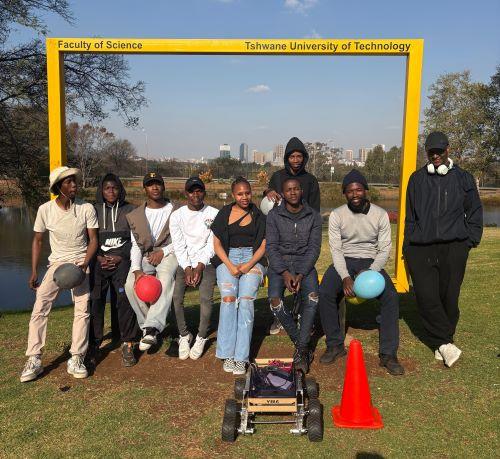
“Around 120 young innovators from South Africa, Kenya and Zimbabwe have tested self-built Mars rover prototypes at the South African National Space Agency’s Hartebeesthoek facility, putting robotics, software engineering, electronics, artificial intelligence and computer-vision skills into practice. The Cars4Mars competition, which began in May and involved about 100 teams from 11 African countries during its online stage, is establishing Hartebeesthoek as a permanent venue for future finals and creating a practical platform for African space and technology innovation.”
Young African innovators turn South African Mars Yard into robotics laboratory
A South African facility designed to support the country’s space ambitions has recently become a testing ground for a new generation of African engineers, programmers and technology innovators.
The South African National Space Agency (SANSA) hosted the Mars Stage Final of the Cars4Mars African Rover Challenge 2026 at its Hartebeesthoek site, where young participants tested rover prototypes that they had designed, built and refined over several months. The event brought together approximately 120 participants from South Africa, Kenya and Zimbabwe, representing 18 finalist teams.
The competition represents a practical intersection between several areas of modern innovation. Robotics, artificial intelligence, computer vision, electronics and software engineering were all required as participants attempted to make their machines navigate difficult terrain and perform autonomous tasks.
Rather than limiting innovation to classrooms and theoretical exercises, Cars4Mars gives participants an opportunity to develop technology and then test it under competitive conditions.
That distinction is important because engineering innovation depends not only on designing an idea but also on building, testing and improving it. The competition therefore provides participants with an environment in which technical problems become part of the learning process.
Five months of design and development
The 2026 Cars4Mars competition began on 1 May 2026 and culminated in the Mars Stage Final at SANSA Space Operations. Before reaching the physical final, approximately 100 teams from 11 African countries participated in the online stage of the competition. Eighteen finalist teams subsequently travelled to Hartebeesthoek for the physical challenge.
During the five-month development period, participants were required to design, engineer, build, test and refine their rover prototypes.
That process exposed students to multiple disciplines rather than a single technical field. A functional rover requires mechanical components, electrical systems, communications, software and control systems to operate together.
The competition also required teams to consider how their machines would respond to unfamiliar terrain and how artificial intelligence could be integrated into their systems.
The Mars Yard at Hartebeesthoek was constructed with more than 40 tonnes of red sand, supplied with support from AFRIMAT, to reproduce some of the visual and physical characteristics associated with a Martian environment.
Although the competition does not involve sending actual machines to Mars, the simulated environment provides a useful engineering challenge. Participants must build systems capable of functioning across uneven terrain while maintaining control and completing specified missions.
Artificial intelligence becomes part of the challenge
One of the most significant aspects of the competition was its focus on artificial intelligence and computer vision.
During the AI Autonomous Mission, teams had to develop systems capable of identifying objects appearing within their rover’s camera view. Objects included items such as a hammer, tennis ball, traffic cone and balloons of different colours. Teams could earn additional points when their systems could use AI or computer-vision algorithms to determine an object’s location within the image.
This type of challenge illustrates how AI is increasingly being integrated into physical machines.
A conventional remotely operated robot depends heavily on a human operator. By contrast, computer vision can allow a machine to interpret information from cameras and use that information to make decisions or assist its operator.
For young innovators, developing such systems requires more than learning how to write software. They also need to understand cameras, sensors, image processing, communications and the limitations of real-world hardware.
The competition therefore provides a practical introduction to the kinds of multidisciplinary engineering increasingly used in autonomous vehicles, industrial robotics, drones and space systems.
Testing robots against difficult terrain
The second major component was the Traversal Mission.
Teams remotely controlled their rovers across uneven terrain while attempting to locate and transport objects positioned around the course. Participants could use camera-based visual feedback or direct observation while controlling their machines.
The exercise tested several engineering requirements simultaneously.
A rover might have a strong mechanical design but still fail if its control system is unreliable. Similarly, effective software cannot compensate for hardware that cannot navigate the terrain.
This creates a realistic engineering environment because successful technology normally depends on multiple systems working together.
The international judging panel included Lukasz Gliwinski, Kuba Kopec and Adam Zagrajek from Europe. They were involved in designing the Mars Yard obstacle course and assessing the teams’ performances.
South African universities and schools among recognised teams
The final results showed participation from institutions across Africa, with South African teams receiving several awards.
Zimbabwe’s Milestone High School team, Cyberstorm, won first place. South Africa’s Inadeptus Mechanicus, representing Rhodes University and Stellenbosch University, finished second, while Tech Tonic from Bryanston High School finished third.
South African teams also received awards for specific technical achievements. Robo TechAura from Tshwane University of Technology was recognised as Best in AI Mission, while Wall-E from Tshwane University of Technology received the Best in Traversal Mission award.
The Best Design award went to Vulcan from Jomo Kenyatta University of Agriculture and Technology in Kenya, while Techne-Cality from the Open Window Institute for Creative Arts in South Africa received the Best Creativity award.
The remaining finalist teams received Perseverance Awards for reaching the final.
The results demonstrate that innovation in the competition was not restricted to one country or one type of institution. High school learners and university students participated alongside teams working with different technical approaches.
From competition to long-term innovation platform
One of the most important developments associated with the 2026 event is that Hartebeesthoek is being established as a permanent venue for future Cars4Mars finals.
According to SANSA, the partnership between the space agency and Cars4Mars is intended to create a lasting environment in which African engineers, scientists and space enthusiasts can develop practical skills.
This gives the initiative significance beyond a single competition.
A recurring physical venue can provide continuity for participants, mentors and technology partners. It can also allow future teams to improve their designs by learning from previous competitions.
For South Africa, the initiative connects youth development with the country’s broader space and technology ecosystem. SANSA’s mandate includes supporting research in space science, advancing scientific engineering through human capital development and supporting industrial development in space technologies.
Industry support adds another dimension
The 2026 event also received support from a number of technology and engineering organisations.
SMD Technologies sponsored Creality 3D printers for the top three teams, while RS South Africa provided vouchers for the leading teams to purchase electronic components. SIMTEQ Engineering supplied 3D-printed trophies and simulation software for participants.
Other supporting organisations included BYMEDICAL, Scientific Technical Labs, MSI ZA, Home Technologies, Stelltron, Counter Space Learn, Woodline Branding Solutions, ER24 and Vision Dynamics.
This involvement highlights another element of innovation ecosystems: young engineers need access not only to ideas and education but also to equipment, software, components, mentorship and testing facilities.
A student may have a promising concept, but turning that concept into a working machine requires resources.
Why practical innovation matters
The Cars4Mars initiative comes at a time when robotics and artificial intelligence are becoming increasingly important across multiple industries.
Robotics can support manufacturing, logistics, agriculture, mining, healthcare and exploration. AI and computer vision can allow machines to interpret their environments and perform increasingly sophisticated tasks.
Training young people through practical projects can therefore expose them to skills that extend beyond the immediate competition.
The experience of designing a rover requires problem-solving, project management, teamwork and persistence. It also introduces participants to the iterative nature of engineering, where an initial design may fail and require modification.
The fact that the competition provides mentoring during the development process is another important component. SANSA describes Cars4Mars as a free educational platform designed to give African youth hands-on experience in robotics, space technologies and artificial intelligence.
Building an African technology pipeline
The event also illustrates the potential importance of regional cooperation in developing technology skills.
Participants came from South Africa, Kenya and Zimbabwe, while the wider competition involved teams from 11 African countries.
Such initiatives can create opportunities for young engineers from different countries to exchange ideas and technical approaches.
Space technology itself is highly collaborative, requiring expertise across engineering, computing, science, telecommunications and data analysis. Developing those capabilities requires sustained education and practical experience.
The establishment of a permanent Cars4Mars final venue in South Africa provides one mechanism for continuing that process.
It also gives participants a physical environment in which they can move from theoretical learning to experimentation.
Looking beyond the 2026 competition
The significance of the latest Cars4Mars event extends beyond the winners.
The 2026 competition demonstrates that African learners and students are building increasingly sophisticated technology using robotics, artificial intelligence and engineering principles.
The machines tested at Hartebeesthoek are not intended to operate on Mars itself. Instead, the competition uses a simulated environment to provide an educational engineering challenge.
That distinction is important because the immediate objective is skills development rather than planetary exploration.
Nevertheless, the abilities developed through such programmes can contribute to broader technology fields. A student learning computer vision for a rover, for example, is also learning concepts applicable to autonomous vehicles, industrial inspection and other robotic systems.
As SANSA and Cars4Mars continue their partnership, future competitions could provide additional opportunities for students to develop and test increasingly sophisticated systems.
For South Africa, the event places innovation, education and space technology in the same environment. For the wider continent, it provides a practical example of how young people can be given opportunities to move from learning about technology to actually building it.
The latest competition at Hartebeesthoek therefore represents more than a simulated journey to Mars. It is a demonstration of how hands-on engineering challenges can help young African innovators develop practical experience in the technologies that are shaping the future.



