




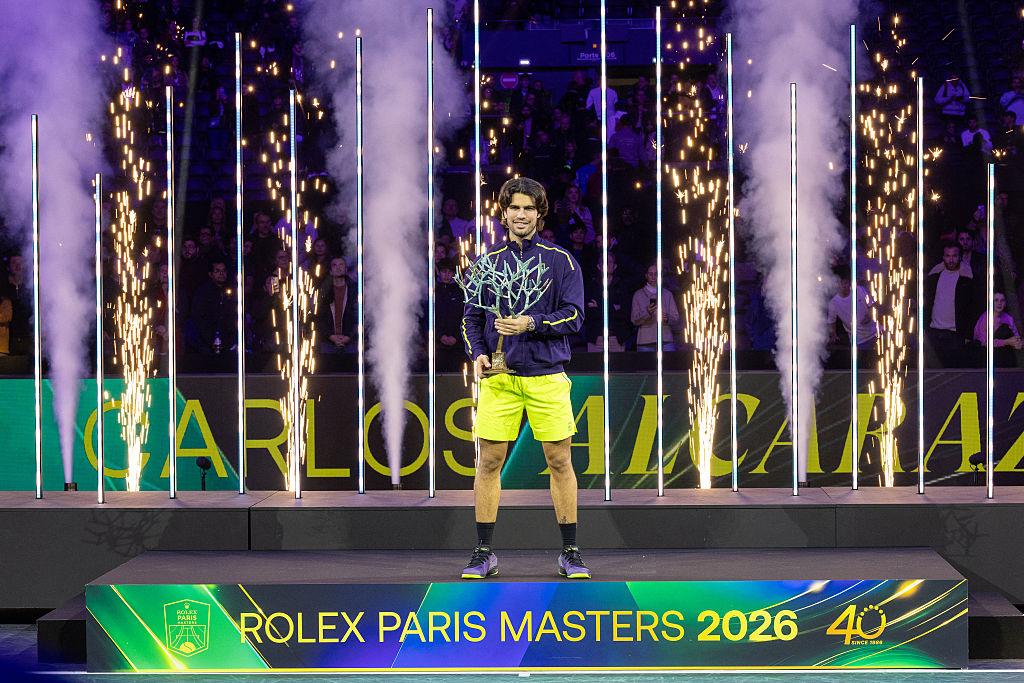
“Carlos Alcaraz’s resilience and self-belief continue to captivate tennis audiences, even as weaknesses in his serve remain a notable concern. His dramatic Paris Masters campaign also influenced the final qualification picture for the ATP Finals, highlighting how individual performances can reshape the season’s biggest events.”
Carlos Alcaraz’s resilience highlights tennis brilliance despite serving concerns
Carlos Alcaraz continues to demonstrate why he remains one of the most captivating figures in international tennis. Despite concerns surrounding the effectiveness and consistency of his serve, the Spanish superstar has repeatedly shown that resilience, creativity and determination can overcome technical limitations. His performance at the Paris Masters provided another compelling illustration of his extraordinary competitive character, while simultaneously influencing the qualification picture for the season-ending ATP Finals.
As tennis approaches the conclusion of another demanding season, Alcaraz’s achievements offer an important reminder that sporting excellence cannot always be measured through individual statistics alone. His ability to recover from difficult situations, maintain belief and deliver decisive performances under pressure has become one of his defining characteristics.
Paris Masters campaign demonstrates remarkable resilience
Alcaraz’s Paris Masters campaign attracted significant attention because it combined moments of vulnerability with extraordinary determination. The Spaniard ultimately captured the tournament title, overcoming challenges that threatened to derail his progress.
According to Business Day’s Deborah Curtis-Setchell, Alcaraz’s serving weaknesses remained a significant concern despite his success. Nevertheless, the Spaniard demonstrated that his broader collection of skills continues to compensate for technical imperfections.
The Paris Masters, one of the most prestigious tournaments on the ATP calendar, traditionally attracts the strongest players in men’s tennis. Its importance extends beyond the trophy because performances in Paris can influence rankings, confidence and qualification for the ATP Finals.
For Alcaraz, the tournament represented an opportunity to strengthen his position among the world’s leading players while demonstrating that he remains capable of winning against difficult opponents under challenging circumstances.
His achievement also reinforced the importance of mental resilience in modern tennis, where players frequently encounter opponents capable of exploiting even minor weaknesses.
The serving challenge remains an important talking point
Serving is among the most influential elements of professional tennis. A strong first serve can generate free points, reduce pressure during service games and establish control over rallies.
Conversely, inconsistent serving can create unnecessary difficulties, particularly against opponents possessing powerful returns.
Alcaraz’s serve has attracted scrutiny because it does not consistently provide the same advantages enjoyed by several other leading players. However, his broader playing style allows him to remain competitive even when his service performance falls below expectations.
His movement, anticipation, shot selection and ability to generate power from difficult positions frequently compensate for moments when his serve becomes vulnerable.
This combination creates an interesting tactical challenge for opponents. Although they may identify serving weaknesses, successfully exploiting them requires sustained pressure and exceptional consistency.
Furthermore, Alcaraz possesses the ability to transform defensive situations into attacking opportunities. His speed and court coverage frequently allow him to recover positions that other players might consider lost.
Consequently, his effectiveness cannot be evaluated exclusively through serving statistics.
Mental strength separates elite champions
One of the most significant characteristics of Alcaraz’s tennis is his psychological resilience.
Professional tennis demands sustained concentration because matches can change dramatically within individual games. Players must respond to setbacks, maintain emotional control and adjust their strategies without losing confidence.
Alcaraz has repeatedly demonstrated an ability to recover from difficult situations.
His Paris Masters victory over Taylor Fritz illustrated this quality particularly clearly. The Spaniard recovered from a set and a break down to win 6-7(10), 7-5, 6-3, according to Business Day’s reporting.
The comeback demonstrated his willingness to continue fighting even when circumstances appeared unfavourable.
Such performances are especially valuable because they establish psychological pressure on opponents. Players facing Alcaraz cannot assume that an advantage will automatically translate into victory.
Instead, they must maintain their intensity throughout the match.
This ability to remain competitive under pressure is one reason his performances continue to attract widespread attention.
Tactical versatility strengthens his competitive position
Alcaraz’s game combines several elements that make him particularly difficult to challenge.
His powerful groundstrokes allow him to dictate rallies, while his movement enables him to defend effectively against aggressive opponents.
Additionally, his ability to vary pace and direction creates opportunities to disrupt opponents’ rhythm.
These qualities become especially important when his serve is not functioning optimally.
Rather than relying exclusively on powerful serving, Alcaraz can construct points through movement, positioning and tactical variation.
His willingness to attack the net also introduces another dimension to his game. By approaching the net at appropriate moments, he can shorten rallies and place additional pressure on opponents.
However, tactical versatility does not eliminate the need for technical improvement.
Against the strongest players, particularly those possessing excellent returning abilities, a more reliable serve could provide Alcaraz with additional advantages.
Improving this element of his game would potentially make his already formidable overall performance even more difficult to challenge.
Paris Masters success influences the ATP Finals picture
The Paris Masters also played an important role in determining the final qualification landscape for the ATP Finals.
The ATP Finals bring together the leading men’s players of the season, making qualification one of the most important objectives during the closing stages of the professional calendar.
Every significant tournament can influence the standings, particularly when players competing for qualification points encounter one another.
Business Day reported that Frances Tiafoe and Rafa Jodar received last-minute qualification opportunities following developments involving Alcaraz’s victory over Taylor Fritz.
The situation illustrated how interconnected professional tennis has become.
A single match can influence several players’ ambitions, creating additional significance for encounters that might otherwise be viewed simply as individual contests.
For competitors seeking qualification, the consequences extend beyond the immediate result.
They must monitor their own performances while remaining aware of the results involving their direct rivals.
This creates a particularly intense competitive environment during the final weeks of the season.
The significance for international tennis audiences
Alcaraz’s performances also demonstrate the continuing appeal of tennis as a global sporting product.
The sport combines individual competition, tactical complexity and dramatic momentum changes.
Unlike many team sports, tennis places substantial responsibility on individual athletes to manage their emotions, decisions and physical performance throughout a contest.
This individual responsibility creates compelling narratives.
Alcaraz’s ability to overcome adversity contributes to his appeal because audiences can identify with the determination required to succeed despite setbacks.
His matches also illustrate how technical excellence and psychological strength complement one another.
For young players, his performances provide valuable lessons about perseverance, adaptability and the importance of developing multiple dimensions of their game.
These lessons remain relevant across different competitive levels.
Implications for South African tennis
Although Alcaraz represents Spain, his performances provide useful lessons for South African tennis players, coaches and development programmes.
South Africa has a longstanding tennis tradition and continues to pursue opportunities to strengthen its presence in international competition.
The country’s tennis development environment faces challenges involving access to facilities, coaching resources and opportunities for young players to compete internationally.
Nevertheless, international performances from leading professionals can provide inspiration and practical examples of what sustained development can achieve.
Alcaraz’s approach demonstrates the importance of combining technical preparation with mental resilience.
South African coaches can draw attention to the value of tactical versatility, physical conditioning and competitive confidence when developing promising players.
His experience also reinforces an important principle: weaknesses should be identified and addressed without overlooking an athlete’s existing strengths.
A player does not necessarily need to possess perfection in every technical category to achieve significant success.
Instead, effective development involves improving weaknesses while maximising the qualities that make an athlete distinctive.
The importance of continued technical development
Despite his achievements, Alcaraz still faces opportunities to improve.
Serving consistency remains particularly relevant because elite competition increasingly rewards players who can combine powerful first serves with accurate second serves.
A more dependable service game could reduce the physical and psychological demands associated with extended rallies.
It could also allow him to preserve energy during demanding tournaments.
However, technical adjustments require careful consideration.
Changes to serving mechanics can influence rhythm, confidence and timing. Players must therefore balance the pursuit of improvement with the need to preserve the strengths that have already delivered success.
For Alcaraz, the challenge is not simply to eliminate weaknesses.
It is to develop a more complete game without compromising his natural creativity and aggressive style.
Looking ahead to the season-ending championships
The ATP Finals provide an opportunity for qualified players to demonstrate their abilities against the strongest competition available.
For Alcaraz, the closing stages of the season represent another chance to reinforce his position among tennis’s leading performers.
His Paris Masters success offers confidence, although the challenges associated with elite competition remain considerable.
The ATP Finals require players to perform consistently across multiple high-level matches.
Consequently, preparation, recovery and tactical adaptability become particularly important.
A player who enters the competition with confidence but insufficient physical preparation may struggle against opponents capable of maintaining exceptional intensity.
Alcaraz’s ability to recover from adversity could prove especially valuable in this environment.
Nevertheless, serving consistency and match management remain areas that deserve attention.
Conclusion
Carlos Alcaraz’s Paris Masters success provides another example of the extraordinary qualities that have established him as one of tennis’s most compelling champions.
His resilience, tactical versatility and competitive determination continue to compensate for weaknesses in his serving performance.
The tournament also demonstrated how individual results can influence the broader ATP Finals qualification picture, reinforcing the interconnected nature of professional tennis.
For South African tennis audiences, Alcaraz’s performances offer inspiration and valuable lessons about player development, psychological strength and technical improvement.
Ultimately, his continuing success demonstrates that champions are not defined by the absence of weaknesses, but by their ability to overcome challenges, adapt under pressure and consistently find ways to win.
As the tennis season approaches its conclusion, Alcaraz remains a central figure in the sport’s international conversation, with his performances continuing to shape expectations and generate excitement among supporters worldwide.



