




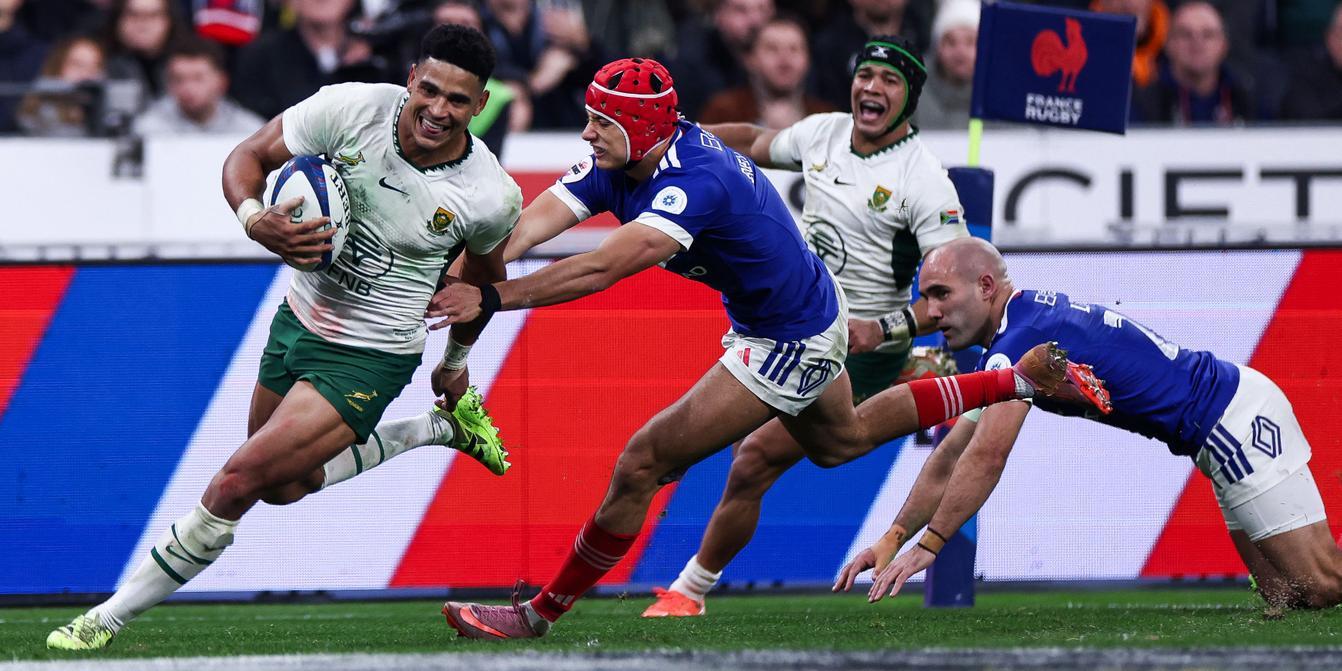
“South Africa’s Springboks are preparing for a demanding Nations Championship encounter against France in Paris, with the French decision to deploy Antoine Dupont at fly-half creating a significant tactical challenge. Captain Siya Kolisi and assistant coach Mzwandile Stick have emphasised defensive discipline, physical intensity and limiting France’s space as key factors in the contest.”
Springboks Prepare for Tactical Showdown Against France as Antoine Dupont Shifts to Fly-Half
South Africa’s Springboks are preparing for one of the most demanding challenges of their Northern Hemisphere campaign as they face France in a highly anticipated Nations Championship encounter at the Stade de France in Paris on Friday, 13 November 2026. The world champions enter the contest determined to maintain their winning momentum, while France’s unexpected selection of Antoine Dupont at fly-half has introduced an intriguing tactical dimension to the international rugby spectacle.
The match has attracted considerable attention because of the quality, history and competitiveness associated with both national teams. Furthermore, the encounter represents an opportunity for South Africa to demonstrate its continued strength against one of Europe’s most formidable rugby nations.
Springboks Remain Focused on Defensive Discipline
Speaking ahead of the encounter, Springbok assistant coach Mzwandile Stick and captain Siya Kolisi expressed confidence in their preparation while acknowledging the considerable challenges France will present.
According to EWN’s reporting on Friday, the South African coaching staff expects the contest to involve much more than traditional physical confrontations. Instead, tactical awareness, defensive organisation and the management of attacking opportunities could determine which team ultimately controls proceedings.
Stick explained that France’s decision to deploy Dupont at fly-half was not particularly surprising to the Springbok coaching team. The French captain has previously demonstrated his ability to perform effectively in different positions, including during his club career.
Consequently, South Africa does not intend to abandon its established defensive system simply because France has adjusted its halfback combination.
The Springboks believe their defensive organisation remains one of their greatest strengths. Therefore, maintaining consistency, communication and discipline will be essential when confronting France’s attacking threats.
Antoine Dupont’s New Position Creates Tactical Interest
One of the principal talking points ahead of Friday’s encounter is Dupont’s appointment at fly-half following France’s injury difficulties in the position.
France suffered significant setbacks when Romain Ntamack, Matthieu Jalibert, Thomas Ramos and Antoine Hastoy became unavailable. The resulting shortage of experienced playmakers forced coach Fabien Galthié to consider alternative combinations.
Dupont, widely recognised for his exceptional performances at scrum-half, will consequently assume additional responsibilities in the number 10 position.
His partnership with Maxime Lucu is expected to provide France with considerable tactical flexibility. Both players possess experience in multiple positions, meaning they can interchange responsibilities during general play.
This flexibility could complicate South Africa’s defensive organisation if France successfully creates uncertainty around the positioning of its attacking playmakers.
However, Kolisi has emphasised that the Springboks understand the possibilities associated with the combination.
The captain explained that Dupont’s ability to move between scrum-half and fly-half is a natural part of his playing style. Lucu also possesses experience at fly-half, allowing the pair to adjust according to the circumstances of the match.
South Africa therefore intends to respond through disciplined execution rather than excessive tactical experimentation.
Kolisi Emphasises Respect Without Fear
Kolisi’s comments ahead of the contest reflected the leadership approach that has become central to the Springboks’ preparations for major international matches.
The captain acknowledged France’s attacking capabilities while insisting that South Africa must concentrate on its own responsibilities.
According to EWN, Kolisi stressed that allowing France’s halfbacks sufficient time and space could create significant problems for the visitors.
Dupont’s ability to identify attacking opportunities, combine with teammates and exploit defensive weaknesses makes him particularly dangerous when operating with freedom.
Nevertheless, the Springbok captain believes his teammates are adequately prepared for the challenge.
Kolisi also dismissed suggestions that South Africa’s previous victories against France would automatically provide a psychological advantage.
Although the Springboks famously defeated France in the 2023 Rugby World Cup quarter-final, the captain explained that historical results cannot determine the outcome of a new encounter.
Instead, the players must approach Friday’s match as an independent challenge requiring fresh preparation, concentration and commitment.
This perspective reflects South Africa’s broader ambition to maintain competitiveness while avoiding complacency.
The Battle for Physical Dominance
Beyond the tactical discussions surrounding Dupont, the physical contest between the two forward packs remains another important storyline.
South Africa has built considerable success through its ability to dominate contact situations, generate momentum and establish powerful attacking platforms.
France, however, possesses forwards capable of challenging the Springboks across the field.
The French pack will therefore need to compete effectively at the scrum, breakdown and gainline if the hosts are to establish sustained attacking opportunities.
The Springboks are expected to rely on experienced forwards including Malcolm Marx, Ox Nché, Wilco Louw, Pieter-Steph du Toit and Kolisi.
Their collective responsibility will include securing possession, disrupting French attacking structures and creating opportunities for South Africa’s backline.
Stick explained that both teams would seek to establish dominance through their forward packs before allowing their attacking players to operate effectively.
The importance of this contest cannot be underestimated. If South Africa establishes a strong physical platform, its attacking playmakers could receive the possession and time necessary to exploit France’s defensive weaknesses.
Conversely, France’s ability to compete physically could prevent the Springboks from imposing their preferred playing style.
Sacha Feinberg-Mngomezulu Faces a Significant Test
South African fly-half Sacha Feinberg-Mngomezulu is another player attracting attention ahead of the encounter.
The young playmaker has demonstrated considerable attacking potential, combining creativity, tactical kicking and confidence in possession.
His responsibilities against France will include managing the Springbok attack, directing teammates and making effective decisions under pressure.
The contest also presents an opportunity to measure his development against one of international rugby’s most respected attacking players.
Although Dupont will occupy France’s fly-half position, the tactical battle between the two playmakers could extend beyond conventional positional responsibilities.
Both players are capable of influencing matches through attacking creativity, intelligent positioning and their ability to exploit defensive mistakes.
However, Feinberg-Mngomezulu will benefit significantly from the support of South Africa’s experienced forward pack and established attacking structures.
His ability to remain composed, manage territory and select appropriate attacking opportunities could prove particularly valuable.
South Africa’s Recent Performance Provides Confidence
The Springboks arrive in Paris following an impressive 66-7 victory against Italy in Turin on 7 November.
South Africa produced a dominant first-half performance, establishing a substantial advantage before completing the match with another convincing international victory.
Nevertheless, the coaching staff has continued to emphasise improvement rather than satisfaction with previous results.
The encounter against France represents a substantially different challenge because of the quality of the opposition, the intensity of the atmosphere and the tactical demands associated with playing away from home.
The Springboks are therefore expected to approach the contest with considerable seriousness.
Their preparation includes maintaining physical intensity, improving execution and ensuring that players remain focused throughout the match.
The coaching team also recognises that France will be motivated to challenge South Africa’s dominance in recent encounters.
France’s Motivation and Home Advantage
Playing at the Stade de France provides France with an important source of motivation.
The French supporters are renowned for creating an intense atmosphere during major international rugby encounters.
Kolisi acknowledged the significance of the Parisian crowd, noting that French supporters demonstrate a passion for rugby comparable to that experienced in South Africa.
However, the Springbok captain believes the players must embrace the atmosphere rather than allow it to distract them.
Once the match begins, concentration, communication and individual responsibilities will become the principal priorities.
France will also be motivated by its recent history against South Africa, particularly the disappointment associated with its elimination from the 2023 Rugby World Cup.
The hosts therefore have considerable reasons to approach Friday’s contest with determination.
Their combination of attacking ambition, experienced players and home support could make the encounter extremely competitive.
Discipline and Momentum Could Determine the Outcome
The importance of discipline is another factor highlighted during the Springboks’ preparations.
Against a team possessing France’s attacking quality, unnecessary penalties and defensive mistakes could quickly create scoring opportunities.
South Africa will therefore need to manage its aggression carefully while maintaining pressure on the French attack.
The breakdown contest, defensive line speed and tactical kicking are expected to contribute significantly to the battle for momentum.
Additionally, both teams will seek to control possession and territory before launching attacking movements.
The Springboks’ ability to maintain defensive organisation while generating quick attacking opportunities could provide a decisive advantage.
France, meanwhile, will attempt to exploit its creativity and movement to disrupt South Africa’s defensive structures.
A Major Opportunity for the Springboks
Friday’s encounter represents an important opportunity for South Africa to reinforce its international standing and demonstrate the continued effectiveness of its rugby system.
The Springboks have established a reputation for combining physical dominance with tactical adaptability, and the contest against France provides another opportunity to demonstrate those qualities.
The match will also test the depth, experience and composure of the South African squad.
Although the visitors possess considerable confidence following their recent victory against Italy, they understand that France presents a significantly different challenge.
Ultimately, the outcome could depend on which team manages pressure more effectively, establishes greater physical dominance and converts its attacking opportunities.
Conclusion
The Springboks’ preparations for France demonstrate a clear commitment to consistency, discipline and tactical awareness.
Antoine Dupont’s appointment at fly-half has created additional interest surrounding the Nations Championship encounter, but South Africa remains determined to rely on its established defensive principles rather than making unnecessary adjustments.
With Siya Kolisi providing leadership, Mzwandile Stick overseeing defensive preparation and Sacha Feinberg-Mngomezulu directing the attack, the Springboks possess several important strengths heading into the contest.
The match at the Stade de France promises an intense international rugby spectacle, with both nations seeking to demonstrate their competitiveness and ambition.
For South Africa, the objective remains straightforward: maintain discipline, dominate the physical exchanges, deny France attacking space and take advantage of opportunities when they emerge.
Whether those principles prove sufficient against France’s talented and motivated squad will be determined on the field.
The encounter nevertheless represents another significant chapter in the rivalry between two of international rugby’s most respected teams.



