




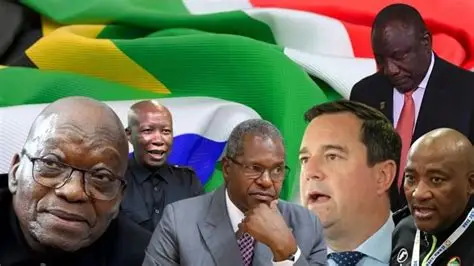
“The Democratic Alliance (DA), led by Geordin Hill-Lewis, has proposed a reshuffle of Government of National Unity (GNU) deployments, sparking internal dissent and raising concerns about coalition stability. The move underscores the fragile balance of power in South Africa’s governance, with implications for policy direction and national unity.”
South Africa’s political landscape is once again in flux as the Democratic Alliance (DA) initiates a Cabinet reshuffle within the Government of National Unity (GNU). This decision, announced by DA leader Geordin Hill-Lewis, has sparked internal revolt among coalition partners and raised pressing questions about governance, stability, and the future of South Africa’s democratic experiment. The reshuffle is framed as a strategic move to strengthen the GNU, but critics argue it risks deepening divisions and undermining the fragile consensus that has held the coalition together.
Background: The Government of National Unity
The GNU was established as a broad coalition to stabilize South Africa’s governance amid economic stagnation, corruption scandals, and declining public trust in political institutions. It brought together the African National Congress (ANC), DA, Inkatha Freedom Party (IFP), and smaller parties under a shared governance framework. While hailed as a pragmatic solution to political fragmentation, the GNU has faced persistent challenges in balancing competing interests and maintaining cohesion.
The DA’s Proposed Reshuffle
Hill-Lewis’s reshuffle plan involves reassigning key ministerial portfolios, particularly in finance, trade, and public administration. The DA argues that these changes are necessary to improve efficiency, curb corruption, and accelerate economic reforms. According to Hill-Lewis, the reshuffle is “about the future, not division,” emphasizing the need for stronger leadership in critical sectors.
Internal Revolt and Criticism
Despite the DA’s rationale, coalition partners have expressed strong opposition. ANC officials accuse the DA of unilateralism, warning that reshuffling portfolios without consensus undermines the GNU’s collaborative spirit. Smaller parties fear marginalization, arguing that the reshuffle consolidates DA influence at the expense of inclusivity. The Economic Freedom Fighters (EFF), though not part of the GNU, have seized the moment to criticize the coalition as unstable and unrepresentative.
Governance Implications
The revolt raises serious governance concerns. A fractured GNU could weaken policy implementation, delay reforms, and erode public confidence. Analysts warn that instability within the coalition risks paralyzing government functions, particularly in areas requiring urgent intervention such as unemployment, service delivery, and migration management.
Public Reaction
Public opinion is divided. Some citizens welcome the reshuffle as a bold step toward accountability and efficiency, while others view it as political maneuvering that distracts from pressing socio-economic challenges. Civil society organizations have called for transparency in the reshuffle process, urging leaders to prioritize national interests over party politics.
Historical Context
South Africa’s history of coalition governance has been fraught with tension. From the post-apartheid GNU in 1994 to more recent municipal coalitions, power-sharing arrangements have often struggled to balance competing agendas. The current crisis echoes these historical challenges, highlighting the difficulty of sustaining unity in a diverse political environment.
Economic and Policy Dimensions
The reshuffle has significant economic implications. By targeting finance and trade portfolios, the DA aims to accelerate reforms in investment, industrial growth, and fiscal discipline. However, uncertainty within the GNU could deter investors and weaken policy coherence. The timing is particularly sensitive, as South Africa grapples with sluggish growth, rising debt, and mounting social pressures.
International Perspective
International observers are closely monitoring the developments. South Africa’s role as a regional leader in the Southern African Development Community (SADC) means that governance instability could have ripple effects across the region. Foreign investors and diplomatic partners are urging stability, emphasizing the importance of a united government in driving economic and social progress.
Conclusion
The DA’s Cabinet reshuffle proposal has exposed deep fissures within the GNU, raising urgent questions about the sustainability of coalition governance in South Africa. While the DA frames the move as a strategic step toward reform, the backlash underscores the fragility of political unity. The coming weeks will be critical in determining whether the GNU can weather the storm or whether South Africa will face yet another chapter of political instability.



